


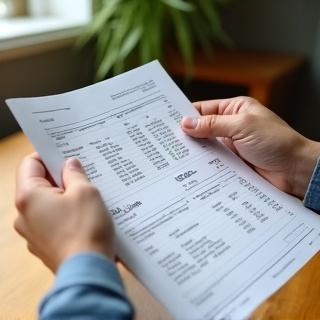
A middle-aged homebuyer sitting at her kitchen table, head in hands looking down at mortgage documents spread before her, dramatic window light casting shadows across her face and the papers, shallow

The $8,000 Rate Trap: Why Buying Mortgage Points Is Quietly Erasing Your Savings

A young father standing in his garage workshop, looking pensively out an open garage door, holding mortgage paperwork at his side, natural light streaming in creating dramatic shadows, tools and movin

If you are closing on a house this spring, your lender will almost certainly slide a tempting proposition across the table: pay a little extra cash upfront to permanently lower your monthly mortgage payment. It sounds like a highly responsible financial move. But for a buyer purchasing a typical home, saying yes to this discount could quietly erase $8,000 of your hard-earned cash.

Welcome to the modern mortgage market, where the urge to escape uncomfortable borrowing costs is driving a massive spike in upfront fees. With the 30-year fixed-rate mortgage hovering at an average of 6.37 percent as of early May 2026 [1], borrowers are desperate for relief. The national median home sale price just hit $396,173 [2], pushing monthly payments to the brink of affordability for many families.

To soften the blow, lenders heavily market discount points. A point is essentially prepaid interest. By handing over cash at closing, you buy down your interest rate for the lifespan of the loan. Each point generally costs 1 percent of your total loan amount and typically shaves about 0.25 percent off your interest rate [3].

On the surface, this feels like an undeniable win. If you take out a $400,000 mortgage and buy two points, you pay $8,000 upfront. In exchange, your rate drops from 6.5 percent to 6.0 percent, saving you roughly $130 every single month on your payment. For a buyer stretching their budget to make the monthly math work, that $130 reduction feels like a crucial safety valve. The problem lies in the structural mechanism of how homeownership actually plays out over time.

According to foundational research from the Consumer Financial Protection Bureau, the share of buyers paying discount points has skyrocketed, with nearly 60 percent of home purchasers and a staggering 87 percent of cash-out refinancers buying down their rates [4].

But the math contains a massive hidden wager. It takes roughly 61 months—just over five years—of that $130 monthly savings to simply break even on your initial $8,000 investment [3]. Until you cross that five-year mark, you are mathematically losing money.

If mortgage rates fall over the next few years and you decide to refinance to capture a better deal, that $8,000 disappears. When your old loan gets paid off, the rate buydown vanishes right alongside it, and you are forced to start fresh. Similarly, if you land a new job and move, or outgrow the house and sell before year six, your upfront cash is completely wiped out. You essentially handed the bank thousands of dollars for a long-term discount you never stuck around to use.

An older loan officer in his home study, seated in a leather chair looking off-camera with a troubled expression, late afternoon light filtering through blinds across his face, mortgage rate sheets an

The data shows that lenders are increasingly using these points to help lower-credit buyers artificially squeeze their debt-to-income ratios into qualifying territory [4]. It gets people into homes, but it strips them of vital cash reserves exactly when they need them for moving expenses, furnishings, or emergency repairs.

Before you finalize a loan this month, here is exactly what you should do to protect your cash:

  • Demand a par rate quote. Ask your loan officer to show you the interest rate and monthly payment with zero points attached so you can see your true baseline.
  • Calculate your personal break-even horizon. Divide the total cost of the points by your projected monthly savings. If the answer is more than 60 months, ask yourself realistically if you will still hold this exact mortgage in five years.
  • Negotiate a temporary seller buydown instead. If the seller is motivated, ask for a 2-1 buydown funded by their concessions. This temporarily lowers your rate for the first two years using the seller's money, keeping your $8,000 safely in your own bank account.

Related from RicherNews

Comments (25) — Page 3 of 3

Jason  ·  May 18, 2026 at 9:12 PM
Yeah, I fell for this a couple years ago when rates were climbing. Paid $6,000 to drop my rate by a quarter point, felt smart at the time. Then got offered a remote contract that meant relocating after three years and I just... lost that money. The article's 61-month breakeven math is spot on and way longer than most people actually stay in their homes. I get why lenders push this so hard, but it's basically betting against yourself moving or refinancing.
Devon  ·  May 19, 2026 at 8:12 PM
This hits different when you're already stretched thin with daycare costs eating up half your paycheck. We're looking at a house right now and our lender keeps pushing those points, saying it'll make the monthly payment more manageable. But you're right about the five year break-even—we'd probably move or refinance way before that. The fact that 87 percent of refinancers are buying points tells me people are desperate enough to not think it through. I'd rather keep that $8,000 as an emergency fund honestly, especially with two kids and all the stuff that breaks in a house. Thanks for laying out the actual math on this, because the monthly savings figure sounds so good your brain just wants to say yes.
Ravi Campbell  ·  May 20, 2026 at 4:12 PM
The break-even math is real, but there's something else nobody talks about: when you're renting in a city like mine, you're already bleeding money every month with zero equity. So when a lender tells you buying points gets you into a home you can actually afford, it's not quite the trap it sounds like for renters. The $8,000 upfront hurts, but I'd have spent that much in rent in like 8 months anyway. My issue isn't the points themselves—it's that the article assumes everyone has a fat emergency fund sitting around. Most of us don't. If I'm scraping together a down payment, I don't have an extra $8,000 cushion, points or not. The real problem is that lenders are using points to qualify people who shouldn't be buying at all, not that the points are inherently bad.
Jason T  ·  May 20, 2026 at 6:12 PM
I wish someone had explained the five-year breakeven math to me before I bought points on my last refinance. Seemed like a no-brainer at the time, but then rates dropped two years later and I lost that entire $8,000. The lenders make it sound so simple, but they're not mentioning that most people don't stay in homes that long anyway.
Tax Hater  ·  May 20, 2026 at 7:12 PM
This hits home. Back when I was doing tax returns, I saw so many clients get sold on points and then move or refinance within five years. That 61-month breakeven is the killer nobody talks about. The real issue is that lenders have every incentive to push this because it gets borderline applicants approved, and borrowers don't think they'll be in that five-year window. Spoiler: most people are. You're absolutely right that it strips cash reserves right when you need them most. I'd rather see people keep that $8,000 liquid for the actual costs of homeownership than gamble on staying put forever.

Leave a Comment

0 / 1000

More Stories