



Wait, selling my empty-nest house to downsize could actually cost me a fortune in taxes?
Have you ever looked at your sprawling, half-empty house and thought about trading it in for a smaller, lower-maintenance place? For millions of older Americans, that logical financial move is quietly triggering a six-figure tax nightmare. Under a nearly thirty-year-old tax rule, selling a highly appreciated primary residence can unexpectedly vaporize a massive chunk of your hard-earned equity.
The culprit is the IRS Section 121 capital gains exclusion. Set in 1997, the rule allows single filers to exclude up to $250,000 of home sale profit from capital gains taxes, and married couples filing jointly to exclude up to $500,000 [1]. At the time, those limits were incredibly generous. But because Congress never indexed the caps to inflation, decades of soaring real estate prices have turned a tax break into a tax trap.
According to recent analysis from Moody's Analytics, a typical long-tenured homeowner—say, a widow who bought her home decades ago and now has a $750,000 paper gain—could face more than $100,000 in combined federal and state taxes upon selling [2]. That single tax bill effectively wipes out 20 percent of her downsizing proceeds, creating a massive financial wall between her and a more practical living situation.
Just how many people are sitting on this hidden tax time bomb?
The scale of this accidental tax trap is staggering, and it is actively paralyzing the American housing market. According to January 2026 testimony from the AEI Housing Center, approximately 9 million homeowners over the age of 65 now exceed the single-filer capital gains exclusion limit [3]. That represents nearly 32 percent of all senior homeowners in the country.
To understand how we got here, you just have to look at the math. When the $250,000 and $500,000 limits were established, they covered the vast majority of home sales. But housing values have exploded since the late 1990s. The median sale price for a home in the United States reached $403,200 in the first quarter of 2026 [4]. In high-growth markets across Florida, California, and the Northeast, homes purchased for $150,000 in 1997 are routinely selling for well over $1 million today.
Because the tax penalty for selling is so severe, older Americans are simply choosing to stay put. This phenomenon creates a severe logjam. Empty nesters hold onto 2,800-square-foot homes they no longer need or want to maintain, which prevents growing families from trading up, and ultimately blocks first-time buyers from entering the market at the bottom [2]. Instead of freeing up an estimated $1.8 trillion in unrealized housing gains, homeowners are digging their heels in to avoid handing a massive cut to the IRS [3].
U.S. Home Prices Rose 178% Since 1997, Creating a Tax Trap
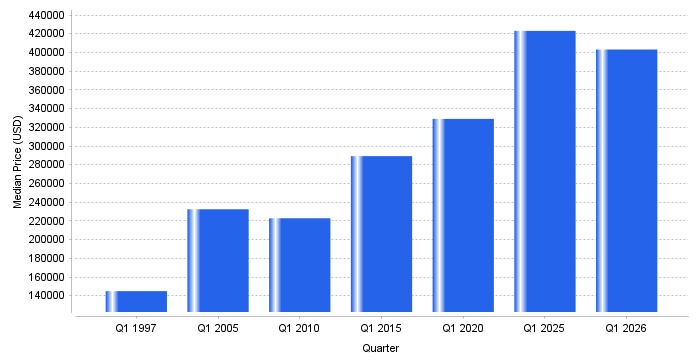
This dataset tracks the median sales price of homes in the United States since the Section 121 capital gains exclusion limits were established in 1997. The data shows that the median home price surged from $145,000 in early 1997 to $403,200 by Q1 2026, vividly illustrating how decades of real estate appreciation have eclipsed the unindexed $250,000 and $500,000 tax exclusion caps. For readers planning to downsize, the primary actionable insight is to meticulously document all major home improvements made over the years. Adding these expenses to your home's original cost basis legally shrinks your total taxable profit and can help protect your equity from the IRS.
| Quarter | Median Price (USD) (USD) |
|---|---|
| 1997-Q1 | 145000.00 |
| 2005-Q1 | 232500.00 |
| 2010-Q1 | 222900.00 |
| 2015-Q1 | 289200.00 |
| 2020-Q1 | 329000.00 |
| 2025-Q1 | 423100.00 |
| 2026-Q1 | 403200.00 |
Source: Federal Reserve Bank of St. Louis (FRED) — Median Sales Price of Houses Sold for the United States
Why is the tax code punishing people for simply making a profit on their primary home?
The current situation is a classic example of well-intentioned legislation colliding with decades of inflation. The Taxpayer Relief Act of 1997 originally created these exclusions to simplify taxes and help homeowners avoid keeping meticulous records of every minor home repair [2]. For a long time, it worked beautifully.
But as the exemption lost its purchasing power, the structural mechanics of capital gains taxes took over. Research from the National Bureau of Economic Research explains that taxing assets only upon realization—meaning when you sell—creates a powerful behavioral distortion known as the lock-in effect [5]. When tax rates act as a high transaction cost, rational investors will hold onto their assets far longer than they otherwise would, often waiting for future tax relief or utilizing other estate-planning loopholes.

In the housing market, this lock-in effect is uniquely potent. Because an heir receives a step-up in basis upon the owner's death—meaning the home's tax value resets to its current market price—many older homeowners realize that the most mathematically sound financial decision is to never sell at all [3].
Is my home equity at risk of being unexpectedly taxed?
You are most vulnerable to this tax penalty if you have lived in your home for more than fifteen years, particularly if you reside in a state that has seen rapid real estate appreciation [2]. Single filers are at the highest risk because their exemption is capped at just $250,000 [1].
This frequently catches widows and widowers off guard. When a spouse passes away, the surviving spouse has a limited window to sell the home and still claim the full $500,000 married exclusion. If they wait too long, their exclusion drops back down to $250,000, instantly exposing hundreds of thousands of dollars of equity to long-term capital gains rates of up to 20 percent [1].
How can I protect my home sale proceeds from the IRS?
You can take concrete steps this month to shrink your future tax burden. First, stop treating home improvements as sunk costs. Track and save the receipts for every major capital improvement you make—such as a new roof, a kitchen remodel, or an HVAC replacement. These expenses legally increase your home's cost basis, which directly shrinks your taxable profit [1].
Second, if you recently lost a spouse, consult a tax professional immediately about your timeline. You generally have up to two years from the date of your spouse's death to sell your home and still utilize the $500,000 exclusion. Finally, if downsizing is too expensive tax-wise, consider converting your property into a rental. While you will eventually face depreciation recapture and capital gains, turning the property into an investment opens the door to 1031 exchanges, allowing you to defer the tax hit while generating monthly income.








Comments (4)
Leave a Comment