


The split
Imagine two identical houses next door to each other, with two identical drivers in the driveway. The neighbors have the exact same credit scores, the same spotless driving records, and the same bundled home and auto coverage. Yet, one of them is paying hundreds of dollars more every year for the exact same protection.
The difference? The homeowner paying more has been a loyal customer for five years.
In most industries, loyalty earns you a discount. But in the insurance world, sticking around often triggers what industry insiders call a loyalty penalty. By quietly raising premiums on long-term customers who rarely check competitive rates, insurers are successfully squeezing extra margin out of complacency. For a typical household with bundled home and auto policies, this algorithm-driven squeeze can easily cost an extra $1,200 a year [1]. Here is how the hidden math of loyalty is quietly punishing good customers.
The winners
The clear winners in today's insurance market are the aggressive switchers. These are the policyholders who treat their home and auto insurance like a temporary subscription rather than a lifetime marriage.
According to recent industry data from J.D. Power, a record 57 percent of insurance customers have actively shopped for a new policy over the past year [2]. That is the highest shopping rate the firm has ever recorded. These proactive consumers are capturing the best introductory rates, which insurers heavily subsidize to bring new business in the door.
When these switchers jump ship, they often secure the new customer tier of pricing. Insurers actively compete for these fresh accounts, offering steep discounts for the first year or two. The winners understand that the minor hassle of uploading a few documents and making a phone call is heavily outweighed by the financial return. By continuously rotating their policies every couple of years, they reset their baseline costs and completely avoid the gradual price creep that plagues their more complacent neighbors.
The $2,580 Trap: How Insurance Loyalty Penalties Compound Over Time
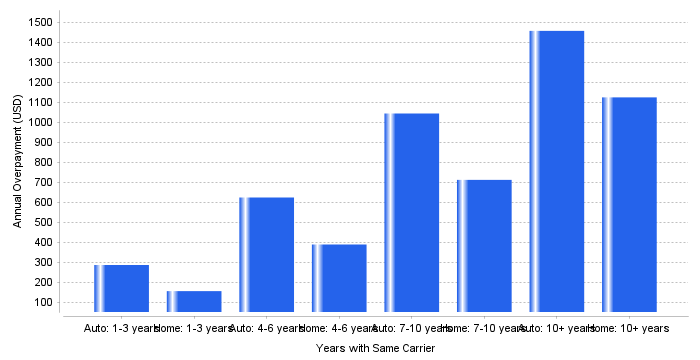
This dataset from a 2025 analysis of 2,400 families reveals a steep 'loyalty penalty' for customers who remain with the same auto and home insurance carriers . Annual overpayments increase significantly the longer a customer stays, reaching an average penalty of $1,456 for auto insurance and $1,124 for home insurance after ten years . To avoid subsidizing aggressive switchers, policyholders should actively shop and compare quotes every two years to reset their rates and eliminate these optimized price hikes .
| Years with Same Carrier | Annual Overpayment (USD) (USD (Annual Overpayment)) |
|---|---|
| Auto: 1-3 years | 287.00 |
| Home: 1-3 years | 156.00 |
| Auto: 4-6 years | 624.00 |
| Home: 4-6 years | 389.00 |
| Auto: 7-10 years | 1043.00 |
| Home: 7-10 years | 712.00 |
| Auto: 10+ years | 1456.00 |
| Home: 10+ years | 1124.00 |
Source: Concierge Insurance Group — Auto and Home Insurance Overpayments by Customer Tenure
The losers
The losers are the set it and forget it households. If you put your home and auto insurance on auto-pay three or more years ago and have not looked at your declaration page since, you are likely subsidizing the discounts given to the aggressive switchers.
People with bundled policies are especially vulnerable. Because it takes more effort to move both a homeowners policy and an auto policy at the same time, algorithms correctly assume these customers are stickier. Consequently, they are prime targets for gradual rate increases. Even without a single accident, ticket, or roof claim, these loyal customers watch their premiums mysteriously rise at each renewal.
While some of these increases are tied to genuine macroeconomic factors -- the U.S. Bureau of Labor Statistics notes that motor vehicle insurance costs have surged dramatically over the past year [3] -- a significant portion of the premium hike is simply a test of your inertia. If you grumble but ultimately pay the bill, the carrier's algorithm successfully registers your willingness to absorb the higher cost.
Why the gap exists
This gap is powered by a controversial actuarial practice known as price optimization. Historically, insurance was priced strictly on risk: how likely you were to crash your car or experience a house fire.
Today, pricing models look at much more than just your risk profile. According to research from the Actuaries Institute on the ethics of data-driven decision making, insurers now utilize non-risk-based behavioral data to estimate a customer's price elasticity of demand, essentially calculating the maximum price a specific customer will tolerate before they finally cancel [4].

The National Association of Insurance Commissioners acknowledges that these sophisticated data mining tools allow companies to quantify exactly how likely a policyholder is to renew [5]. If the data predicts you are too busy with work and family to shop around, the pricing model automatically serves up a higher premium. In short, the gap exists because the algorithm is not just measuring the risk of your house catching fire; it is measuring the risk of you leaving.
Is the gap closing or widening?
Right now, the gap is widening in most of the country, driven by a perfect storm of inflation and advanced analytics. As insurers struggle with the rising costs of building materials, medical care, and auto parts, they are leaning heavily on price optimization to repair their profit margins.
However, the regulatory landscape is beginning to fracture. A growing coalition of state insurance commissioners -- including those in California, Maryland, and Pennsylvania -- have issued bulletins banning or heavily restricting price optimization, arguing that two people with the exact same risk profile must legally be charged the same rate. But in states where regulations remain loose, insurers continue to deploy behavioral algorithms freely. Until more states classify price optimization as unfairly discriminatory, the loyalty penalty will continue to quietly inflate renewal notices.
What to do if you're on the wrong side
If you have been with the same carrier for more than two years, you are almost certainly paying a loyalty penalty. It is time to reclaim your household margin.
This week, dedicate 20 minutes to an insurance audit. Pull up your current premium and use an online comparison tool to grab two competitive quotes for the exact same coverage limits.
Next, call your current broker or agent. Tell them you have a lower quote in hand and ask if they can rewrite your policy to match the new customer pricing. If they refuse, make the switch. Moving forward, adopt the two-year rule: calendar a recurring reminder every 24 months to shop your policies. Treating your home and auto insurance like a highly competitive contract rather than a permanent utility is the easiest way to keep your money in your own pocket.






Comments (3)
Leave a Comment