



Is my credit card company really just handing out discounts?
American households are leaning heavily on revolving credit. The Federal Reserve's latest G.19 consumer credit report shows revolving balances growing at a rapid annualized rate of 12.6 percent, helping push overall consumer credit past the $5.1 trillion mark [1]. But hidden beneath these record balances is a surprising loophole that banks are quietly leaving open for those bold enough to use it.
If you are carrying a balance, a simple five-minute phone call to your issuer could instantly shave $1,600 off your total repayment costs. According to a recent LendingTree report, a staggering 83 percent of cardholders who asked to have their interest rate lowered in the past year were successful [2].
These are not tiny, symbolic reductions, either. The average rate cut granted over the phone was 6.7 percentage points. For a typical household carrying an ongoing balance, that single adjustment alters the math of their monthly budget immediately, keeping cash in their pocket rather than funneling it toward bank profit margins. The catch? You have to be the one to initiate the conversation.
How much money are we actually talking about here?
To understand the scale of this quiet relief valve, you have to look at the typical household ledger. The average American now carries $6,715 in credit card debt [3]. Meanwhile, average credit card interest rates have stubbornly hovered above 21 percent.
If you are making $150 monthly payments on that $6,715 balance at 21.5 percent, you will be chained to that debt for more than seven years, paying over $7,000 in interest alone. But if you secure that average 6.7-point reduction, dropping your rate to 14.8 percent, you will cut your repayment timeline by roughly two years and save more than $2,500 in total interest over the life of the balance.
This phone call strategy is becoming increasingly urgent because the traditional escape hatch for debt, the balance transfer, is quietly getting more expensive. While asking for a lower rate has an 83 percent success rate, issuers are simultaneously getting stingier about letting you move debt for free. LendingTree data shows that the success rate for asking a bank to waive a balance transfer fee has plummeted to just 51 percent [2]. With most cards now charging a steep 5 percent fee just to transfer a balance, moving $6,715 would instantly tack on a $335 charge to your principal [4]. Negotiating a lower rate on your existing card bypasses this transfer trap entirely.
With Credit Card Rates Hitting 21.52% in 2026, the $1,600 Phone Call is Crucial
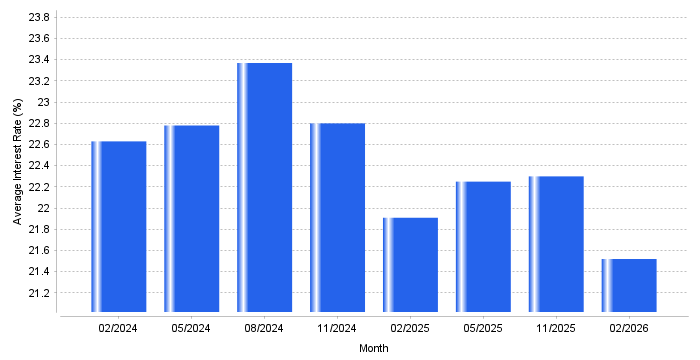
Federal Reserve data shows that average interest rates for credit cards assessing interest peaked at an all-time high of 23.37% in late 2024 and remain stubbornly elevated at 21.52% as of early 2026. These persistently high borrowing costs confirm the article's core claim that cardholders face crushing debt obligations if they passively accept their bank's default terms. Because issuers are maintaining fat profit margins, consumers have significant leverage to negotiate lower rates to retain their business. Readers should immediately call their credit card issuers and request a rate reduction to keep cash in their pockets and bypass expensive balance transfer fees.
| Month | Average Interest Rate (%) (Percent) |
|---|---|
| 2024-02 | 22.63 |
| 2024-05 | 22.78 |
| 2024-08 | 23.37 |
| 2024-11 | 22.80 |
| 2025-02 | 21.91 |
| 2025-05 | 22.25 |
| 2025-11 | 22.30 |
| 2026-02 | 21.52 |
Source: Federal Reserve Economic Data (FRED) — Commercial Bank Interest Rate on Credit Card Plans, Accounts Assessed Interest
Why would a massive bank voluntarily give up its profit?
It feels counterintuitive that a profit-driven financial institution would voluntarily slash your borrowing costs. The mechanism behind this generosity boils down to the staggering economics of customer acquisition and retention.
Research by the Federal Deposit Insurance Corporation on credit card banking reveals that card issuers operate with incredibly fat margins. Even after adjusting for the risk of customers defaulting, credit card portfolios generate a net spread of 6 to 12 percent, allowing the sector to pull in a 6.8 percent return on assets. That is more than four times the profitability of general banking [5].

Because these accounts are so lucrative, banks spend aggressively on marketing to win you over. Once you are in their ecosystem, losing you to a competitor's zero percent introductory offer is a costly failure. The data shows that your credit card issuer possesses immense pricing power, and they have the built-in margin to lower your rate if it means keeping you around as a paying customer. Giving you a 6.7-point discount is simply a retention expense, and it is vastly cheaper for them than spending hundreds of marketing dollars to find your replacement.
Will this actually work for someone with average credit?
You do not need a flawless 800 FICO score to negotiate successfully. While banks certainly favor borrowers with stellar histories, the sheer volume of granted requests suggests this tactic works broadly.
Banks are keenly aware of how expensive daily life has become, and their internal metrics trigger alerts when a customer might be looking for the exit. If you have a track record of making consistent, on-time payments, you have leverage. Even if you have missed a payment in the distant past, your ongoing status as a reliable source of interest income makes you highly valuable. The primary barrier stopping most consumers from securing this discount is not their credit score; it is simply the friction of picking up the phone. Most people assume the answer will be no, so they never ask.
What exactly should I say on the phone?
This is an actionable financial lever you can pull today. First, spend five minutes online looking up competing credit card offers tailored to your current credit score. Write down the rates they are advertising.
Next, call the customer service number on the back of your card and politely ask to speak with the retention department. Tell the representative: I have been a loyal customer, but my current interest rate is making it difficult to manage my balance. I have an offer from another bank for a lower rate, but I prefer to stay with you. Can you lower my APR?
If they hesitate, offer to enroll in automatic payments as a show of good faith. Even if they can only drop your rate by three points instead of six, you have just secured a guaranteed return on a five-minute conversation.






Comments (7)
Leave a Comment