



The Bedrock of American Wealth: Why Tax-Advantaged Accounts Matter
The modern landscape of personal finance and retirement planning is fundamentally different from the one navigated by previous generations. The days of relying entirely on a corporate pension, also known as a defined benefit plan, are largely over. In their place stands the defined contribution system, a massive, participant-driven financial ecosystem composed primarily of workplace 401(k) plans and Individual Retirement Accounts. This transition shifted the responsibility of funding retirement from the employer to the employee, requiring individuals to become the chief financial officers of their own lives.
Understanding and utilizing tax-advantaged accounts is not merely a matter of tax optimization; it is the absolute bedrock of wealth accumulation in the United States. The federal government, recognizing the need for citizens to support themselves in their later years, has written the tax code to heavily subsidize those who lock their money away for the long term. These subsidies come in two primary forms: tax deductions today or tax-free withdrawals tomorrow. By shielding your investments from the annual drag of capital gains and income taxes, your wealth is allowed to compound at a dramatically accelerated rate.
The sheer scale of this system is staggering. Total retirement assets in the United States reached forty trillion dollars (as of 2024), representing nearly a third of all household financial assets [1]. Within that massive pool, Individual Retirement Accounts hold roughly seventeen trillion dollars, while workplace defined contribution plans hold over twelve trillion dollars [1]. Over forty-four percent of all households in the country own an IRA, and nearly three-quarters have some form of formal, tax-advantaged retirement savings [2]. However, simply having an account is not enough. The difference between those who merely participate in the system and those who master it often amounts to hundreds of thousands, if not millions, of dollars over a working lifetime.
The Accumulation Framework: 401(k)s, Traditional IRAs, and Roths
To navigate the retirement ecosystem, you must understand the rules of engagement for the three primary vehicles: the 401(k), the Traditional IRA, and the Roth IRA. Each comes with its own set of rules, contribution limits, and phase-out thresholds determined by the Internal Revenue Service.
The 401(k) Powerhouse
For most workers, the 401(k) or its non-profit equivalent, the 403(b), is the primary engine of wealth creation. Contributions are deferred directly from your paycheck, making the saving process entirely frictionless. The baseline employee deferral limit is twenty-four thousand five hundred dollars (as of 2026) [3]. However, the IRS allows older workers to accelerate their savings. If you are aged fifty or older, you are eligible for an eight thousand dollar catch-up contribution, bringing your individual total to thirty-two thousand five hundred dollars [3].
Recent legislative changes have added another layer of opportunity for workers nearing the finish line. Under the SECURE 2.0 Act, a special super catch-up was introduced. Employees aged sixty to sixty-three can contribute an additional eleven thousand two hundred fifty dollars instead of the standard catch-up, allowing for massive capital injection right before retirement [4]. Furthermore, the true ceiling of a 401(k) is much higher when factoring in employer matches and profit-sharing. The combined maximum limit for both employee and employer contributions sits at seventy-two thousand dollars (as of 2026), or eighty thousand dollars for those fifty and older [4].
The Individual Retirement Account Landscape
While the 401(k) is tied to your employer, the Individual Retirement Account is entirely under your control. The annual contribution limit for an IRA is seven thousand five hundred dollars, with a one thousand one hundred dollar catch-up allowance for those fifty and older (as of 2026) [3]. IRAs come in two distinct tax flavors: Traditional and Roth.
Traditional IRAs offer a potential upfront tax deduction, allowing your investments to grow tax-deferred until you withdraw them in retirement, at which point they are taxed as ordinary income. However, if you or your spouse are covered by a retirement plan at work, your ability to deduct your Traditional IRA contribution phases out based on your Modified Adjusted Gross Income. For single filers with a workplace plan, the deduction begins to phase out at eighty-one thousand dollars and disappears entirely at ninety-one thousand dollars. For married couples filing jointly where the contributing spouse has a workplace plan, the phase-out range is one hundred twenty-nine thousand to one hundred forty-nine thousand dollars (as of 2026) [3].
Roth IRAs, conversely, offer no upfront tax break. You contribute after-tax dollars, but the crucial advantage is that all future growth and withdrawals are completely tax-free, provided you follow the age and holding period rules. Because of this powerful tax shield, the IRS restricts who can contribute directly to a Roth IRA. For single filers, the ability to contribute phases out between one hundred fifty-three thousand and one hundred sixty-eight thousand dollars. For married couples filing jointly, the phase-out range is two hundred forty-two thousand to two hundred fifty-two thousand dollars (as of 2026) [3].
The Pre-Tax Versus Post-Tax Decision
Choosing between Traditional (pre-tax) and Roth (post-tax) comes down to marginal tax rate arbitrage. You are essentially making an educated guess on whether your tax rate today is higher than your tax rate will be in retirement. The federal income tax system is progressive, utilizing seven brackets: 10, 12, 22, 24, 32, 35, and 37 percent [5]. The top marginal rate of 37 percent applies to taxable income over six hundred forty thousand six hundred dollars for singles and seven hundred sixty-eight thousand seven hundred dollars for married couples (as of 2026) [5].
When deciding, you must also factor in the standard deduction, which shields a baseline amount of income from taxes entirely. The standard deduction is sixteen thousand one hundred dollars for single filers and thirty-two thousand two hundred dollars for married couples filing jointly (as of 2026) [5]. If you are in your peak earning years and sitting in the 24 percent or 32 percent bracket, taking the upfront tax deduction of a Traditional 401(k) is often mathematically superior. Conversely, younger workers in the 10 percent or 12 percent brackets are typically better served locking in their low tax rate today by choosing Roth contributions, allowing decades of compounding growth to remain forever untouched by the IRS.
Median Retirement Savings Hit Only $185,000 for Pre-Retirees
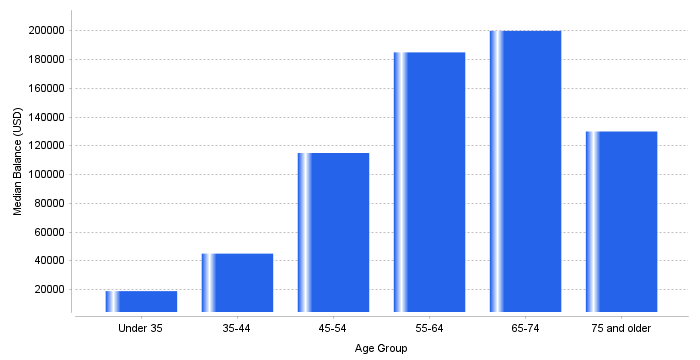
This dataset from the 2022 Survey of Consumer Finances tracks median retirement account balances across American age cohorts. While balances grow during peak earning years, the $185,000 median for the 55-64 pre-retiree group falls dangerously short of recommended wealth benchmarks. To avoid a severe income shortfall, readers must aggressively capture employer matches, leverage catch-up contributions, and audit their tax-advantaged strategies.
| Age Group | Median Balance (USD) (USD) |
|---|---|
| Under 35 | 18880.00 |
| 35-44 | 45000.00 |
| 45-54 | 115000.00 |
| 55-64 | 185000.00 |
| 65-74 | 200000.00 |
| 75 and older | 130000.00 |
Source: Federal Reserve Survey of Consumer Finances — Median Retirement Savings by Age
The Numbers Most People Don't Know: Federal Reserve Wealth Benchmarks
One of the most profound psychological hurdles in personal finance is understanding where you actually stand relative to your peers. Social media and financial news often distort reality, highlighting outliers and creating a false sense of inadequacy. To find the truth, economists rely on the Survey of Consumer Finances, a triennial report conducted by the Federal Reserve that serves as the most comprehensive snapshot of American household wealth [6].

The Illusion of the Average
When measuring retirement savings, it is critical to distinguish between the average (mean) and the median. The average is calculated by pooling all the retirement wealth in the country and dividing it by the number of households. Because ultra-high-net-worth individuals have tens of millions of dollars in their accounts, the average is pulled drastically upward, creating a benchmark that is practically useless for the typical worker.
The median, on the other hand, represents the exact middle point. Half of the households have more, and half have less. The gap between these two numbers is the single best illustration of wealth inequality in the retirement system. For households in the crucial pre-retirement window of ages fifty-five to sixty-four, the average retirement account balance is five hundred thirty-seven thousand five hundred sixty dollars [7]. However, the median balance for that exact same age group is only one hundred eighty-five thousand dollars (as of 2022) [7].
Decoding the Benchmarks by Age
Looking at the median balances across different age cohorts provides a realistic roadmap of accumulation. For households under the age of thirty-five, the median retirement balance is a modest eighteen thousand eight hundred eighty dollars. As careers stabilize and incomes rise, households aged thirty-five to forty-four see their median balance grow to forty-five thousand dollars. In the forty-five to fifty-four age bracket, the median jumps to one hundred fifteen thousand dollars [7].
While these numbers reflect the reality of the middle class, they also highlight a looming retirement security crisis. Applying the commonly used four percent withdrawal rule to the median pre-retiree balance of one hundred eighty-five thousand dollars yields an annual income of just seven thousand four hundred dollars, or roughly six hundred sixteen dollars a month [8]. Even when combined with Social Security benefits, this paints a picture of a very tight financial reality for millions of future retirees. Furthermore, these figures only represent households that actually have retirement accounts; the Federal Reserve notes that nearly forty-six percent of all households have no dedicated retirement savings whatsoever [9].
Common Mistakes and How to Avoid Them
The rules governing tax-advantaged accounts are rigid, and running afoul of them can trigger severe penalties that erode the very wealth you are trying to build. Avoiding these unforced errors is just as important as selecting the right investments.
The Six Percent Penalty Trap
One of the most punitive mechanics in the IRS code is the excise tax on excess contributions. If you accidentally contribute more than the annual limit to your IRA or Roth IRA, the IRS considers it an excess contribution. If not corrected by the tax filing deadline, this excess amount is hit with a six percent penalty tax [10]. Crucially, this is not a one-time fee; the six percent penalty applies every single year the excess funds remain in the account [10]. To fix this, you must contact your brokerage and request a specific removal of excess contributions, which will pull out the principal plus any earnings generated by that excess money, the latter of which will be taxed as regular income.
The Married Filing Separately Hazard
Many married couples choose to file their taxes separately for a variety of reasons, such as managing income-driven student loan repayment plans. However, doing so triggers a devastating trap for Roth IRA eligibility. If you are married, file separately, and lived with your spouse at any point during the year, your ability to contribute to a Roth IRA phases out between zero and ten thousand dollars of income (as of 2026) [3]. Earning more than ten thousand dollars completely disqualifies you from making a direct Roth IRA contribution. Many taxpayers are unaware of this obscure rule and inadvertently trigger the six percent excess contribution penalty.
The Cash Drag Error
A retirement account is simply a tax-sheltered container; it is not an investment in itself. A shockingly common mistake is successfully transferring money into an IRA and then failing to invest it, leaving it sitting in a money market or cash sweep vehicle. Over a thirty-year timeline, the opportunity cost of this cash drag is catastrophic. Research from the Investment Company Institute shows that successful, young Roth IRA investors typically maintain highly aggressive postures, with those under the age of sixty holding an average of ninety percent of their portfolios in equities and equity funds [11].
How to Actually Take Action This Week
Reading about tax code nuances and median wealth statistics is only valuable if it translates into behavioral change. To optimize your retirement trajectory, you need a systematic blueprint that can be executed immediately.
Step One: The Employer Match Audit
Your first priority is capturing any free money offered by your employer. Log into your company payroll or 401(k) portal and verify your current deferral percentage. If your company matches fifty percent of your contributions up to six percent of your salary, you must ensure you are contributing at least that six percent. Failing to secure the full match is the mathematical equivalent of voluntarily taking a








Comments (1)
Leave a Comment