



Have you checked your mortgage statement lately? If you only glance at the total amount due, you might be missing a quiet addition that is sweeping through the housing market. It is called force-placed insurance, and it happens when your mortgage servicer believes your home insurance coverage has lapsed.
Mortgage contracts require you to keep your property insured to protect the collateral on the loan. If your policy is canceled, not renewed, or if you simply switch carriers without telling your lender, the bank steps in. They legally have the right to purchase an insurance policy on your behalf to protect their financial interest and add the premium directly to your monthly mortgage bill [1].
This is not a minor administrative fee. A typical force-placed insurance policy can easily cost $4,500 a year—nearly triple the cost of standard coverage [1]. And unlike standard coverage, this expensive backup policy typically protects only the structure of the house, leaving your personal belongings entirely uninsured.
Wait, my mortgage lender can buy insurance for me?
The financial shock of force-placed insurance—also known as lender-placed insurance—can completely derail a household budget. Over the past few years, standard homeowners insurance has already become increasingly expensive. According to recent servicing data, the average national annual premium for standard home insurance reached $2,625 at the end of 2025 [2]. But when a bank steps in to insure your home, that baseline price tag gets thrown out the window.
Lender-placed policies routinely cost two to three times more than the coverage you could buy on the open market [1]. If your standard policy was around $2,600, a force-placed policy could push your annual cost well past $5,000. Because this premium is chopped into twelve pieces and added to your monthly escrow payment, your mortgage bill could suddenly spike by $200 to $400 a month.
Worse, you are paying a massive premium for a fraction of the protection. These policies are designed strictly to cover the outstanding balance of the loan, protecting the bank's investment [3]. They rarely include personal property coverage, meaning your furniture, electronics, and clothing are unprotected if a fire destroys the home [1]. They also exclude liability coverage, which pays out if someone gets injured on your property and decides to sue. You are essentially paying triple the price to protect someone else's asset [4].
Why is this backup coverage so outrageously expensive?
You might assume that banks, with their massive purchasing power, would negotiate competitive rates for these backup policies. Instead, the market operates on a mechanism that economists and regulators call reverse competition [3].
In a normal market, insurance companies compete for your business by offering lower prices or better coverage. But with force-placed insurance, the consumer is entirely removed from the transaction. The bank chooses the insurance provider and the coverage limits, but the homeowner is legally obligated to pay the bill [3]. Because the lender does not bear the cost of the premium, they have absolutely no incentive to shop around for the lowest rate.
Foundational legal and economic research shows that this structural dynamic fundamentally breaks the pricing model. Insurers effectively compete to offer the lenders the most attractive administrative setups or bundled services, while passing the inflated premiums directly to captive borrowers [5]. The National Bureau of Economic Research notes that these specific policies reflect an efficient solution only for the bank's risk exposure, leaving the homeowner to shoulder an outsized financial burden for a policy they never approved [4].

U.S. Home Insurance Costs Surge, Hitting a Record 165.68 Index in 2025
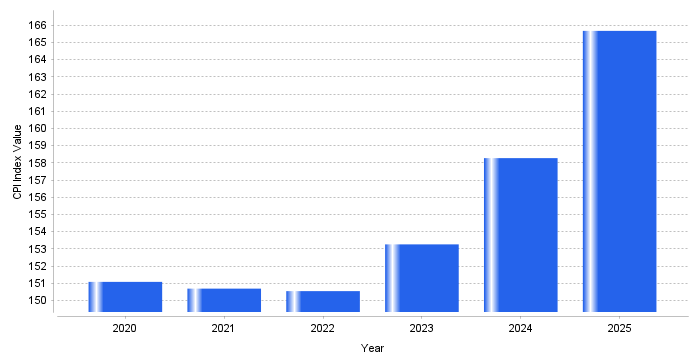
This dataset tracks the Consumer Price Index for home insurance, showing a steep acceleration in premium costs starting in 2023. By 2025, the index reached 165.68, reflecting the severe price hikes burdening homeowners nationwide. As standard policies become increasingly expensive, the financial penalty of defaulting into a force-placed insurance policy—which routinely costs double or triple the market rate—is more devastating than ever. Homeowners should immediately set up autopay and continuously update their mortgage servicer with their current declaration page to avoid coverage lapses and exorbitant lender-placed fees.
| Year | CPI Index Value (Index (Base Year 1997=100)) |
|---|---|
| 2020 | 151.08 |
| 2021 | 150.69 |
| 2022 | 150.54 |
| 2023 | 153.26 |
| 2024 | 158.28 |
| 2025 | 165.68 |
Source: WalletHub / U.S. Bureau of Labor Statistics — Consumer Price Index (CPI) for Tenants' and Household Insurance
Who is most likely to fall into this trap right now?
Historically, this issue primarily affected borrowers in deep financial distress who could no longer afford their insurance premiums. But today, the trap is catching everyday homeowners who are simply trying to navigate a chaotic insurance market.
If you live in a state where insurers are aggressively dropping customers or exiting the market entirely, you are at high risk. Homeowners who are forced to find a new carrier often forget to forward their new declaration pages to their mortgage servicer. Even a simple administrative glitch—like a misspelled name or an incorrect loan number on your new policy—can trigger the bank's automated tracking systems to register a lapse in coverage [1]. If the bank's mail goes to an old address or gets lost in your spam folder, you might not realize you have been enrolled until your mortgage payment spikes [3].
What exact steps should I take to avoid this?
First, check your most recent mortgage escrow statement. Look for any line items labeled 'LPI,' 'CPI,' or 'Lender-Placed Insurance.' If you see it, contact your servicer immediately.
If you currently have valid coverage, send your lender your updated declaration page today. Under federal regulations, once you prove you have adequate insurance, the lender must cancel the force-placed policy within 15 days and refund any overlapping premiums [1].
To prevent this from happening in the future, set your home insurance premiums to autopay and link them directly to your current email address. If you ever switch insurance carriers to get a better rate, do not assume your new agent will handle the paperwork flawlessly. Take five minutes to upload your new policy documents directly to your mortgage servicer's online portal to ensure the automated system registers your continuous coverage.






Comments (4)
Leave a Comment