



The split
The U.S. housing market has officially fractured into two completely different realities. Single-family homes remain stubbornly expensive and highly competitive. But condominiums? They are suddenly on clearance. According to recent Redfin data, a record 68.4 percent of condos sold for less than their original asking price in February 2025.
It is not just a minor discount, either. The typical condo is now selling for 4.6 percent below its list price, compared to nearly full price just three years ago [1]. For a buyer eyeing a typical $400,000 condo, this split translates to an $18,400 discount at the closing table. That is a massive chunk of real money staying in a buyer's wallet, creating a glaring divergence between attached and detached starter homes.
The winners
First-time buyers willing to do the math are walking away with the biggest advantages. If you are trying to break into homeownership, the condo market is offering a rare window of negotiating power that simply does not exist in the single-family space. In cities like Denver, over 77 percent of condos are selling below asking, and in Orlando, that number has surged to nearly 85 percent [1]. Buyers finally have the leverage to demand seller concessions, request rate buydowns, or aggressively negotiate the purchase price. The key is understanding that the upfront discount helps offset the heavier monthly carrying costs.
Another unexpected group of winners? Buyers looking for smaller, older single-family homes without homeowners associations. As frustrated condo owners try to exit the attached-housing market to escape rising fees, they are dramatically increasing the demand for detached starter homes. This gives sellers of modest, no-HOA properties a remarkably resilient asset, as their homes become the preferred safe haven for buyers wary of shared-building liabilities.
Condo Sales Plunge: May 2025 Volume Drops to 50,000
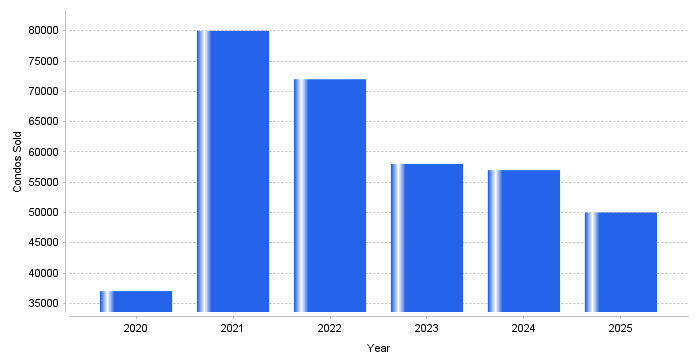
This dataset tracks the total number of U.S. condominiums sold in May from 2020 to 2025. It reveals a dramatic 37.5 percent plunge in condo sales since the 2021 peak of 80,000, falling to just 50,000 by May 2025. The steep decline directly supports the article's claim that the condo market is struggling heavily under the weight of surging HOA fees, mandatory reserve funding, and skyrocketing insurance premiums. For buyers, this plummeting sales volume signifies a major shift in negotiating power.
| Year | Condos Sold (Number of sales) |
|---|---|
| 2020 | 37000.00 |
| 2021 | 80000.00 |
| 2022 | 72000.00 |
| 2023 | 58000.00 |
| 2024 | 57000.00 |
| 2025 | 50000.00 |
Source: Redfin — U.S. Condo Sales Volume (May 2020-2025)
The losers
The most obvious losers are current condo owners who need to sell, particularly retirees and those on fixed incomes. These sellers are caught in a painful squeeze between ballooning building inventory and cautious buyers who hold all the cards. But the deeper financial drain is hitting condo owners who are not even trying to move.
According to the U.S. Census Bureau 2024 American Community Survey, 3 million households are now paying more than $500 every single month just in condo or homeowners association dues [2]. The geographic pain is widespread. In Washington, D.C., about half of all owned households pay over $500, while in New York, the median fee has reached a staggering $739 [2]. These owners are seeing their home equity erode while their non-mortgage monthly obligations spike. Condos were traditionally viewed as the affordable stepping stone to building wealth, but for many existing owners, that stone has become a sinking weight.
Why the gap exists
This massive divergence is not about a sudden cultural distaste for shared walls or communal pools. It is a structural shift. For decades, many condo boards kept monthly dues artificially low to appease current owners, pushing necessary maintenance and roof replacements into the future. That future has finally arrived, bringing the bill with it.
A 2026 working paper published on the Social Science Research Network isolated this exact mechanism. The research examined condo markets forced to comply with strict new structural reserve funding mandates. The study found that a major adjustment in reserve funding requirements correlates with a 7 percent drop in condo list prices [3]. The researcher noted that buyers do not just see a monthly fee increase; they treat these higher reserve contributions as a glaring warning sign. Buyers mechanically discount the purchase price of the home because they view the new fees as a replacement for expected future special assessments [3]. Throw in skyrocketing master insurance premiums for multi-family buildings across the country, and the fundamental math for condo ownership has completely changed.
Is the gap closing or widening?
The gap is widening, and historical trends suggest it will continue to stretch for the foreseeable future. Just a few years ago, before the pandemic boom completely cooled, condos and single-family homes appreciated largely in tandem. But as of early 2025, condo inventory is piling up at double-digit rates year over year, while detached homes remain scarce [1].
Because the underlying causes are entirely structural, including state laws requiring fully funded reserves, an aging supply of 1980s buildings requiring concrete work, and climate-driven insurance hikes, there is no quick fix. The era of the heavily subsidized, cheap condo fee is effectively over. Until the housing market fully prices in these new, mandatory carrying costs, single-family homes and condominiums will remain on two entirely different financial trajectories.
What to do if you're on the wrong side
If you currently own a condo and plan to stay, you need to get intimately familiar with your association reserve study. You must find out if a massive special assessment is looming. You can mitigate the shock by lobbying your board to incrementally raise monthly dues now rather than forcing owners to take a large unexpected bill all at once when a roof fails.
If you are a buyer eyeing a condo because of the attractive, discounted list price, demand the full HOA financials before making a binding offer. Look for associations that are at least 70 percent funded on their long-term reserves. Ask your real estate agent to specifically request the building master insurance policy history to see exactly how much premiums have jumped over the last three years. You can absolutely use the current buyer-friendly market to secure a deep discount, but you must ensure that your $18,400 savings at closing is not instantly wiped out by a $20,000 structural assessment the following year.








Comments (7)
Leave a Comment