



The split
When you check your local tax bill this year, you might notice a painful upward spike. Local municipalities rely heavily on property taxes to fund essentials like schools, road maintenance, and emergency services. Historically, commercial real estate carried a massive chunk of this financial burden. But as the work-from-home era leaves downtowns dotted with empty office space, those commercial property values are plummeting. To keep city budgets intact, tax assessors are quietly shifting the bill onto regular homeowners.
What does this mean for your money? In a typical mid-sized market undergoing revaluation, this divergence means a homeowner with a modestly priced $200,000 house is suddenly paying an extra $304 a year in property taxes, representing an 8% jump, even if the city has not spent a single penny more [1]. This is the new, invisible property tax math. While you might be happy your home's equity has grown, that paper wealth is suddenly being leveraged by local governments to plug the revenue holes left by vacant corporate real estate.
The winners
The clearest winners in this scenario are the owners of struggling commercial real estate, specifically those holding aging office buildings in major urban centers. As their properties are reassessed to reflect drastically lower market values and soaring vacancy rates, their property tax liabilities are plunging. Commercial landlords are successfully appealing their valuations, arguing that an empty building is worth a fraction of its pre-pandemic price. By winning these appeals, they successfully shrink their slice of the communal tax pie.
Suburban commercial hubs and industrial warehouses are faring better, but the primary beneficiaries of this tax shift are the corporate landlords in downtown cores who are legally paying significantly less into local budgets. When a massive downtown office building is half empty, its assessed value drops, and it pays a fraction of its normal real estate taxes [2].
Another subtle winner is state and local governments that are managing to keep their revenues stable. According to the US Census Bureau data released in March 2026, overall state and local property tax collections have continued to rise at the national level [3]. This steady revenue flow is driven almost entirely by the residential side, shielding budgets from the commercial real estate crash while leaving local homeowners to pick up the tab.
Homeowners Hit: Boston Residential Tax Rate Spikes 13% to $12.40
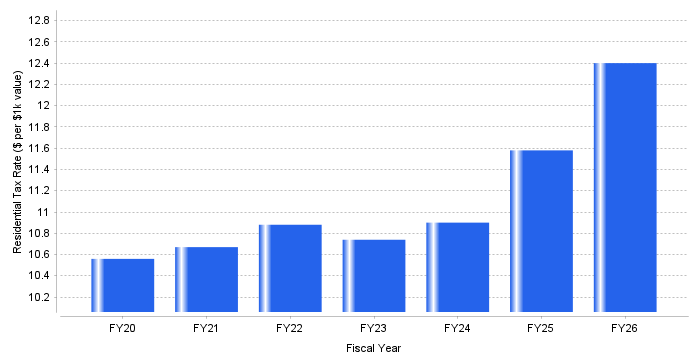
This dataset tracks the residential property tax rate in Boston from FY20 to FY26. For years, the rate remained stable near $10.50-$10.90 as commercial real estate heavily subsidized the city budget. However, as the remote work era caused commercial building values to plummet, the city was forced to drastically hike the residential tax rate (reaching $12.40 in FY26) to plug the revenue gap. Homeowners should actively audit their assessment records and file for all applicable exemptions to mitigate these aggressive municipal tax shifts.
| Fiscal Year | Residential Tax Rate ($ per $1k value) (USD per $1,000 of assessed value) |
|---|---|
| FY20 | 10.56 |
| FY21 | 10.67 |
| FY22 | 10.88 |
| FY23 | 10.74 |
| FY24 | 10.90 |
| FY25 | 11.58 |
| FY26 | 12.40 |
Source: City of Boston Budget / Boston Municipal Research Bureau — Boston Historical Residential Property Tax Rates
The losers
The losers in this equation are everyday homeowners, particularly those living in residential neighborhoods adjacent to struggling metropolitan downtowns. Because local governments need a fixed, guaranteed amount of revenue to keep schools open and fire trucks fueled, a shrinking commercial tax base mathematically forces the residential tax rate up. If the commercial slice of the pie shrinks, your slice has to get thicker to feed the municipal budget.
In Chicago's Cook County, for example, the median residential property tax bill for some neighborhoods jumped by more than 50% following recent reassessments [2]. Overall, the county's property tax burden shifted heavily onto homeowners, raising collective residential bills by hundreds of millions of dollars [2].
The financial pain is uniquely acute for low- and middle-income families. While some wealthy residential enclaves experienced manageable single-digit tax increases, working-class neighborhoods where home values spiked post-pandemic are absorbing the brunt of the office market slump [2]. If your home appreciated in value over the last four years, your local assessor is likely using that gain to offset the losses from empty downtown skyscrapers. You are effectively paying a structural penalty for the remote work revolution every time your escrow account adjusts.
Why the gap exists
The core mechanism driving this shift is known among economists as the Office Real Estate Apocalypse. Foundational research (older than 90 days) from the National Bureau of Economic Research (NBER) comprehensively outlines how the remote work revolution wiped out roughly $557 billion in commercial office value nationwide [4].

Here is how the underlying math of the gap works: Property taxes function as a zero-sum game within a municipality. A city calculates its annual budget, then divides that total cost among all properties based on their relative assessed values. If the commercial sector's slice of the total value shrinks significantly because companies abandoned their long-term leases, the residential sector's slice must mathematically expand to cover the difference [1].
The NBER research explicitly warned of an impending fiscal doom loop, where severely degraded office values would lead to plunging commercial property tax revenues [4]. To avoid insolvency and maintain public services, cities would be forced to hike residential rates. That theoretical loop has now arrived at your front door. Assessors are finally catching up to the post-2020 economic reality, legally slashing commercial valuations and offsetting those profound municipal losses by tapping into the inflated home values of everyday citizens.
Is the gap closing or widening?
The gap is actively widening, and the current year is shaping up to be an era of residential tax shocks. Property reassessments typically happen on delayed three-to-five-year cycles depending on your state and county. This lag means the catastrophic commercial real estate drops from recent years are only just now being formalized on official municipal tax rolls [1].
Recent tax collection data confirms that local property tax revenues continue to climb nationwide, despite the severe and highly publicized commercial distress [3]. This indicates the burden shift is fully underway and accelerating. Cities from Boston to Chicago are witnessing fierce legislative battles over this exact divergence, with proposals to legally cap the residential share frequently failing against the hard reality of municipal budget requirements. Until commercial office values find a hard bottom and stabilize, or cities discover entirely new revenue streams, the residential housing sector will continue to heavily subsidize the commercial slump.
What to do if you're on the wrong side
You do not have to passively accept the city's math. Your first actionable step this week is to pull your property record card from your county assessor's website. Assessors frequently make clerical errors regarding square footage, bathroom counts, and property features. If the data is wrong, you have immediate, objective grounds for an appeal.
Second, build a comparable sales file this month. Use real estate platforms to find three to five similar homes in your exact neighborhood that recently sold for less than your newly assessed value. Submit these sales as evidence to your local Board of Assessment Review before the brief appeal window closes.
Finally, verify that you are receiving every tax exemption you qualify for. Many homeowners accidentally leave money on the table by failing to file paperwork for homestead, senior citizen, veteran, or long-term residency exemptions. These programs shield a fixed percentage of your home's assessed value from the shifting tax burden, directly lowering your final bill.







Comments (29) — Page 2 of 3
Leave a Comment