



Wait, my company is spending more on me but I am not seeing it?
Did your last annual raise feel a little underwhelming? You are not crazy, and you are not alone. Across the country, workers are receiving robust bumps in their total compensation, but a massive chunk of that money is completely bypassing their bank accounts. Right now, the average employer pays $16,357 a year to provide family health insurance coverage [1]. According to the latest Employment Cost Index data, employer health insurance costs just surged by 5.7% over the past year [2]. For a typical household with family coverage, that means your company effectively spent an extra $932 on your compensation this year. But because standard wages only grew by 3.4%, you did not see a dime of that specific increase [3]. It is the ultimate invisible raise. Your employer feels like they are spending top dollar to retain you, but from your perspective, your paycheck has barely budged. This widening disconnect between what companies pay and what workers actually take home is quietly eating away at household purchasing power, transforming expected merit increases into invisible insurance subsidies.
How much of my paycheck is vanishing into this 'invisible' bucket?
To understand just how much of your paycheck is vanishing before it ever reaches you, we have to look at the total pie of your compensation. According to the Bureau of Labor Statistics, the average total compensation for a civilian worker is currently $48.78 per hour. But the actual wage portion of that is only $33.45. The remaining $15.33, nearly 30% of your total employment cost, is tied up entirely in benefits [4].
Recent analysis by the Indeed Hiring Lab highlights a stark reality: for the fifth consecutive quarter, the cost of providing health insurance is growing much faster than actual worker wages [2]. While nominal wages grew 3.4% year-over-year, inflation ate almost all of it. After adjusting for higher prices at the grocery store and the gas pump, workers were left with a microscopic 0.1% real wage increase [2].
Meanwhile, that 5.7% spike in health costs is devouring the exact budget pools that companies usually reserve for cash bonuses, merit increases, and promotions. Think of it as a massive shadow tax on your career growth. When executives sit down to map out their annual labor budgets, they look at the total spend. If the insurance company demands a larger slice of that pie just to maintain the exact same health coverage you had last year, the slice left over for your direct salary automatically shrinks.
Health Insurance Costs Hit 20-Year High with 6.4% Surge Before Settling at 5.7%
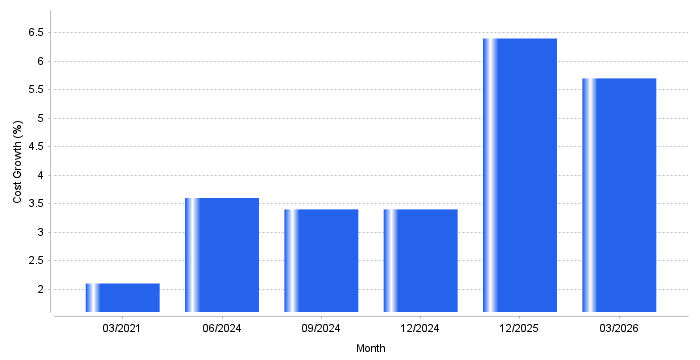
This dataset tracks the year-over-year percent change in what private employers pay for employee health insurance [cite: 1]. It highlights a dramatic acceleration from a steady 3.4% growth rate in late 2024 to a massive 6.4% spike by the end of 2025 [cite: 2, 3]. By early 2026, costs were still surging at 5.7%, significantly outpacing the 3.4% growth in standard wages [cite: 4, 5]. For workers, this proves that a massive chunk of their total compensation is being quietly devoured by insurers before it ever reaches their paychecks. Employees should review their total compensation statements and consider if alternative health plans could return some of this invisible spend to their base salaries.
| Month | Cost Growth (%) (12-Month Percent Change (%)) |
|---|---|
| 2021-03 | 2.10 |
| 2024-06 | 3.60 |
| 2024-09 | 3.40 |
| 2024-12 | 3.40 |
| 2025-12 | 6.40 |
| 2026-03 | 5.70 |
Source: U.S. Bureau of Labor Statistics — Employment Cost Index: Health Insurance Benefits (Private Industry)
Why are companies structuring pay this way?
Why are businesses structuring pay this way, instead of just handing you the cash to buy your own insurance? It comes down to labor market dynamics and structural trade-offs. Foundational research from the National Bureau of Economic Research explains a key mechanism in modern compensation: companies frequently use non-wage amenities and comprehensive benefits to offset direct wage-growth pressures [5] (Foundational research, older than 90 days).

Furthermore, a brand-new NBER working paper explores how modern career progression relies on a multi-dimensional job ladder. The research shows that when workers switch jobs, they frequently accept flatter wage trajectories in exchange for better health coverage, workplace flexibility, or other valuable non-wage amenities [6]. Employers know that a robust benefits package is a powerful retention tool. So, when healthcare premiums inevitably hike, companies choose to absorb the bulk of the cost rather than slashing the benefit quality and risking a mass exodus of talent. To balance the books, they have to quietly freeze or shrink the cash pool available for your annual raise.
Who is taking the biggest hit from this trend?
This invisible wage freeze is hitting private industry workers the hardest, particularly those in middle-management and professional roles. In these specific occupations, employer contributions to health insurance are significantly higher, averaging $5.61 per hour compared to just $1.70 per hour for service sector workers [4].
If you work for a mid-sized to large company that prides itself on offering gold-standard health coverage, your cash raises are highly vulnerable to these insurance premium hikes. As the cost of providing premium care accelerates, high-earning professionals whose benefits packages make up a larger absolute slice of their total compensation will continue to see their cash raises cannibalized by their insurer.
How do I claw back some of this missing cash?
Since your company is spending more on your benefits than ever before, you need to extract every possible dollar of value from them. First, audit your health plan this week. If you are generally healthy, calculate if switching to a High Deductible Health Plan with a Health Savings Account will significantly lower your monthly premiums and put more of your total compensation back into your actual paycheck.
Second, when negotiating your next raise, explicitly ask your manager for a total compensation statement. If they cite rising benefit costs as an excuse for a smaller cash bump, pivot the negotiation immediately. Ask for alternative, low-cost perks that improve your life: extra paid time off, dedicated remote work days, or a professional development stipend.






Comments (2)
Leave a Comment