



The $321 Penalty Making a Quiet Comeback
The spring of 2026 has brought a quiet but expensive reversal to the American banking system. After years of regulatory pressure aimed at eliminating so-called 'junk fees,' the average bank overdraft fee currently sits at $26.77, with many major traditional financial institutions continuing to charge up to $35 for the privilege of letting your balance slip below zero [1].
For a typical household that accidentally overdraws its account just once a month, that penalty translates to roughly $321 quietly erased from their annual budget [1]. Nationally, this adds up to a staggering wealth transfer. American consumers paid approximately $12.1 billion in combined overdraft and non-sufficient funds (NSF) fees recently, according to market data compiled by the Consumer Financial Protection Bureau [2].
If you thought these fees were on the verge of extinction, your confusion is justified. In late 2024, the CFPB finalized a landmark rule intended to cap these charges at just $5 for the nation's largest banks. However, in May 2025, President Trump signed a Congressional Review Act resolution that completely nullified the CFPB's rule, citing concerns over regulatory overreach and the restriction of short-term liquidity options for consumers [3].
With the federal cap legally erased, the traditional $35 overdraft fee has secured a new lease on life for 2026. But the most surprising aspect of this $12 billion industry isn't just that the fees survived the regulatory chopping block. It is how highly concentrated the financial pain actually is.
According to industry data, roughly 70 percent of checking accounts never trigger an overdraft fee at all. Meanwhile, a tiny fraction of accounts—just 7 percent—overdraft ten or more times a year and generate roughly 75 percent of all overdraft revenue [2]. This extreme imbalance forces a deeply uncomfortable question for anyone who regularly checks their balances and easily avoids these penalties: Who is really paying for your seemingly 'free' checking account?
The Hidden 'Free Checking' Subsidy
To understand why banks fight so fiercely to protect overdraft fees, you have to look at the underlying mechanics of retail banking. Maintaining a checking account, processing digital transactions, staffing physical branches, and building secure mobile apps costs a significant amount of money. Yet, most consumers absolutely refuse to pay a monthly maintenance fee. In fact, nearly half of all non-interest checking accounts today charge no monthly service fee whatsoever [1].
This creates a classic economic cross-subsidy. The 9 percent of customers who frequently dip into the red are effectively financing the free banking ecosystem for the other 91 percent who do not. When regulators try to forcibly eliminate these penalty fees, the entire financial ecosystem has to shift to replace the lost revenue.
We know exactly how this plays out thanks to foundational research (older than 90 days) conducted by the Federal Reserve Bank of New York. In a comprehensive study titled 'Who Pays the Price? Overdraft Fee Ceilings and the Unbanked,' researchers examined a historical quirk where national banks were exempted from certain state-level overdraft fee caps, while state-chartered banks were not [4].
The structural mechanism revealed in the study was deeply counterintuitive. When national banks were allowed to operate without overdraft fee limits, they naturally raised those specific fees by about 10 percent. But with that highly profitable revenue stream secured, they simultaneously expanded their deposit supply. To attract more customers, they lowered their minimum balance requirements by a massive 30 percent compared to the state banks that were still capped [4].
By lowering the barrier to entry, these banks made it vastly easier for lower-income consumers to open and maintain an account. The researchers found that in states where the fee caps were lifted, the share of low-income households with a checking account actually rose by 10 percent [4]. High minimum balance requirements are consistently ranked by the FDIC as the number one reason households remain unbanked. So, while overdraft fees undeniably punish those living paycheck to paycheck, aggressively capping them forces banks to raise the velvet rope, effectively locking out the exact vulnerable populations the caps were meant to protect.

Now that the $5 federal cap has been repealed, banks are navigating a complex landscape of consumer expectations and margin pressures. If you aren't paying overdraft fees, banks are finding other ways to monetize your access to cash. The cost of using an out-of-network ATM has hit a record high of $4.86 per transaction in 2026 [1]. If you use an out-of-network ATM just once a week, that is another $253 a year drained from your savings [1]. In an era where digital banking makes it incredibly easy for customers to move their money, traditional banks are desperate for sticky, low-cost deposits. The billions generated by those who stumble into the overdraft trap provide the necessary financial cushion that allows banks to offer zero-minimum, fee-free accounts to the rest of the market. You are either the one paying the fee, or you are the one quietly benefiting from it.
The Sticky Penalty: Average Bank Overdraft Fees (2019-2025)
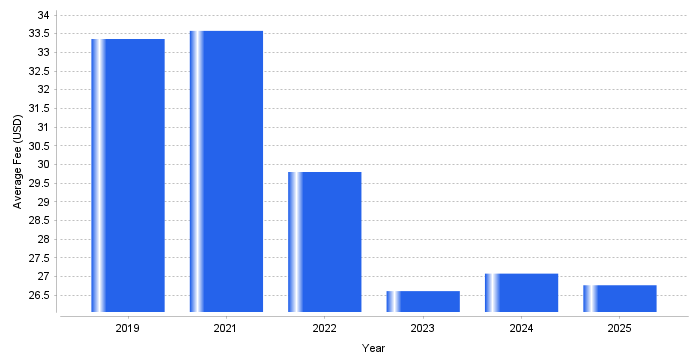
This dataset tracks the average overdraft fee charged by U.S. banks, illustrating the persistence of these penalties despite regulatory pressures. After peaking at $33.58 in 2021, average fees saw a drop in 2022 and 2023 amid initial CFPB crackdowns and voluntary bank policy changes. However, the data reveals that these fees stabilized at nearly $27 in 2024 and 2025, confirming the article's claim that the penalty remains a structural fixture in retail banking. To protect their finances, consumers should proactively set up low-balance alerts, opt out of automatic overdraft coverage, or switch to institutions that have eliminated these fees entirely.
| Year | Average Fee (USD) (USD) |
|---|---|
| 2019 | 33.36 |
| 2021 | 33.58 |
| 2022 | 29.80 |
| 2023 | 26.61 |
| 2024 | 27.08 |
| 2025 | 26.77 |
Source: Bankrate Checking Account and ATM Fee Study — Average Bank Overdraft Fee in the U.S.
How to Opt Out of the Penalty Box
With federal caps officially off the table for the foreseeable future, the responsibility for protecting your wallet falls entirely on your own shoulders. Fortunately, the competitive landscape of the banking industry gives you more leverage than ever before to avoid both overdraft and ATM access fees.
First, explicitly turn off 'courtesy pay' or standard overdraft coverage for your checking account. By law, banks must ask you to opt-in to overdraft coverage for everyday debit card transactions. If you opt out, your card will simply be declined at the register if you lack the funds. It might be a momentary embarrassment at the grocery store, but a declined payment will not trigger a $35 penalty.
Second, set up a proactive low-balance alert. Most modern banking apps allow you to set push notifications or text alerts. Do not set your alert for zero. Set your threshold at $100 or $150. This gives you a critical window of time to transfer funds from a savings account or delay a discretionary purchase before an automatic bill payment pulls your account into negative territory.
Third, to avoid the $253 annual drain of ATM fees, locate your bank's in-network map on their app, or simply ask for cash back at the register when buying groceries. Major retailers rarely charge a fee for this service, turning every supermarket into a free ATM.
Finally, take advantage of the institutions that have voluntarily left the overdraft business. Despite the federal repeal, several major banks—including Capital One, Ally Bank, and Citibank—have completely eliminated overdraft fees as a competitive strategy to win over frustrated customers [5]. Moving your direct deposit to a bank that refuses to charge these penalties is the easiest way to guarantee you will never inadvertently subsidize someone else's banking experience again.






Comments (3)
Leave a Comment