



The split
If your spouse has a job that offers health insurance, but they choose to stay on your family plan instead, your human resources department is about to notice. Welcome to the era of the spousal carve-out. With corporate health care costs surging for 2026, companies are cracking down on dual-income couples who cluster on one family plan. The result is a sharp divide between families who successfully separate their health insurance and those who stick together out of habit. If you do not decouple your coverage during open enrollment, you might find yourself on the wrong side of an increasingly common corporate policy: the spousal surcharge. This quiet penalty averages $157 a month, or $1,884 a year, and is actively reshaping how households buy their medical coverage [1].
The winners
The primary beneficiaries of this shift are the companies writing the premium checks. By forcing working spouses off their health plans, employers immediately shed significant medical liabilities. Spouses historically account for a larger share of medical utilization and high-cost claims than the employees themselves. Single employees and workers whose spouses do not have access to their own employer coverage also win. By removing working spouses from the risk pool, companies can moderate the overall premium increases for everyone else.
Additionally, some workers are actually getting paid to kick their spouses off the family plan. A growing number of companies are adopting spousal incentive health reimbursement arrangements. Instead of penalizing you for keeping a spouse on the plan, these employers will deposit tax-free money into a dedicated account to cover deductibles and copays if your spouse agrees to switch to their own employer's coverage. For households willing to manage two separate insurance policies, this cash incentive can significantly lower their annual out-of-pocket medical costs.
Family Health Premiums Hit $26,993 in 2025, Driving Employer Surcharges
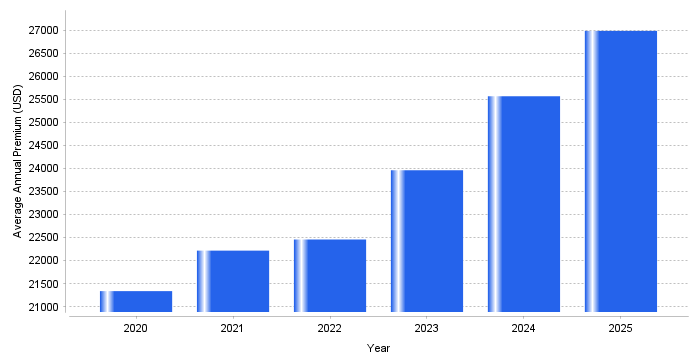
Data from the KFF Employer Health Benefits Survey reveals a steep, continuous upward trend in the cost of family coverage, surging from $21,342 in 2020 to $26,993 by 2025. This relentless rise in corporate liabilities explains why companies are aggressively adopting spousal surcharges to shift costs back to dual-income households. Employees should carefully calculate whether paying the average $1,884 annual penalty is cheaper than splitting into two separate employer plans during open enrollment.
| Year | Average Annual Premium (USD) (USD) |
|---|---|
| 2020 | 21342.00 |
| 2021 | 22221.00 |
| 2022 | 22463.00 |
| 2023 | 23968.00 |
| 2024 | 25572.00 |
| 2025 | 26993.00 |
Source: Kaiser Family Foundation (KFF) — Average Annual Family Premiums for Employer-Sponsored Health Insurance
The losers
The clear losers are married couples who prefer the convenience of a single family plan, even when both partners have access to workplace coverage. According to industry tracking, the average spousal surcharge now runs about $157 per month [1]. That is a hidden penalty of $1,884 a year just for the privilege of keeping your working spouse on your insurance. In some corporate plans, this surcharge can reach $400 a month, or $4,800 annually [1].
This extra fee is stacked on top of already rising premium costs. The average monthly cost for a standard health plan reached $752 in 2026 [2]. Add a typical spousal surcharge, and a dual-income household could easily be paying thousands more annually just to maintain their premium coverage, before seeing a single doctor or paying a single copay. Couples who miss the fine print in their 2026 open enrollment packets will simply see this money vanish from their paychecks.
Why the gap exists
To understand why companies are suddenly so aggressive about spousal coverage, you have to look at the underlying math of compensation. Research from the National Bureau of Economic Research explains the mechanism behind this shift: employer-sponsored health insurance operates as a direct tradeoff with wages [3]. Because health benefits are expensive, companies factor them into total compensation.
When an employee adds a spouse who already has access to health insurance at their own job, that couple is effectively double-dipping into corporate wage-benefit pools, while the spouse's employer gets away with paying nothing. The math has reached a breaking point. The latest data from the Bureau of Labor Statistics shows that employer costs for employee benefits rose 3.6 percent over the last year, officially outpacing wage and salary growth [4]. Companies are tired of subsidizing the health care costs of other companies' workers, and these surcharges force those costs back onto the proper ledger.

Is the gap closing or widening?
This gap is widening rapidly. For 2026, health insurance premiums jumped 21 percent year-over-year in the broader market, sending shockwaves through employer budgets [2]. Faced with this spike, the majority of employers are actively making cost-cutting changes to their plans. When companies look for ways to trim millions of dollars in future liabilities without cutting core benefits for their direct employees, working spouses are the easiest target. The trend is moving beyond mere surcharges into absolute bans, known as spousal carve-outs, where a working spouse is entirely blocked from enrolling if they have access to their own employer's plan [1]. As medical inflation continues to bite, expect these penalties to become a standard feature of corporate benefit packages.
What to do if you're on the wrong side
Your first move is to read your 2026 open enrollment documents carefully. Look specifically for the terms spousal surcharge, working-spouse provision, or spousal carve-out. If your employer is implementing one, you and your partner need to sit down and run the numbers on splitting your coverage.
Compare the cost of two individual plans against the cost of your family plan plus the new surcharge. Do not forget to factor in deductibles and out-of-pocket maximums, as hitting two separate individual deductibles might end up costing more than paying the surcharge if you expect heavy medical expenses. If you do split into two plans, update your tax withholdings on your W-4 forms to reflect the change in pre-tax payroll deductions. Finally, if you separate plans, verify exactly how this affects your ability to contribute to a family Health Savings Account.








Comments (15) — Page 2 of 2
Leave a Comment