


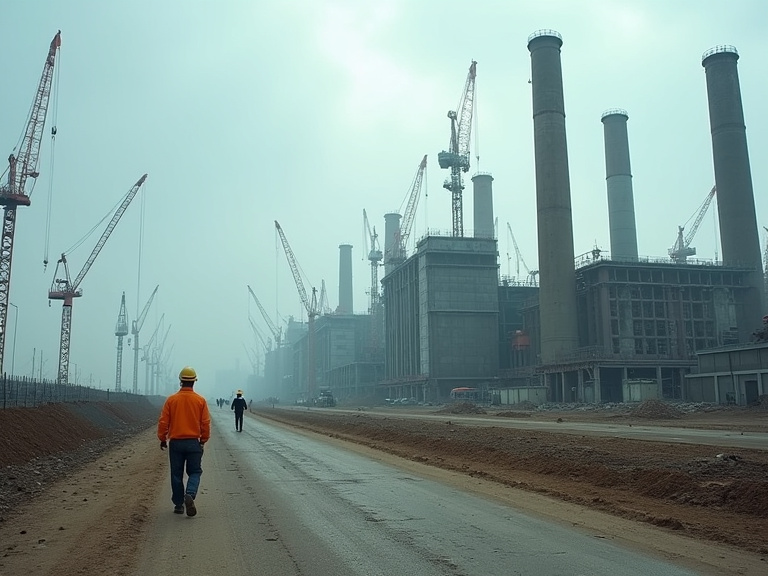
The construction cranes are coming down, but the conveyor belts are finally speeding up.
For the past three years, the loudest story in the American economy has been the "Manufacturing Supercycle." Driven by federal incentives like the CHIPS Act and the Inflation Reduction Act, companies poured hundreds of billions into breaking ground on massive new facilities. That era appears to be over.
New data reveals a stark pivot: The relentless boom in building factories has undeniably reversed, posting sharp year-over-year declines. Yet, just as the physical building spree cools, the actual production of goods—the metric that matters for the long term—is showing its strongest pulse in a year. The U.S. industrial sector is graduating from the "spending money" phase to the "making money" phase, a quiet but critical shift that changes the calculus for investors and the labor market.
The Numbers
- Construction Spending Drop: After years of record growth, total construction spending on U.S. manufacturing facilities fell 9.6% year-over-year as of the latest Census Bureau data release in January 2026 [1].
- Future Forecast: The contraction isn't a blip. The American Institute of Architects (AIA) Consensus Construction Forecast now projects a further 3.9% decline in manufacturing building spending for the full year of 2026 [2].
- Production Pop: Conversely, the Federal Reserve reported that manufacturing output rose 0.6% in January 2026, beating analyst expectations and marking the strongest monthly gain since early 2025 [3].
Why Now?
The timing of this divergence is structural, not accidental. The massive wave of groundbreakings initiated in 2022 and 2023 has crested. Megaprojects, particularly in semiconductors and EVs, are moving from the capital-intensive shell construction phase to the equipment installation and operational testing phase. Anirban Basu, chief economist for the Associated Builders and Contractors, noted that the "precipitous drop" in manufacturing investment is largely due to these CHIPS Act-enabled projects winding down their initial construction activity [1]. Furthermore, high interest rates through late 2025 likely curbed the appetite for starting new speculative industrial projects, leaving a gap as the funded megaprojects complete their build cycles.
What's Interesting
There is a "weird gap" between how we measure industrial health and what is actually happening. While the headline construction numbers look recessionary (a nearly 10% drop is usually alarming), the output data suggests resilience. We are seeing a baton handoff: the economic engine is switching from construction crews to assembly workers.
This transition is complicated by how we measure value. Recent research from the National Bureau of Economic Research (NBER) suggests that standard metrics may significantly understate the productivity of this new manufacturing wave [4]. The researchers found that in high-tech sectors—exactly where the U.S. has been building capacity—official statistics often fail to capture quality improvements, potentially underestimating productivity growth by as much as 5.7 percentage points in specific electronics subsectors [4]. As these new factories come online, the "official" output numbers might mask the true economic value being generated.

Who It Affects
- Construction Firms: General contractors specializing in industrial shells face a shrinking backlog. The AIA notes that manufacturing is one of the few sectors projected to shrink in 2026, while data centers continue to boom [2].
- Factory Workers: The labor demand is shifting skills. The January Fed report showed specific strength in motor vehicles and computer electronics [3], signaling that hiring is moving from pouring concrete to operating machinery.
- Investors: The capital expenditure (CapEx) cycle is peaking. For companies that spent billions building, the pressure is now on to show operational yield and efficiency rather than just construction progress updates.
Historical Context
To understand the scale of the reversal, look at the run-up. Manufacturing construction spending roughly tripled between 2021 and 2024, an unprecedented vertical line on historical charts. A 9.6% pullback [1] is significant, but it leaves spending levels far above the pre-pandemic average. We aren't returning to the doldrums of the 2010s; we are simply descending from a jagged peak. Similarly, the 0.6% gain in output [3] is a welcome change after a sluggish 2025, where manufacturing output was largely flat or negative for consecutive quarters.
What This Might Mean
First, the "industrial recession" narrative may need retiring. If output continues to track with the January surprise, 2026 could be the year U.S. domestic manufacturing finally contributes positively to GDP growth rather than weighing it down. Second, the "productivity paradox"—where huge investments yield low measured growth—might widen before it closes. As the NBER research highlights, the high-tech goods pouring out of these new factories (like advanced chips) provide value that is notoriously hard for government statistics to capture [4]. The economy might feel stronger than the headline productivity numbers imply.
Factory Construction Spend Drops 16% from $240B Peak to $202B in Dec 2025
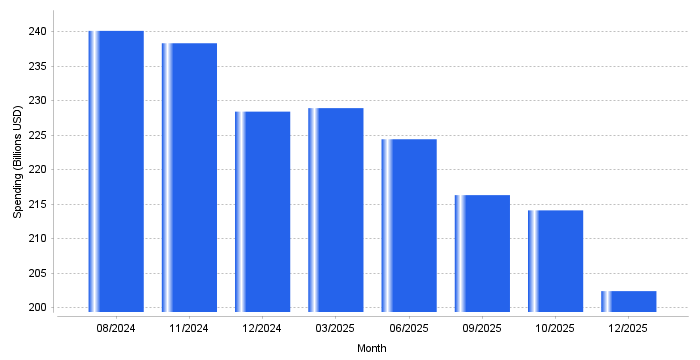
This dataset confirms the article's central claim of a 'flipped' supercycle. After peaking at an all-time high of $240.1 billion in August 2024, manufacturing construction spending has entered a sustained contraction, falling to $202.4 billion by December 2025. This 15.7% decline from the peak aligns with the article's narrative that the initial phase of massive facility groundbreakings has crested and is winding down.
| Month | Spending (Billions USD) (Billions of USD (SAAR)) |
|---|---|
| 2024-08 | 240.10 |
| 2024-11 | 238.30 |
| 2024-12 | 228.40 |
| 2025-03 | 228.90 |
| 2025-06 | 224.40 |
| 2025-09 | 216.30 |
| 2025-10 | 214.10 |
| 2025-12 | 202.40 |
Source: U.S. Census Bureau — U.S. Total Manufacturing Construction Spending (Seasonally Adjusted Annual Rate)








Comments (2)
Leave a Comment