



WHAT HAPPENED
For nearly four decades, the "College Wage Premium" — the gap between what degree-holders and high school graduates earn — was the most reliable law in economics. It doubled between 1980 and 2000, fueling the narrative that a four-year degree was the only safe bet for financial mobility. That engine has now stalled.
New government data confirms a quiet but structural reversal: wage growth for service and blue-collar roles is now outpacing that of white-collar professionals. After years of widening inequality, the financial edge provided by a bachelor's degree has hit a ceiling, driven by a saturation of graduates and a sharp pivot in how companies hire.
College Pay Advantage Drops to 75%, Erasing Gains Since 2000
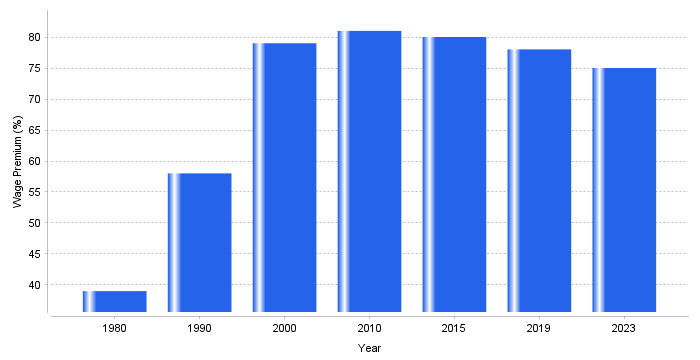
This dataset illustrates the 'Premium Plateau' described in the article. After doubling from roughly 40% in 1980 to nearly 80% in 2000, the wage advantage for college graduates flattened and has recently declined to 75% as of roughly 2023. This confirms the structural shift where the financial edge of a degree is no longer widening but compressing.
| Year | Wage Premium (%) (Percent Advantage (College vs. HS Wages)) |
|---|---|
| 1980 | 39.00 |
| 1990 | 58.00 |
| 2000 | 79.00 |
| 2010 | 81.00 |
| 2015 | 80.00 |
| 2019 | 78.00 |
| 2023 | 75.00 |
Source: Federal Reserve Bank of San Francisco — The College Wage Premium (1980–2023)
THE NUMBERS
- 3.5% vs. 3.3%: The year-over-year growth in wages for service occupations versus management and professional roles, respectively, for the period ending December 2025 [1].
- Flat since 2015: While the premium grew rapidly in the 80s and 90s, foundational research from the Federal Reserve Bank of San Francisco indicates the gap has been statistically stagnant for roughly a decade [2].
- 3.6%: The overall wage growth tracking figure for January 2026, which has cooled significantly, showing that degree-heavy sectors are no longer immune to gravity [3].
WHY NOW?
Two massive forces are colliding. First, the labor market is saturated with degree-holders. In 2000, about 31% of the workforce had a bachelor's degree; by early 2025, that figure hit 45% [2]. The scarcity value of the credential has simply evaporated.
Second, the "Paper Ceiling" is tearing. Major employers are systematically removing degree requirements for roles that never truly needed them. This isn't just a temporary post-pandemic blip; it is a structural change in hiring philosophy. According to Gartner's 2026 Future of Work report, we are seeing a "Tech-to-Trades" blossoming, where skilled trade work — immune to AI automation — is commanding premium pay growth while entry-level white-collar wages stagnate [4].
WHAT'S INTERESTING OR UNUSUAL
The twist is that technology, which used to be the graduate's best friend, is now becoming a frenemy. For thirty years, technological change was "skill-biased," meaning it specifically helped educated workers earn more. Now, that dynamic is fading. The San Francisco Fed notes a slowdown in this skill-biased change, suggesting that digital tools have become so accessible that they no longer confer a massive wage advantage solely to the college-educated [2]. At the same time, the roles seeing the fastest current acceleration — service and trades — are those least likely to be replaced by the current generation of AI [4].

WHO IT AFFECTS
- Students & Families: The ROI calculation for expensive private universities is changing. The automatic income boost is no longer guaranteed to outpace debt service.
- Employers: Companies clinging to strict degree requirements are paying a premium for talent that doesn't necessarily perform better, while competitors adopt skills-first hiring.
- Non-Graduates: This group is seeing the strongest relative leverage in decades as the "wage floor" rises faster than the "wage ceiling."
HISTORICAL CONTEXT
In 1980, a college graduate earned roughly 40% more than a high school graduate. By 2000, that advantage had exploded to nearly 80% [2]. That rapid ascent created the cultural imperative to "go to college at all costs."
Today's data shows we have shifted from an era of expansion to an era of compression. The premium hasn't disappeared — grads still earn more on average — but the gap is no longer widening. In fact, following the Great Recession, the premium actually dipped slightly before flattening out, a trend that accelerated through the mid-2020s [2].
WHAT THIS MIGHT MEAN
Expect a rise in "hybrid" career paths. Gartner predicts a surge in apprenticeship programs for digital workers transitioning into skilled trades [4]. We may also see the "college premium" replaced by a "skill premium," where specific, verifiable capabilities (like specialized data literacy or trade certification) drive earnings more than the general credential of a bachelor's degree.







Comments (2)
Leave a Comment