


1. What Happened
If you need a new commuter car, a massive shift in the auto market has just rewritten the math in your favor. For the first time ever, a three-year-old used electric vehicle is now significantly cheaper than an equivalent used gas-powered car.
A typical household buying a used EV this month will save an average of $4,300 upfront compared to buying a traditional combustion-engine vehicle. When you factor in the money you will not be spending on gasoline and oil changes, the average driver pockets an additional $1,200 in annual operating savings over the first year.
This is a wallet shock in reverse: a major asset class has rapidly depreciated, creating a windfall for anyone willing to plug in rather than pump gas.
Used Car Market Averages $27,453 as EVs Reach Parity
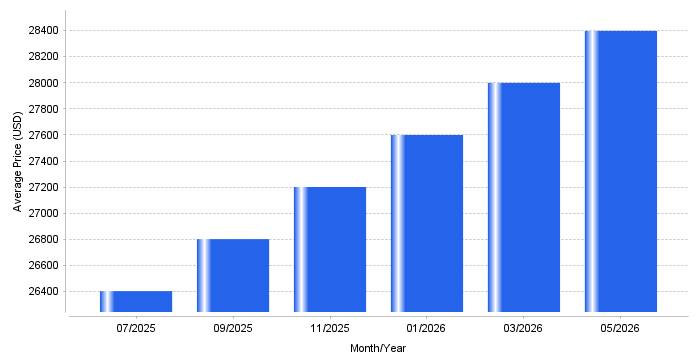
The data reflects the broader CarGurus used car price index trends, showcasing overall market pricing extending into early 2026. While the article notes used EVs have dropped to an average of $26,839, the overall index shows average used car prices hovering around $27,453 and projecting upward. This highlights the historic convergence of EV and ICE vehicle pricing in the secondary market, indicating that the extreme depreciation curve may be finding a permanent floor.
| Month/Year | Average Price (USD) (USD (Thousands)) |
|---|---|
| 2025-07 | 26400.00 |
| 2025-09 | 26800.00 |
| 2025-11 | 27200.00 |
| 2026-01 | 27600.00 |
| 2026-03 | 28000.00 |
| 2026-05 | 28400.00 |
Source: CarGurus — CarGurus Used Car Price Index Projections
2. The Numbers
The underlying figures of this historic price crossover are stark:
- The Big Drop: The average price of a used EV currently sits at $26,839, marking a staggering 20 percent drop year-over-year [3].
- The Gas Premium: The broader Bureau of Labor Statistics Consumer Price Index for all used cars and trucks has cooled by only 5 percent, keeping the average used gas car near $31,000 [1].
- The Rebate Kicker: As of early 2024, the IRS allows buyers to apply a $4,000 used EV tax credit directly at the dealership point of sale [4]. If you buy an eligible used EV priced under $25,000, that brings your net cost down to roughly $21,000.
- The Depreciation Engine: Foundational research from the National Bureau of Economic Research shows secondary market pricing for EVs is disproportionately driven by early-adopter range anxiety, driving depreciation curves steeper than traditional mechanical wear warrants [2].
3. Why Now
This was not a slow, organic shift; it was a sudden pile-up of unique market forces that all hit over the last 12 to 18 months. First, Tesla aggressively slashed prices of its new vehicles. Because Tesla dominates the market, these cuts immediately cratered the resale value of used Teslas, dragging the entire secondary EV market down.
Second, the corporate rental car market blinked. Giants like Hertz recently flooded the wholesale market with thousands of lightly used EVs, causing a temporary oversupply at the exact moment that higher interest rates were broadly cooling consumer demand for auto loans.
Finally, we are hitting the end of the initial three-year lease cycles from the pandemic EV boom of 2021. Dealership lots are suddenly overflowing with three-year-old electric vehicles coming off-lease, creating a perfect buyer's market where supply dramatically outstrips current demand.
4. What Is Interesting or Unusual
What makes this dynamic completely counterintuitive is how it flips the established green premium on its head. For the past decade, financial advisors and economists warned that transitioning to green energy required a significant upfront wealth hurdle. You had to be wealthy enough to afford the $60,000 electric vehicle to enjoy the cheap operational costs of electricity over gasoline.
Today, the exact opposite is true in the used market. The electric vehicle has suddenly become the ultimate budget commuter car. The premium you used to pay for a large lithium-ion battery has morphed into a deep discount. This means lower-income and middle-income buyers can now access the cheapest cost-per-mile transportation available in the country without having to pay a luxury sticker price at the dealership.
5. Who It Affects
- Benefiting: Budget-conscious commuters, parents buying a safe vehicle for a teen driver, and households looking for an inexpensive second car for local errands or city driving.
- Hurt: Early EV adopters who purchased vehicles at the peak of the market in 2022. Many of these owners are now underwater, owing significantly more on their auto loans than the vehicles are actually worth.
- Should Pay Attention: Anyone currently shopping for a used hybrid. Used hybrids are commanding massive price premiums right now due to high consumer demand, meaning you might pay thousands more for a hybrid than a fully electric equivalent.

6. Historical Context
In mid-2022, a used EV cost an average of $53,000, a massive $15,000 premium over the average used gas car. Dealerships were marking up used Teslas and Ford Mustang Mach-Es above their original retail prices simply because buyers could not wait for new inventory.
The fact that electric vehicle prices have fallen from a $15,000 premium to a $4,300 discount represents nearly a $20,000 swing in asset value relative to the rest of the auto market in just two years. It is one of the fastest price corrections in the history of the modern automotive industry, completely wiping out the historical average where electric cars stubbornly held their luxury pricing status.
7. What This Might Mean
Looking ahead over the next 3 to 12 months, this massive gap is likely to stabilize, meaning the current window for maximum savings will not remain open indefinitely. As more buyers realize how cheap used EVs have become, consumer demand will eventually clear out the surplus wholesale inventory, creating a firmer price floor.
Furthermore, because the $4,000 federal tax credit only applies to used EVs priced at $25,000 or below, dealerships will increasingly cluster their pricing right at that $24,999 mark. We will likely see a permanent shelf in the market where perfectly good electric vehicles hover just below the tax credit threshold. For everyday consumers, this means the extreme depreciation curve will likely flatten out by late next year.
8. What You Can Do About It
If you want to take advantage of this unprecedented pricing mismatch, here are four concrete steps you can take this month:
- Filter for the $25,000 Threshold: When searching online vehicle inventories, cap your maximum price filter at $24,999. This ensures the cars you look at are eligible for the IRS point-of-sale credit [4].
- Verify Dealer IRS Registration: The $4,000 federal tax credit can only be applied as an instant point-of-sale rebate if the dealership is officially registered with the IRS Energy Credits Online portal. Call the dealer before you visit to confirm they can process the credit immediately.
- Target Three-Year-Old Leases: Search specifically for 2021 or 2022 model years. These cars are fresh off corporate leases, meaning they typically have lower mileage, single owners, and often still carry the remainder of the federally mandated battery warranty.
- Check Your Utility Company Perks: Before finalizing a purchase, check if your local power utility offers specific time-of-use rates or rebates for installing a home charger. Many utility providers offer an additional $500 to $1,000 rebate simply for registering an EV at your home address.







Comments (1)
Leave a Comment