



WHAT HAPPENED
If you only glanced at the headline numbers for the January 2026 jobs report, the U.S. economy looks surprisingly durable. Employers added 130,000 jobs, and the unemployment rate held steady at a respectable 4.3% [1]. On paper, this suggests a "soft landing" is still very much in play. But dig just one layer deeper, and a starker reality emerges: the American labor market is currently flying on a single engine.
That engine is healthcare. While technology, finance, and manufacturing sectors are tapping the brakes or shedding workers, the healthcare sector is hiring at a breakneck pace. In fact, without the massive influx of nurses, aides, and medical administrators, the January jobs report would have looked drastically different—potentially signaling a contraction rather than growth.
This isn't just a monthly blip; it is the culmination of a structural shift where the "care economy" has decoupled from the rest of the business cycle, creating a two-track labor market where your job security depends entirely on which industry you work in.
Healthcare Added 82k Jobs in Jan 2026; Sector Exceeded Total US Net Growth in Late 2025
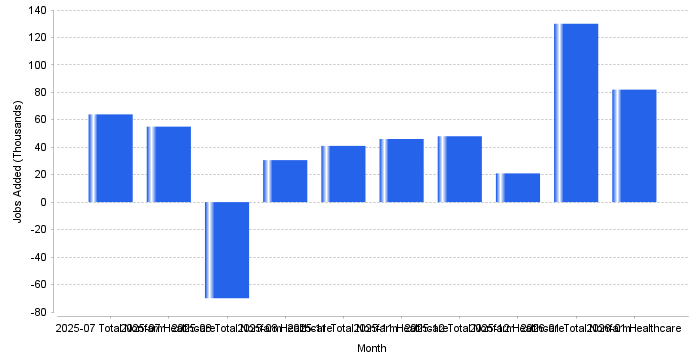
This dataset highlights the 'One-Engine' phenomenon described in the article. While the total nonfarm payroll numbers (blue) fluctuated wildly—even turning negative in August 2025—the healthcare sector (red) provided a consistent floor of job creation. In months like August and November 2025, healthcare job gains actually exceeded the net total for the entire economy, proving that without this sector, the U.S. labor market would have been in contraction.
| Month | Jobs Added (Thousands) (Jobs Added (Thousands)) |
|---|---|
| 2025-07 Total Nonfarm | 64.00 |
| 2025-07 Healthcare | 55.00 |
| 2025-08 Total Nonfarm | -70.00 |
| 2025-08 Healthcare | 30.60 |
| 2025-11 Total Nonfarm | 41.00 |
| 2025-11 Healthcare | 46.00 |
| 2025-12 Total Nonfarm | 48.00 |
| 2025-12 Healthcare | 21.00 |
| 2026-01 Total Nonfarm | 130.00 |
| 2026-01 Healthcare | 82.00 |
Source: U.S. Bureau of Labor Statistics — Monthly Job Growth: Total Nonfarm vs. Healthcare Sector (July 2025 – January 2026)
THE NUMBERS
- 130,000: Total nonfarm payroll jobs added in January 2026 [1].
- 82,000: Jobs added specifically by the healthcare sector in January [2].
- 63%: The portion of all new jobs created in January that came from healthcare providers [2].
- 108,435: The number of job cuts announced by U.S. employers in January, the highest January total since 2009, driven by tech and transportation [3].
WHY NOW?
Two powerful forces are colliding to create this lopsided market. First, the "post-COVID" normalization is finally hitting cyclical industries. During the pandemic recovery, every sector scrambled to re-hire. Now, high interest rates and cooling demand are forcing industries like finance and manufacturing to trim fat. For example, the financial activities sector actually lost 22,000 jobs in January [1], and companies like UPS and Amazon contributed to a surge in layoff announcements [3].
Second, demographics are destiny. Foundational research from the National Bureau of Economic Research (NBER) highlights that healthcare employment has grown more than twice as fast as the general labor force since 1980 [4]. This trend is accelerating as the Baby Boomer generation enters their highest-need years for medical services. Unlike a tech startup or a factory, healthcare demand is largely immune to interest rate hikes—people need care regardless of what the Federal Reserve does.
WHAT'S INTERESTING OR UNUSUAL
The twist here is the sheer magnitude of the divergence. Typically, a healthy economy sees broad-based hiring—construction, retail, and business services usually move somewhat in sync. In January, however, we saw a "masking" effect.
While the top-line number showed growth, sectors that usually signal economic vitality were flashing warning signs. The transportation sector, often a bellwether for consumer goods demand, saw significant cuts [3]. Meanwhile, temporary help services—often a leading indicator for future permanent hiring—remained weak [1]. The economy effectively swapped high-paid consultants and logistics workers for nurses and medical assistants. This creates a confusing signal for investors: the labor market looks tight, but many workers feel like they are in a recession.

WHO IT AFFECTS
- Workers: Job security is now highly sector-specific. Professionals in finance, tech, and logistics face the highest layoff risk since 2009 [3], while healthcare workers enjoy unprecedented bargaining power.
- Investors: The "recession" might be hiding in plain sight. If you strip out healthcare, the private sector is barely growing, which could impact earnings in cyclical stocks.
- Businesses: Companies outside of healthcare may find wage pressure easing as the talent pool deepens, but they are also facing softer demand.
HISTORICAL CONTEXT
To understand the severity of the layoff announcements, we have to look back to the Great Financial Crisis. The 108,435 job cuts announced in January 2026 represent the highest total for the month of January since 2009 [3].
However, the healthcare resilience is also historical. During the 2001 and 2008 recessions, healthcare was one of the few sectors that continued to add jobs while others collapsed. The difference today is that healthcare isn't just surviving a downturn; it is mathematically carrying the headline growth numbers, masking weakness elsewhere to a degree we haven't seen in typical expansion cycles [4].
WHAT THIS MIGHT MEAN
First, the Federal Reserve faces a tricky path. With headline unemployment at a low 4.3% [1], they may feel pressure to keep rates steady, even though cyclical sectors are clearly hurting. They can't easily cut rates to help manufacturing without potentially fueling inflation in the service sector.
Second, we may be settling into a "rolling adjustment" economy. Rather than a dramatic crash, we could see a slow-motion rotation where white-collar and industrial reliance fades, and the U.S. economy becomes increasingly service- and care-oriented. For the next few quarters, watch the "ex-healthcare" job numbers—that is where the real story of the economy's health will be told.








Comments (2)
Leave a Comment