


If you are one of the millions of Americans diligently stuffing money into a Health Savings Account (HSA) this year, you might be making a $20,000 mistake by doing absolutely nothing.
New data released this week suggests that while Americans are saving record amounts for healthcare, the vast majority are treating their most powerful investment vehicle like a glorified checking account. This passive approach is creating a massive "wealth gap" between the few who invest their HSA funds and the many who leave them in cash—a decision that could cost the average household roughly $420 a year in lost growth on current balances, and significantly more over a lifetime.
1. WHAT HAPPENED
According to the latest Participant Pulse report from Bank of America, released in late February 2026, the average HSA balance has climbed to a record $5,600, up from $5,030 at the end of 2024 [1]. This 11% jump signals that workers are taking rising healthcare costs seriously and maxing out their contributions.
However, the same report reveals a glaring disconnect: Only 15% of accountholders are investing their funds for future growth [1]. The remaining 85% are leaving their balances in cash, earning negligible interest rates that likely lag behind medical inflation. By failing to toggle their accounts from "save" to "invest," typical account holders are effectively paying a penalty of inaction, missing out on hundreds of dollars in tax-free compounded returns this year alone.
Wealth Gap Widens: Invested HSAs Hit Record $22,635 vs. Cash Peers
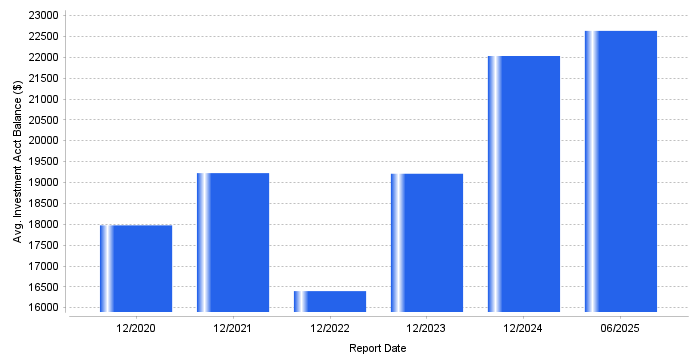
This dataset tracks the average total balance (deposits + investments) for HSA accountholders who invest, directly supporting the article's claim of a $20,000+ 'wealth gap.' While the article notes the average cash-only balance is just $2,469, this data shows that investors have successfully ridden market volatility to reach a record $22,635 average balance in 2025—nearly 9 times the size of non-invested accounts.
| Report Date | Avg. Investment Acct Balance ($) (USD) |
|---|---|
| 2020-12 | 17975.00 |
| 2021-12 | 19224.00 |
| 2022-12 | 16397.00 |
| 2023-12 | 19212.00 |
| 2024-12 | 22032.00 |
| 2025-06 | 22635.00 |
Source: Devenir Research — Average Total Balance of HSA Investment Accounts (2020-2025)
2. THE NUMBERS
- $5,600: The average HSA balance as of early 2026, a record high [1].
- 15% vs. 85%: The split between "investors" (who buy mutual funds or stocks within their HSA) and "savers" (who leave funds in cash) [1].
- $20,166: The staggering wealth gap created by this behavior. Research from Devenir shows that the average invested HSA balance sits at roughly $22,635, while the average funded deposit-only (cash) balance is just $2,469 [2].
- $4,400: The new self-only contribution limit for 2026, up $100 from last year [3]. For families, the limit is now $8,750.
What this means for you: If you hold the average balance of $5,600 in a standard cash account yielding 0.5%, you earn about $28 this year. If that same money were invested in a diversified fund earning a conservative 7.5%, you would gain $420. That is a $392 difference in a single year—enough to cover a minor ER copay or several prescriptions.
3. WHY NOW?
This divergence is widening right now because IRS contribution limits just increased for 2026, allowing savers to sock away more money than ever—up to $8,750 for families [3]. At the same time, 401(k) balances surged 13% in 2025 due to strong market performance [1], making the stagnant cash returns in HSAs feel even more punishing by comparison.
Additionally, medical inflation continues to outpace general inflation. Paying for 2035 healthcare prices with 2026 cash dollars that haven't grown is a losing mathematical proposition. The "gap" is becoming visible now because balances have finally grown large enough ($5,600 avg) where the lost investment returns are no longer trivial.
4. WHAT'S INTERESTING OR UNUSUAL
The twist here is that the HSA is technically the most tax-efficient account in the U.S. tax code, offering a "triple tax advantage" (tax-free in, tax-free growth, tax-free out for medical). Mathematically, it should be the first account you invest, even before a 401(k) match in some cases.
Yet, behavioral data shows people treat it exactly the opposite. While 401(k) plans often "auto-invest" your money into Target Date Funds, HSAs typically "auto-cash" your contributions. Unless you actively log in and click "invest," your money sits idle. It is a user-interface trap that separates the "super savers" from the "pass-through" users [4].

5. WHO IT AFFECTS
- The Winners: "Shoebox Savers." These are the 15% who pay current medical bills out-of-pocket, leave their HSA funds invested, and save the receipts (in a shoebox or digital folder) to reimburse themselves years later, letting the money grow tax-free [1].
- The Losers: "Pass-Through" Users. The 72% of users who treat the HSA like a debit card, contributing funds only to spend them immediately on current expenses, gaining zero investment leverage [1].
- The Sleeping Giants: Anyone with a balance over $2,000. Most HSA providers require a minimum cash threshold (often $1,000 or $2,000) before allowing investment. If you have crossed this line but haven't acted, you are voluntarily taking a 0% real return.
6. HISTORICAL CONTEXT
When HSAs were introduced in 2003, they were pitched as a solution to high deductibles, not a retirement vehicle. For a decade, balances were too low to matter. But we have crossed a threshold. The average investment balance ($22,635) has grown to nearly 9 times the size of the average cash balance ($2,469) [2]. This gap didn't exist 15 years ago; it is a modern inequality driven entirely by one checkbox setting.
7. WHAT THIS MIGHT MEAN
If this trend holds, we will see a bifurcated retirement reality in the next 3-12 months and beyond. One group will have a six-figure tax-free "health 401(k)" to pay for Medicare premiums, while the other will have a depleted savings account that lost purchasing power to inflation. As 2026 contribution limits kick in, the cost of being in the "cash" group is rising by the day.
8. WHAT YOU CAN DO ABOUT IT
Don't let the "default" setting drain your future purchasing power. Take these specific steps this month:
- Check your "Investment Threshold": Log into your HSA provider (e.g., Optum, Fidelity, HSA Bank) and look for a setting called "Investment Threshold" or "Auto-Sweep." Set it to the minimum allowed (usually $1,000 or $2,000). Any dollar above this amount will automatically move into investments.
- Pick a Boring Fund: You don't need to be a stock picker. Choose a broad index fund (like an S&P 500 equivalent) or a Target Date Fund if available. The goal is to beat medical inflation, not beat Wall Street.
- Stop Swiping the Card: If you can afford a $50 pharmacy bill out of your checking account, do it. Leave the $50 in the HSA to grow. Treat the HSA debit card as a last resort, not a first option.




Comments (1)
Leave a Comment