



WHAT HAPPENED
If you live in the Midwest and opened your home insurance renewal notice this month, you likely experienced a distinct moment of sticker shock. While national attention often focuses on hurricane-ravaged Florida or wildfire-prone California, a quieter financial storm has made landfall in the heartland. As of February 24, 2026, Allstate implemented a rate increase for approximately 250,000 Illinois homeowners, raising premiums by an average of roughly 14% [1].
This isn't an isolated bump. It follows a massive 27% rate hike by State Farm in the same region, which added approximately $746 to the average customer's annual bill [2]. These abrupt increases signal a major shift in how insurers price risk for "safe" neighborhoods. The driver isn't a single catastrophic event, but a relentless accumulation of what the industry calls "severe convective storms"—a technical term for the thunderstorms and baseball-sized hail that are becoming the most expensive weather threat to your wallet.
For the typical homeowner, this means the "safe" geography discount is dead. Insurers are no longer subsidizing the Midwest with profits from the coasts; instead, they are passing through the raw costs of roof replacements directly to you, dollar for dollar.
U.S. hail & storm losses top $50B for 3rd straight year
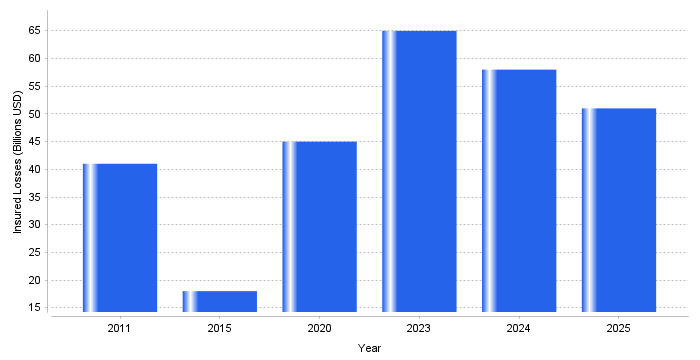
This dataset confirms the "Hail Tax" phenomenon: severe convective storms (thunderstorms, hail, tornadoes) have shifted from secondary risks to primary loss drivers. After a relatively calm 2015, losses spiked in 2020 and have surged since 2023, maintaining a "new normal" above $50 billion annually. This sustained high loss volume explains why insurers are aggressively raising premiums in the Midwest to cover these escalating payouts.
| Year | Insured Losses (Billions USD) (Billions of USD) |
|---|---|
| 2011 | 41.00 |
| 2015 | 18.00 |
| 2020 | 45.00 |
| 2023 | 65.00 |
| 2024 | 58.00 |
| 2025 | 51.00 |
Source: Gallagher Re — U.S. Insured Losses from Severe Convective Storms (SCS)
THE NUMBERS
- $746: The estimated annual increase for a typical Illinois homeowner under State Farm's recent 27% rate adjustment [2].
- 14%: The average rate increase Allstate implemented for Illinois customers effective February 24, 2026 [1].
- $42 Billion: Insured losses from severe convective storms (SCS) in the U.S. during the first nine months of 2025 alone, establishing a "new normal" for weather losses [3].
- 6.9%: The year-over-year increase in the "Tenants' and household insurance" index as of January 2026, according to the Bureau of Labor Statistics [4].
WHY NOW?
Why is your bill jumping in 2026? The answer lies in the plumbing of the global insurance market. Primary insurers (the companies you pay) buy their own insurance, known as reinsurance, to protect against bankruptcy. A landmark NBER study by researchers Benjamin Keys and Philip Mulder explains that the cost of this reinsurance has effectively doubled in recent years due to climate risks [5].
Crucially, the researchers found that insurers are increasingly passing these costs straight through to homeowners. In the past, a bad storm year might have been absorbed by the insurer's reserves. Today, because reinsurance is so expensive, insurers are rapidly repricing premiums to reflect the immediate cost of capital. The "hail tax" you are paying now is a direct pass-through of these global market shifts. The NBER paper notes that for every one standard deviation increase in disaster risk, premiums now rise significantly more than they did just five years ago [5].
WHAT'S INTERESTING
The twist here is the *type* of disaster driving the cost. We are conditioned to think of climate risk as rising sea levels or massive hurricanes. But "secondary perils"—frequency events like hail and wind—are now generating losses comparable to major hurricanes. In 2025, severe convective storms accounted for a staggering portion of global insured losses [3].
Unlike a hurricane that destroys a home completely, hail damages thousands of roofs just enough to require replacement. For insurers, a $20,000 roof replacement on 10,000 homes is just as financially devastating as a total loss on a smaller number of properties. Your premium spike isn't paying for a total rebuild; it's pre-paying for your next roof.
WHO IT AFFECTS

- The Losers: Homeowners in the Midwest (Illinois, Nebraska, Minnesota) and Plains states. Nebraska premiums, for instance, have doubled in the last decade and are now among the highest in the nation relative to home value [2].
- The Winners: Homeowners with "Class 4" impact-resistant roofs. These materials can withstand severe hail without cracking, qualifying owners for significant premium discounts (often 15-35%) [6].
- The Watch List: Anyone with a roof older than 10 years. Insurers are aggressively shifting these policies to "Actual Cash Value" (ACV), meaning they will only pay the depreciated value of your roof, not the replacement cost, leaving you with a massive bill if a storm hits.
HISTORICAL CONTEXT
For decades, homeowners insurance was a relatively stable, boring line item in the household budget, typically rising just enough to cover inflation. That era is over. The CPI data for January 2026 shows household insurance costs outpacing broader inflation metrics significantly [4]. We are seeing a structural reset similar to what happened to flood insurance a decade ago: risk pricing is becoming granular and immediate. The days of the $800 annual premium for a single-family home in the suburbs are likely gone forever.
WHAT THIS MIGHT MEAN
Looking ahead to the rest of 2026, expect insurers to tighten their belts further on *coverage* rather than just price. You will likely see more policies moving to mandatory 1% deductibles for wind and hail. This means if your home is insured for $400,000, your deductible for a hail claim isn't $1,000—it's $4,000. This effectively shifts the cost of smaller storms entirely onto the homeowner, turning insurance into catastrophic-only coverage for many.
WHAT YOU CAN DO ABOUT IT
Don't just auto-renew. Take these three specific steps this month to mitigate the hike:
- Check your "Wind/Hail Deductible": Look at your Declarations Page immediately. If your insurer switched you to a 1% or 2% deductible, you could be on the hook for thousands out of pocket. If you have a healthy emergency fund, voluntarily raising your standard deductible (e.g., from $1,000 to $2,500) can lower your premium, but ensure you understand the separate wind/hail rules.
- Ask about "Class 4" Roof Discounts: If you need a new roof, do not install standard asphalt shingles. Ask a roofer for "Class 4 Impact Resistant" shingles. Installing these can trigger an annual premium discount of 15% to 35% with many carriers [6]. Ask your agent specifically: "What is the discount amount for a UL 2218 Class 4 roof?"
- Verify your "Loss Settlement" terms: Call your agent and ask: "Is my roof covered for Replacement Cost or Actual Cash Value?" If you have an older roof and are switched to Actual Cash Value, you are effectively self-insuring for 50% or more of a roof replacement. If possible, pay the extra premium to keep Replacement Cost coverage—it is often worth more than the premium savings.








Comments (2)
Leave a Comment