



1. WHAT HAPPENED
For nearly three years, the American labor market was defined by the "Great Resignation"—a period of record-breaking turnover where workers quit in droves to chase higher pay and better perks. That era is officially history. In its place, a new, quieter dynamic has taken hold: the "Big Stay."
Recent data released this month confirms that the revolving door of the U.S. workforce has slowed to a crawl. Americans are no longer job-hopping with confidence; they are hunkering down. But in a surprising twist, employers aren't letting them go, either. The result is a labor market that isn't crashing, but rather freezing—a state of suspended animation that economists are calling a "low-hire, low-fire" equilibrium.
Quits Rate Plunges From 3.0% Peak to 2.0% Flatline in 'Big Stay' Era
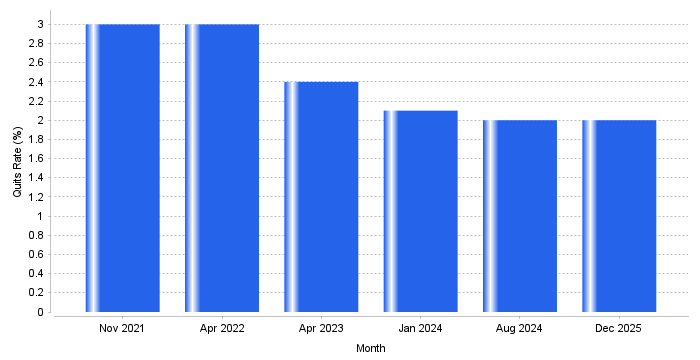
The data illustrates the complete reversal of the 'Great Resignation,' with the voluntary quits rate falling from a record high of 3.0% in late 2021 to a stagnant 2.0% by late 2025. This 2.0% rate has held steady through the end of 2025, confirming the article's 'low-hire, low-fire' thesis where worker mobility has frozen to pre-pandemic levels.
| Month | Quits Rate (%) (Percent of Total Employment) |
|---|---|
| Nov 2021 | 3.00 |
| Apr 2022 | 3.00 |
| Apr 2023 | 2.40 |
| Jan 2024 | 2.10 |
| Aug 2024 | 2.00 |
| Dec 2025 | 2.00 |
Source: U.S. Bureau of Labor Statistics (JOLTS) — U.S. Job Quits Rate (Seasonally Adjusted)
2. THE NUMBERS
The latest government data paints a clear picture of this deep freeze. According to the Bureau of Labor Statistics' JOLTS report released February 5, 2026:
- Quits Rate: Held steady at just 2.0% in December 2025, a figure that signals workers are staying put at rates comparable to pre-pandemic norms [1].
- Job Openings: Dropped to 6.5 million, the lowest level since 2017 (excluding the pandemic shock). This is a dramatic decline from the peak of over 12 million in 2022 [1].
- Hiring Rate: Ticked down to 3.3%, reflecting employer caution [1].
- Layoffs: Remained historically low at just 1.1% (1.8 million total), showing that businesses are hoarding talent rather than shedding it [1].
3. WHY NOW?
Why has the music stopped? According to researchers at the Federal Reserve Bank of San Francisco, we are witnessing a "joint slowdown" where both the supply of workers and the demand for them have cooled in tandem [2].
Through mid-2025, labor force growth decelerated due to shifts in immigration and participation, while businesses simultaneously tapped the brakes on expansion [2]. This wasn't an abrupt crash caused by a single shock, but a gradual synchronization. As economic uncertainty—fueled by tariff discussions and global volatility—persisted through late 2025, companies adopted a defensive crouch. They aren't confident enough to hire aggressively, but they are too scarred by the post-pandemic labor shortages to fire existing staff [3].
4. WHAT'S INTERESTING OR UNUSUAL
The twist here is the absence of pain usually associated with a cooling market. Typically, when job openings plummet and hiring slows, unemployment spikes and layoffs surge. That isn't happening yet.
Instead, we are seeing a "strategic hibernation." Indeed Hiring Lab describes this as a "low-hire, low-fire" environment [3]. The labor market has bent without breaking. Employers are effectively hoarding labor—keeping workers on payroll even if growth slows—because the cost and trauma of recruiting replacement talent in the recent past is still fresh in their minds. It creates a weirdly stable but stagnant environment where job security is high, but upward mobility is low.

5. WHO IT AFFECTS
- Job Seekers: They face the toughest challenge. With hiring rates at multi-year lows and openings down 386,000 in December alone, breaking into a new role is significantly harder than it was a year ago [1].
- Employers: Retention is suddenly easier. The "loyalty tax" is back; companies no longer need to offer massive sign-on bonuses to keep staff from poaching competitors.
- Consumers: The "job-hopper pay bump" has evaporated. Without the leverage to quit for a 10-20% raise, wage growth is likely to moderate, which curbs spending power but also cools inflation.
6. HISTORICAL CONTEXT
To understand the scale of this reversal, look back to the peak of the Great Resignation in 2021-2022. At that time, the quits rate soared as high as 3.0%, and there were two job openings for every unemployed person. Today, that ratio has collapsed, and the quits rate has flatlined at 2.0%—a level last seen consistently before the pandemic [1].
Furthermore, job openings have fallen by nearly 50% from their 2022 peak [3]. We have effectively unwound the entire post-pandemic overheating period and returned to a 2017-style labor market, but with higher prices and interest rates.
7. WHAT THIS MIGHT MEAN
First, wage growth will likely stabilize. With fewer workers quitting for better offers, the pressure on companies to aggressively raise pay diminishes. This is the "final mile" the Federal Reserve has been waiting for to ensure inflation stays tamed [2].
Second, productivity could become the new focus. Since companies aren't hiring, growth in 2026 will have to come from getting more out of existing teams. Expect a pivot from "headcount growth" to "efficiency" and tech integration.
Finally, this "freeze" is fragile. As Indeed notes, while layoffs are low, the buffer is thin. If demand drops further, the "low-fire" dynamic could snap, turning a freeze into a traditional downturn [3]. For now, though, stability is the name of the game.






Comments (1)
Leave a Comment