



WHAT HAPPENED
For decades, a high credit score was the gold standard of financial health—a reliable signal that a borrower would pay their bills on time. That signal has become distorted. A confusing new rift has opened in the American economy: Consumer credit scores remain near historic highs, yet borrowers are defaulting on credit cards and auto loans at rates not seen since the Great Financial Crisis. Lenders who trusted these elevated scores are now discovering that many "prime" borrowers were never quite as financially solid as they looked on paper.
This phenomenon, described by researchers as a form of credit score "grade inflation," suggests that the metrics banks use to gauge risk broke down during the pandemic and haven't fully recovered. As a result, financial institutions are sitting on a pile of debt held by borrowers who look safe statistically but are actually struggling to keep up with the post-inflation cost of living.
Credit Card Debt Surges 66% Since 2021 to Record $1.28 Trillion
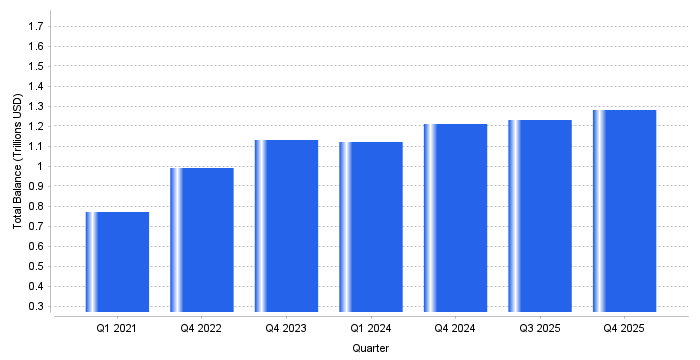
This dataset illustrates the massive accumulation of unsecured debt described in the article as the 'pile of debt' underlying the grade inflation trap. While credit scores rose artificially during the pandemic, credit card balances exploded from a low of $0.77 trillion in early 2021 to a record $1.28 trillion by late 2025. This trend supports the claim that 'prime' borrowers are becoming increasingly leveraged, creating the fragility that is now leading to unexpected defaults among high-scoring consumers.
| Quarter | Total Balance (Trillions USD) (Trillions of USD) |
|---|---|
| 2021-Q1 | 0.77 |
| 2022-Q4 | 0.99 |
| 2023-Q4 | 1.13 |
| 2024-Q1 | 1.12 |
| 2024-Q4 | 1.21 |
| 2025-Q3 | 1.23 |
| 2025-Q4 | 1.28 |
Source: Federal Reserve Bank of New York — Total U.S. Household Credit Card Debt (2021–2025)
THE NUMBERS
- 4.8%: The percentage of outstanding household debt in some stage of delinquency as of Q4 2025, a noticeable jump from the previous quarter [1].
- $1.28 trillion: Total U.S. credit card balances reached this record high in late 2025, rising by $44 billion in just three months [2].
- 12 points: The median credit score jumped from 719 to 731 in just two years during the pandemic—a leap that typically takes five years of economic expansion to achieve [3].
- 5.7%: The share of consumers with at least one account 60+ days past due as of December 2025, which remains elevated above pre-pandemic norms [4].
WHY NOW?
The roots of this confusion lie in the unique economics of the pandemic years (2020–2022). Government stimulus checks, forbearance programs (like the pause on student loan payments), and reduced spending opportunities allowed millions of Americans to pay down debt and pad their savings. As a result, credit scores skyrocketed artificially fast [3].
When the economy reopened, lenders used these inflated scores to extend credit, assuming the new scores reflected permanent financial improvements. However, as inflation took hold and savings dried up over the last 12 months, the artificial supports fell away. The borrowers looked the same on paper—still sporting those higher scores—but their actual ability to absorb financial shocks had weakened significantly.
WHAT'S INTERESTING OR UNUSUAL
The twist is that credit scores briefly lost their predictive power. Researchers at the Philadelphia Fed found that the "informativeness" of credit scores—their ability to accurately predict who will default—dropped during the pandemic and again in mid-2022 for certain borrowers [3].
Usually, a credit score of 720 implies a very specific, low risk of default. But recently, borrowers with "prime" scores have been defaulting at rates historically associated with lower-tier borrowers. Data from 2025 showed that serious delinquencies were rising even among "Superprime" and "Prime" consumers—groups that are typically immune to this kind of stress [5]. It turns out that a 720 credit score built on stimulus cash behaves very differently than a 720 score built on long-term wage growth.

WHO IT AFFECTS
- Lenders: Banks and card issuers are seeing losses on loans they thought were safe, prompting them to tighten lending standards even for applicants with good scores [1].
- Middle-Class Borrowers: Consumers who legitimately have good credit may find it harder to get approved or face higher interest rates as banks try to compensate for the "phantom" risk in the system.
- Retailers: As "prime" borrowers pull back to manage debt service, big-ticket discretionary spending (electronics, furniture) could soften further.
HISTORICAL CONTEXT
The speed of the recent credit score rise has no modern parallel. The median score rose 12 points in two years (2020–2022). In the pre-pandemic era, such an improvement was a slow grind, taking five full years to achieve [3]. Furthermore, the distribution of scores "compressed," meaning the gap between the 20th and 50th percentile of borrowers shrank to its smallest level since the year 2000 [3]. This compression made risky borrowers look nearly identical to safe ones, blinding models to the underlying danger.
WHAT THIS MIGHT MEAN
First, expect a "credit box" squeeze. Lenders will likely stop relying solely on FICO or VantageScore numbers and start asking for more proof of stability, such as cash flow data or larger down payments. Second, we may see a persistent divergence where the labor market remains strong—unemployment is a low 4.3% [6]—but loan defaults rise anyway, decoupling employment data from credit performance. Finally, this "grade inflation" unwinding suggests that consumer spending power might be more fragile than headline income data suggests, as households prioritize debt service over new purchases.





Comments (1)
Leave a Comment