



The Default Trap and the 2026 Cash Surge
Think back to the ritual of starting a new job. Human resources hands you a benefits packet, you log into the retirement portal, and you are immediately faced with an overwhelming list of mutual funds. To avoid the stress of picking individual investments, you select the default option with the year closest to your 65th birthday. You set your contribution rate, close the browser, and likely never think about it again. This is the financial reality for millions of Americans who trust that the system has their best interests mapped out.
This year, the stakes of that hands-off mindset just got much higher. The Internal Revenue Service recently announced that the maximum 401(k) contribution limit for 2026 has been increased to $24,500 [1]. As workers log in to automate their new, higher contributions, the vast majority will let their money flow straight into a Target-Date Fund. According to the Bureau of Labor Statistics, 70 percent of private industry workers currently have access to defined contribution plans, and these default funds have become the undisputed primary engine for capturing that wealth, holding trillions in American retirement savings [2].
But setting your investments on autopilot is masking a deeply flawed structural assumption in how these funds operate. If you funnel this year's $24,500 maximum into a standard target-date fund designed for a younger or middle-aged worker, you are likely putting 90 percent of that money into equities. If a standard 20 percent market correction hits, that aggressive exposure triggers a sudden $4,900 drop in your portfolio value.
For a high-net-worth investor, a $4,900 paper loss is a temporary nuisance easily weathered with other cash reserves. But for the typical middle-class household, this loss carries a hidden, counterintuitive danger. Target-date funds are built on a specific mathematical assumption about how you earn a living that does not actually apply to the modern American worker. Because of this structural mismatch, that $4,900 portfolio drop is mathematically programmed to strike at the exact moment your employer is most likely to freeze your wages or eliminate your job entirely.
The Structural Mechanism: When Your Paycheck Acts Like a Stock
To understand why your retirement account might be accidentally betraying your wallet, we have to look at the invisible architecture of the target-date fund. These funds were originally designed as a brilliant behavioral finance hack to prevent workers from hoarding their 401(k) money in zero-yield cash. They operate on what the financial industry calls a glidepath. The mechanism is simple: the fund starts heavily weighted in high-risk, high-reward stocks when you are young, and it slowly glides into safe, low-yield bonds as you approach retirement age.
The financial theory justifying this aggressive early start relies on a concept called human capital, which is essentially the present value of all the wages you will earn over the rest of your working life. Wall Street models have traditionally treated a young worker's human capital like a rock-solid, risk-free government bond. The logic dictates that because you have this massive, ultra-safe bond paying you a steady dividend every two weeks in the form of a paycheck, your investment portfolio should take maximum risk in the stock market to balance out your total wealth.
But a groundbreaking March 2026 working paper from the National Bureau of Economic Research completely dismantles this one-size-fits-all assumption [3]. The researchers analyzed the life-cycle portfolio choices of workers and found that for many middle- and lower-income Americans, human capital is not bond-like at all. Instead, their labor earnings growth is highly correlated with stock market returns. When the broader market thrives, their wages grow. But when the market crashes, their industry pulls back, hours are cut, and layoffs surge across the board.
In plain English, your paycheck behaves exactly like a stock. By defaulting you into a target-date fund that is heavily concentrated in equities, the financial industry is forcing you to double down on the exact same economic vulnerability. You might think your 401(k) is perfectly diversified across thousands of global companies, but from a total-life perspective, you are highly leveraged to a single, fragile economic outcome. When a recession inevitably hits, your stock-like paycheck and your stock-heavy portfolio will plummet in unison.
This double-exposure risk is not just a theoretical academic concern; it is already forcing workers to make painful, wealth-destroying choices in the real economy. When the market dips and job security falters, workers without alternative safety nets are forced to raid their retirement accounts to keep the lights on, selling their assets at the absolute bottom of the market and incurring steep tax penalties. The data proves this out. In recent years, economic strain has pushed an increasing number of Americans to break the glass on their nest eggs. According to recent reporting, a record 6 percent of participants in Vanguard-managed retirement plans were forced to take hardship withdrawals in a single year, up significantly from previous baselines [4]. These workers are locking in permanent market losses precisely because their portfolio and their paycheck were hit by the same macroeconomic storm.

The financial industry is slowly waking up to this systemic failure. A 2026 retirement trends report from BlackRock acknowledges that the 401(k) system must evolve from an accumulation-focused, generic plan into a more individualized, risk-managed portfolio system [5]. The era of treating every worker's career risk as identical is coming to an end. But until the industry fully redesigns the default options, the burden of fixing this glidepath illusion falls squarely on your shoulders.
401(k) Hardship Withdrawals Hit Record 6.0% in 2025
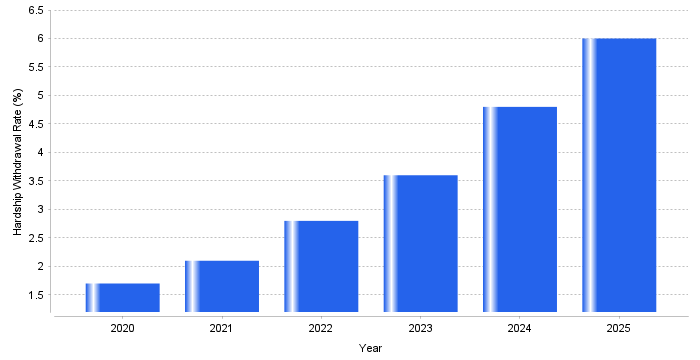
Vanguard data shows a continuous, six-year increase in the percentage of 401(k) participants taking hardship withdrawals, escalating from a pandemic-era low of 1.7% in 2020 to a record 6.0% in 2025. This trend underscores mounting financial pressure on middle-class households, illustrating that economic shocks are forcing workers to raid their retirement funds at the exact moments their equity-heavy portfolios are most vulnerable. To counteract this dual exposure, workers must audit their career volatility and build robust, market-immune emergency cash reserves.
| Year | Hardship Withdrawal Rate (%) (Percent of Vanguard 401(k) Participants) |
|---|---|
| 2020 | 1.70 |
| 2021 | 2.10 |
| 2022 | 2.80 |
| 2023 | 3.60 |
| 2024 | 4.80 |
| 2025 | 6.00 |
Source: Vanguard 'How America Saves' Report — Vanguard 401(k) Hardship Withdrawal Rates (2020-2025)
Customizing Your Glidepath for the Modern Economy
The target-date fund is not an inherently bad product, but treating it as a universal, hands-off solution is a risk you can no longer afford. As the modern workforce faces increasing economic volatility, your retirement savings must be actively managed to complement your specific career risk, rather than compound it. You can take immediate control of this dynamic with a few strategic moves this month.
- Audit your career volatility. If you work in a highly cyclical industry like technology, construction, manufacturing, or real estate, your job security is directly tied to the stock market. To counteract this, consider manually shifting 10 to 15 percent of your 401(k) contributions out of the target-date fund and into a stable value fund or a core bond index. You are artificially creating the bond safety inside your portfolio that your paycheck lacks in the real world.
- Fortify your anti-correlation cash reserve. If your 401(k) is heavily invested in equities, your emergency fund must be utterly immune to market drops. Keep three to six months of living expenses in a high-yield savings account or Treasury bills so you never have to sell your 401(k) assets at a loss if you experience a layoff.
- Optimize your strategy for the new 2026 limits. If you have the cash flow, take full advantage of the newly increased $24,500 contribution limit [1]. However, if you are over 50 and earn more than $150,000, remember that new IRS rules force your $8,000 catch-up contributions into after-tax Roth accounts [6]. Plan your household budget accordingly, as this will slightly reduce your immediate take-home pay.







Comments (1)
Leave a Comment