

1. WHAT HAPPENED
You download a popular coffee chain's app, load $25 from your checking account to get a free pastry, and completely forget about the remaining $18. Or you clean out a desk drawer and find a restaurant gift card you received two holidays ago. It seems like a harmless oversight, but multiply those forgotten balances across the entire economy, and it represents a staggering, invisible drain on consumer wallets.
Consumers are currently sitting on an average of $244 per person in unused gift cards and prepaid digital balances. What feels like a minor personal inconvenience is actually a massive, highly engineered wealth transfer. While millions of households struggle with the rising cost of living and take on expensive credit card debt to make ends meet, they are simultaneously providing billions of dollars in interest-free loans to retail and restaurant corporations. By pre-loading cash into apps and letting it sit, everyday people are actively losing purchasing power while boosting corporate bottom lines.
Corporate Windfall: Starbucks Pocketed $222.4M from Unused App Balances in 2025
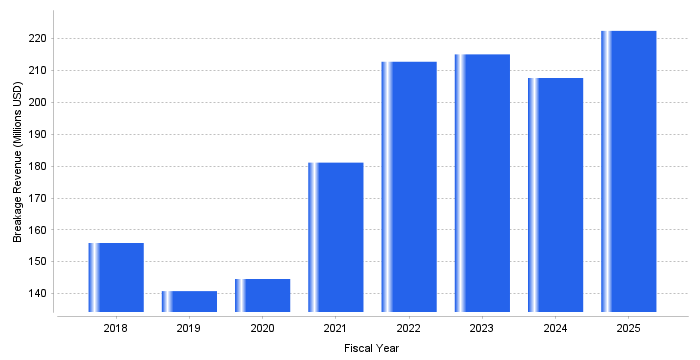
The article highlights how unredeemed prepaid balances act as a massive wealth transfer from consumers to corporations. This dataset from Starbucks' annual SEC filings perfectly illustrates this corporate windfall, showing that the company's 'breakage' revenue—pure profit from forgotten gift cards and app balances—has steadily climbed, reaching $222.4 million in 2025. Over the last eight years, Starbucks alone has captured over $1.4 billion in these unspent funds. To protect your wallet, readers should follow the article's advice to disable auto-reload features and spend lingering app balances immediately.
| Fiscal Year | Breakage Revenue (Millions USD) (Millions of USD) |
|---|---|
| 2018 | 155.90 |
| 2019 | 140.80 |
| 2020 | 144.60 |
| 2021 | 181.10 |
| 2022 | 212.70 |
| 2023 | 215.00 |
| 2024 | 207.60 |
| 2025 | 222.40 |
Source: Starbucks Corporation SEC Form 10-K Filings — Starbucks Annual Breakage Revenue (Unredeemed Gift Card Balances)
2. THE NUMBERS
The scale of this unspent cash is massive, and it directly affects the typical household's balance sheet:
- $244: The average amount of unspent gift card and prepaid voucher value held by American adults today, representing a 30 percent increase from the $187 average recorded the previous year [1].
- 40 percent: The staggering share of prepaid restaurant and retail credit that goes entirely unredeemed by consumers [2].
- 3.2 percent: The annualized growth rate of consumer credit borrowing in the first quarter of 2026, with revolving credit like credit cards growing even faster at 3.8 percent [3].
- $488: What this trend costs a typical two-adult household in trapped liquidity. Translating these macro numbers to a standard family, that is nearly $500 of dead money that could otherwise be used to cover half a month of groceries or pay down high-interest debt.
3. WHY NOW?
Over the last 24 months, the retail industry has quietly shifted away from physical plastic gift cards and toward digital Pay Now, Buy Later ecosystems. Companies have built these payment portals directly into the mobile apps you use every day. To incentivize you to pre-load money, they offer aggressive upfront bonuses, such as giving you an extra $5 reward for loading $50 into your digital wallet.
Behavioral economics refers to this phenomenon as mental accounting. Once your money moves from your primary checking account to a specific brand's mobile app, your brain categorizes that money as already spent. Because the psychological pain of parting with the money has already occurred, you feel less urgency to actually go out and consume the goods you paid for. The friction of opening the app, remembering your balance, and redeeming it is just high enough that millions of people simply delay the purchase indefinitely.
4. WHAT'S INTERESTING OR UNUSUAL
The biggest twist in this modern retail strategy is that what looks and feels like a generous consumer perk is actually a highly profitable corporate mechanism. In the accounting world, the money consumers forget to spend is referred to as breakage. Because businesses do not have to provide any actual food, coffee, or merchandise in exchange for breakage, it is booked as nearly pure profit.
A recent National Bureau of Economic Research study analyzed millions of prepaid transactions to uncover the true economics of this trend. The researchers found that because consumer underutilization is so high, the median business earns roughly $5.50 in pure breakage profit for every $1 they give away in upfront bonus credits [2]. You might think you are outsmarting the system by snagging a reload bonus, but the mathematics of human forgetfulness ensure that the house almost always wins.
5. WHO IT AFFECTS
- Winners: Corporate retailers and chain restaurants. They receive an estimated $23 billion in interest-free capital from their own customers, allowing them to pad their earnings without selling a single actual product.
- Losers: Millennials. Recent survey data shows this demographic currently holds the highest average unused balances, carrying $332 per person in unspent digital and physical gift cards [1].
- Pay Attention: Anyone who uses auto-reload features on transit apps, coffee apps, or digital wallets. If you have your settings configured to automatically pull cash from your bank whenever your app balance drops below a certain threshold, you are highly susceptible to trapping your own money.

6. HISTORICAL CONTEXT
In a low-inflation, low-interest-rate environment, letting a $25 gift card sit in a drawer for two years was not a severe financial penalty. However, the economic landscape has changed dramatically. The Bureau of Labor Statistics reported in April 2026 that the Consumer Price Index rose 3.3 percent over the previous 12 months [4].
This means that the $244 sitting idle in your various apps and drawers is actively losing its purchasing power every single month. Furthermore, with consumer credit card interest rates hovering at elevated levels, the opportunity cost of this trapped cash has never been higher. The last time consumer debt burdens were this heavily scrutinized, people were actively looking for spare change in their couches. Today, that spare change is locked behind digital passwords.
7. WHAT THIS MIGHT MEAN
As major corporations realize the massive profitability of breakage, expect consumer loyalty programs to fundamentally change in the coming months. Traditional points-per-purchase systems, where you earn a free item after buying ten, will likely be phased out and replaced by aggressive pre-load requirements.
If you want a discount on your daily routine purchases in the future, you will almost certainly be forced to front the company your cash first. We will likely see a surge in mandatory digital wallet ecosystems across fast food, hardware stores, and entertainment venues, all designed to secure your money before you have even decided what you want to buy.
8. WHAT YOU CAN DO ABOUT IT
- Audit your smartphone apps this week: Open the top five food, retail, and transit apps on your phone. Drain any lingering prepaid balances by using them for your planned purchases this month before you swipe your credit card again.
- Turn off auto-reload settings: Go into your account preferences and disable any feature that automatically pulls funds from your checking account or credit card. Only load the exact amount of money you need while you are standing in line.
- Sell your unwanted plastic: If you have physical gift cards to stores you never visit, use secondary market websites like Raise or CardCash. You will typically receive 70 to 80 cents on the dollar in cash, which is significantly better than letting inflation erode the balance to zero.
- Check your state's unclaimed property database: Go to MissingMoney.com to search your name. In many states, businesses are legally required to hand over the cash value of long-expired gift cards to the government, and you can claim those funds back for free.




Comments (2)
Leave a Comment