



1. WHAT HAPPENED
If you are agonizing over whether to sign another lease or stretch your budget to buy a house, the math right now looks incredibly one-sided. Across the top 50 U.S. metro areas, renting a starter home will currently save you an average of $920 every single month compared to buying the exact same property [1].
But a massive new 10-year wealth study has revealed a surprising twist: Even if you take that $920 monthly windfall, combine it with the cash you would have used for a down payment, and invest every penny in the stock market, you will likely still end up hundreds of thousands of dollars poorer than the person who bought the house [2].
Data Shows Renting Saves $920/Month, But Buying Builds More Wealth
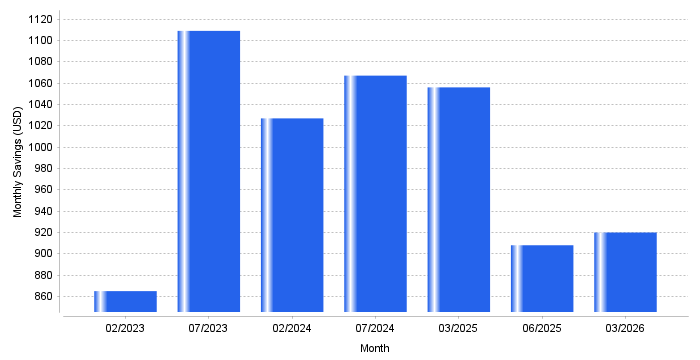
This dataset tracks the average monthly savings of renting a starter home instead of buying one across the 50 largest U.S. metros. While renting currently saves a typical household $920 per month, this short-term cash flow advantage often obscures the long-term reality of wealth accumulation. Renters who want to build wealth must diligently and automatically invest these monthly savings to counter the forced savings and leveraged asset appreciation enjoyed by homeowners.
| Month | Monthly Savings (USD) (USD) |
|---|---|
| 2023-02 | 865.00 |
| 2023-07 | 1109.00 |
| 2024-02 | 1027.00 |
| 2024-07 | 1067.00 |
| 2025-03 | 1056.00 |
| 2025-06 | 908.00 |
| 2026-03 | 920.00 |
Source: Realtor.com — Realtor.com Rent vs. Buy Monthly Savings
2. THE NUMBERS
According to the latest Realtor.com Rental Report released in April 2026, renting a starter home is now more affordable than buying one in all 50 of the largest U.S. metro areas [1]. Nationally, the median asking rent has fallen 1.5 percent over the last year to $1,669 per month, creating a $920 monthly cash flow advantage for a typical renting household [1].
However, an April 2026 study by AD Mortgage ran the numbers on a 10-year timeline to see what happens to that cash. The researchers pitted a typical homeowner against a perfect renter—someone who takes their entire hypothetical down payment, plus their monthly rent savings, and diligently invests it in the S&P 500 at a 10.35 percent annual return [2].
Even against this aggressive stock market investing strategy, homeownership still generated more net wealth over a decade in 199 out of the 250 largest U.S. cities analyzed [2]. For example, in markets like Miami, the projected 10-year wealth advantage for a homeowner topped $500,000 compared to the renter who invested their monthly savings [2].
3. WHY NOW?
This massive divergence between monthly affordability and long-term wealth building is the result of two colliding economic forces over the past 24 months. On the homeownership side, mortgage rates hovering near 6 percent combined with stubbornly elevated property prices have pushed the monthly cost of a new mortgage to painful heights for first-time buyers [2].
At the exact same time, the rental market is experiencing a historic influx of new supply. A multi-year boom in apartment construction has finally delivered millions of new units to the market, forcing landlords to compete for tenants. Data from the Federal Reserve Economic Data (FRED) system shows the Consumer Price Index for rent of primary residences softening steadily through March 2026 [3]. Because supply has finally caught up with demand in the rental sector, tenants have unprecedented pricing power, driving the monthly cost of renting down while the cost of buying remains locked at a premium.
4. WHAT'S INTERESTING OR UNUSUAL
The most counterintuitive part of this trend is how completely the monthly cash flow numbers obscure the true financial reality. It comes down to an economic framework known as the user cost of housing [4].
Foundational research from the Federal Reserve Bank of Richmond explains that a mortgage payment is not entirely a housing expense. A significant chunk of that monthly check goes toward paying down the loan's principal, which acts as an invisible, forced savings account [4].
Furthermore, homeowners benefit from the sheer power of leveraged appreciation. If you put 5 percent down on a $400,000 house, your wealth grows based on the appreciation of the entire $400,000 asset. A renter who puts that same 5 percent down payment into a stock index fund is only earning a return on their $20,000 cash. Even if the stock market outperforms the housing market on a percentage basis, the leveraged nature of real estate means the homeowner is building wealth off a much larger financial base [2].

5. WHO IT AFFECTS
- Renters who benefit: Residents in ultra-expensive coastal hubs like Los Angeles, San Jose, and San Francisco. In these specific, high-cost markets, the monthly cost of buying is so punishing that the rent-and-invest strategy actually beats homeownership over a 10-year horizon [2].
- Renters who are hurt: Accidental long-term renters who pocket their $920 monthly savings but allow it to bleed into lifestyle inflation—like nicer dinners or vacations—instead of aggressively investing it.
- Who should pay attention: Current homeowners feeling house-poor. While your monthly budget might feel tight today compared to your renting friends, you are quietly accumulating wealth at a dramatically faster pace behind the scenes.
6. HISTORICAL CONTEXT
Traditionally, buying a home was the cheaper option on a monthly basis, allowing families to lock in their housing costs against future inflation. Today, we are in an inverted market where you are essentially paid a monthly premium to not own a home [1]. However, historically, skipping homeownership has been disastrous for personal wealth building; data from the Urban Institute shows that the median homeowner currently holds nearly $390,000 more in total wealth than the typical renter [5].
7. WHAT THIS MIGHT MEAN
The old narrative that renting is throwing money away is completely dead on a month-to-month basis, but it remains remarkably true for long-term net worth. Over the next 12 months, as rents stay flat and landlords offer concessions, the temptation to delay buying will grow stronger for many young professionals. However, waiting indefinitely for mortgage rates to drop significantly means missing out on the early equity accumulation phase, effectively trading long-term financial security for short-term cash comfort.
8. WHAT YOU CAN DO ABOUT IT
- Automate your rent savings: If you are renting primarily to save money, calculate the exact difference between your current rent and a hypothetical mortgage in your area. Set up an automatic monthly transfer of that exact amount from your checking account to a brokerage account to ensure you are actually capturing the wealth-building benefit of renting.
- Run your local breakeven horizon: Use the free Rent vs. Buy Calculator on Realtor.com to see the exact timeline for your specific zip code. As a general rule, if your timeline to stay in a home is under five years, renting almost mathematically always wins due to the high closing costs of buying.
- Check for tenant-equity programs: A growing number of real estate funds and property managers are rolling out renter wealth models. If you are apartment hunting, ask leasing offices if they participate in programs that offer cash-back rewards or fractional property equity for renters who pay on time [6].







Comments (1)
Leave a Comment