


1. WHAT HAPPENED
While the broader U.S. labor market is showing signs of a pulse again, a massive and unprecedented contraction is taking place in one specific sector: the federal government. The latest jobs report released in February 2026 reveals that while the private sector—led by healthcare and construction—is hiring, the federal workforce is shrinking at a rate rarely seen outside of demobilization after a major war.
Total nonfarm payrolls rose by a respectable 130,000 in January, pushing the unemployment rate down to 4.3% [1]. However, hidden beneath that headline number is a stark decline in public sector employment. This isn't just a hiring freeze; it is a structural shedding of headcount driven by a unique policy experiment that has quietly removed hundreds of thousands of workers from the federal payroll over the last year.
Federal Payrolls Plunge: Workforce Shrinks by 327,000 Since Oct 2024 Peak
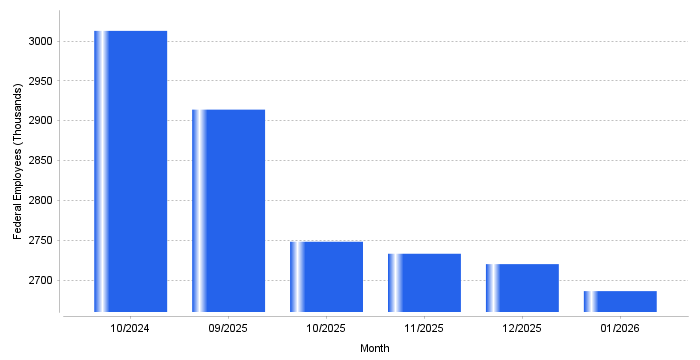
The dataset illustrates the historic contraction in federal employment described in the article. From a peak of 3.01 million workers in October 2024, the federal headcount dropped to 2.69 million by January 2026, with a sharp acceleration in workforce shedding observed in late 2025 due to the Deferred Resignation Program. This structural decline creates a drag on headline job numbers, masking underlying growth in the private sector.
| Month | Federal Employees (Thousands) (Thousands of Persons (Seasonally Adjusted)) |
|---|---|
| 2024-10 | 3013.00 |
| 2025-09 | 2914.00 |
| 2025-10 | 2748.00 |
| 2025-11 | 2733.00 |
| 2025-12 | 2720.00 |
| 2026-01 | 2686.00 |
Source: Federal Reserve Bank of St. Louis (FRED); U.S. Bureau of Labor Statistics — All Employees, Federal Government (CES9091000001)
2. THE NUMBERS
- -34,000 jobs: The net decline in federal government employment in January 2026 alone [1].
- -327,000 jobs: The total reduction in the federal workforce since its peak in October 2024, representing a drop of roughly 10.9% [1].
- 154,000 buyouts: The estimated number of federal employees who accepted the "Deferred Resignation Program" (DRP) to leave government service voluntarily [2].
- +130,000 vs. +181,000: The U.S. economy added 130,000 jobs in January 2026, a strong start compared to the revised total of just 181,000 jobs added for the entirety of 2025 [1].
3. WHY NOW?
The acceleration in federal job losses is the direct result of the "Deferred Resignation Program" (DRP), often referred to internally as the "Fork in the Road" memo. Initiated in early 2025, this program offered federal employees a deal: resign voluntarily in exchange for full pay and benefits through September 30, 2025 (or later for retirees), without the requirement to report to the office [2].
According to the Government Accountability Office (GAO), roughly 144,000 to 154,000 employees accepted this off-ramp [2]. As these deferred resignation dates hit their deadlines between late 2025 and early 2026, these workers are officially falling off the payrolls. Simultaneously, strict hiring freezes have prevented agencies from backfilling these roles, turning natural attrition and voluntary exits into a net reduction in workforce size [3].
4. WHAT'S INTERESTING OR UNUSUAL
The "twist" here is the mechanism. Governments typically shrink through attrition (not replacing retirees) or hard layoffs (Reductions in Force). This shift was engineered through a "soft" purge designed to bypass the slow, litigious process of firing civil servants. By incentivizing voluntary departures, the administration achieved a rapid downsizing that mimics private sector restructuring—specifically resembling strategies used in the tech sector [3].
Furthermore, research from the Brookings Institution highlights a critical divergence: while the headcount is dropping, the budget savings may lag due to the upfront costs of paying people not to work for several months. The true economic impact is a "hollow out" effect, where agencies lose institutional memory faster than they can automate processes, creating a unique test of whether the federal government can maintain service levels with 11% fewer hands on deck [3].

5. WHO IT AFFECTS
- Businesses: Government contractors may see delays in payments or contract processing due to reduced staffing in procurement offices. Conversely, private firms are actively recruiting the "brain drain" of skilled technical workers leaving federal service.
- Workers: Remaining federal employees face increased workloads as teams shrink. However, the private sector labor market remains tepid, with 2025 being the weakest year for hiring since 2003 (excluding recession years) [4].
- Consumers: Americans may experience slower service delivery for passports, permits, and benefit processing as the "capacity shock" of losing 327,000 workers sets in [3].
6. HISTORICAL CONTEXT
To find a comparable contraction in federal employment, one generally has to look back to post-war demobilizations. For context, the federal workforce has historically remained relatively flat or grown slightly over the last decade. The current drop of nearly 330,000 employees in roughly 15 months is a statistical outlier [1].
Foundational economic research suggests that fiscal contractions (cutting government wage bills) can sometimes stimulate private investment by reducing anticipated tax burdens, but they also create an immediate drag on aggregate demand [5]. The current shift is testing this theory in real-time, as the public sector shrinks while the private sector attempts to regain momentum after a sluggish 2025.
7. WHAT THIS MIGHT MEAN
First, the "efficiency experiment" is now live. Proponents argue this slimdown will force modernization and AI adoption, while skeptics warn of impending service failures in critical agencies like the FDA or FAA. The coming months will reveal if the government can do the same amount of work with over 10% fewer people.
Second, this shift distorts the headline jobs numbers. While the private sector is recovering (adding 130k jobs in January), the federal drag masks the true strength of business hiring. Investors watching the Fed should note that without the government shedding jobs, the labor market would look significantly hotter, potentially influencing interest rate decisions.






Comments (2)
Leave a Comment