



1. WHAT HAPPENED
For years, the prevailing economic narrative suggested that the youngest adults—Gen Z—were the most financially precarious, prone to "doom spending" and living paycheck to paycheck. However, a startling reversal has appeared in early 2026 data. While inflation and high interest rates have squeezed everyone, the youngest adults are managing to build a cash buffer that is leaving their older counterparts behind.
New data released this February reveals that Gen Zers (ages 18-29) are now significantly more likely to have a healthy savings cushion than Millennials (ages 30-45). While Millennials are increasingly sliding into a "debt trap" where credit balances exceed their emergency funds, Gen Z is flipping the script, prioritizing liquidity over leverage in a way that defies their income levels.
35% of Millennials have more card debt than savings, compared to just 19% of Gen Z
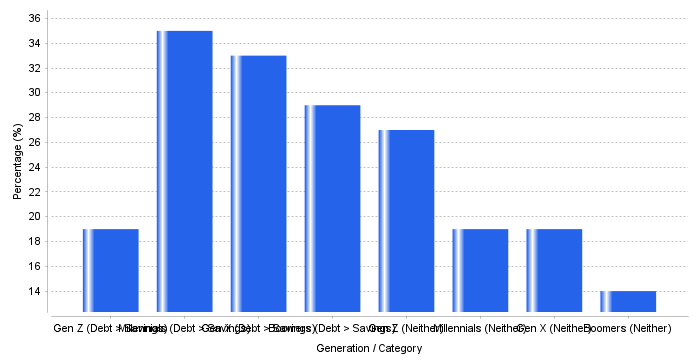
This February 2026 dataset from Bankrate confirms the 'Solvency Flip' described in the article. It shows that Millennials are currently the generation most likely to be 'underwater,' with 35% holding more credit card debt than emergency savings—nearly double the rate of Gen Z (19%). Meanwhile, the data supports the 'opting out' theory: Gen Z is the most likely group to have neither debt nor savings (27%), suggesting they are avoiding the credit system entirely rather than leveraging it.
| Generation / Category | Percentage (%) (Percent of Generation) |
|---|---|
| Gen Z (Debt > Savings) | 19.00 |
| Millennials (Debt > Savings) | 35.00 |
| Gen X (Debt > Savings) | 33.00 |
| Boomers (Debt > Savings) | 29.00 |
| Gen Z (Neither) | 27.00 |
| Millennials (Neither) | 19.00 |
| Gen X (Neither) | 19.00 |
| Boomers (Neither) | 14.00 |
Source: Bankrate — Emergency Savings vs. Credit Card Debt by Generation (2026)
2. THE NUMBERS
The divergence between the two generations is measurable and widening, according to fresh reports from February 2026:
- The Savings Gap: 44% of Gen Zers now report having more emergency savings than credit card debt. In contrast, only 38% of Millennials can say the same [1].
- The Debt Trap: Millennials are now the generation most likely to be "underwater" on unsecured debt. Approximately 35% of Millennials have more credit card debt than emergency savings, compared to just 19% of Gen Z [1].
- Record Balances: This comes as total U.S. household debt hit a record $18.8 trillion in Q4 2025, with credit card balances jumping $44 billion to hit $1.28 trillion [2].
- Interest Pain: The average credit card interest rate stands at 19.59% as of late February 2026, making carrying a balance historically expensive [3].
3. WHY NOW?
Why are the youngest workers saving better than those with a decade more experience? The answer lies in the "sandwich" pressure cooker. Millennials are currently in the most expensive phase of life—often juggling childcare, mortgages, and aging parents simultaneously. The AICPA found that while Gen Z's top financial goals for 2026 are focused on milestones like buying a car (41%), Millennials are forced to play defense, with their primary focus shifting to paying down debt [4].
Additionally, the "financial trauma" of entering adulthood during a pandemic and high-inflation era appears to have radically altered Gen Z's risk tolerance. Rather than relying on cheap credit—which doesn't exist for them—they are hoarding cash. Bankrate analysts note that Gen Z is the group most likely to have neither debt nor savings (27%), suggesting a large cohort is simply opting out of the credit system entirely to avoid the trap [1].
4. WHAT'S INTERESTING OR UNUSUAL
The twist here is a structural mechanism called the "redistribution of rewards," which usually hurts younger, poorer borrowers. Foundational research has shown that credit card markets typically transfer wealth from "naive" users (who carry balances and pay interest) to "sophisticated" users (who pay in full and earn points) [5].
Logic dictates Gen Z should be the "naive" group losing this game. Instead, by avoiding credit card debt more effectively than Millennials, Gen Z is sidestepping this wealth transfer. It is the Millennials—often carrying high-limit premium cards but failing to pay them off due to lifestyle costs—who are inadvertently subsidizing the rewards ecosystem. Gen Z is effectively "hacking" the system by refusing to play.

5. WHO IT AFFECTS
- Retailers: Companies relying on credit-fueled consumption may see a pullback from younger shoppers who prefer debit or cash to avoid 19%+ interest rates.
- Millennials: This cohort faces a compounding wealth drag; servicing high-interest debt at 35 is far more damaging to long-term net worth than having low savings at 25.
- Banks: Lenders may see rising delinquency risk concentrate in the 30-45 demographic, forcing a rethink of risk models that traditionally favored older borrowers.
6. HISTORICAL CONTEXT
To understand the severity of this flip, look at the Boomers. Baby Boomers remain the gold standard for solvency, with 52% having more savings than debt [1]. Historically, financial stability correlates strictly with age—the older you are, the more stability you have.
Gen Z breaking this correlation and overtaking Millennials is an anomaly. Furthermore, the overall credit card delinquency rate has ticked up to roughly 4.8% of outstanding debt, the highest level since 2017 [2]. We are seeing a credit stress cycle that is skipping the youngest generation and landing squarely on the shoulders of those in their prime earning years.
7. WHAT THIS MIGHT MEAN
First, we may see a "credit cooling" among young consumers who view credit cards as traps rather than tools, potentially boosting the usage of "pay now" rails like real-time payments or debit. Second, the "Millennial Squeeze" could delay the housing market recovery; if Millennials are using their capital to service 20% APR credit card debt, they cannot accumulate down payments. Finally, banks might tighten lending standards for the 30-45 demographic, creating a credit crunch for the very group that drives the bulk of consumer spending.