



The Piggy Bank Raid
For decades, the golden rule of American retirement has been simple: set it and forget it. But a new stream of data suggests that millions of savers have stopped forgetting and started raiding. According to a new analysis of retirement plan behaviors, the number of workers taking "hardship withdrawals" from their 401(k)s hit a record high of 4.8% in 2024 and maintained elevated levels through late 2025 [1].
This isn't just about dipping into savings for a vacation. It is a structural shift in how households manage cash flow. Driven by persistent inflation and high interest rates, workers are treating their retirement funds less like a vault and more like a high-fee ATM. The immediate cost of this behavior is steep: A typical $10,000 hardship withdrawal can cost you roughly $3,800 immediately in taxes and penalties, leaving you with just $6,200 in cash to solve your emergency [2].
But the real wallet shock is the future cost. By pulling that $10,000 out at age 40, you aren't just losing the principal; you are erasing approximately $67,000 in future retirement wealth, assuming a standard market return over 20 years [2]. This trend—the "Revolving Door" retirement—threatens to undo the progress of the last decade's automatic enrollment boom.
401(k) Hardship Withdrawals Hit Record 4.8% in 2024, Nearly Tripling Since 2020
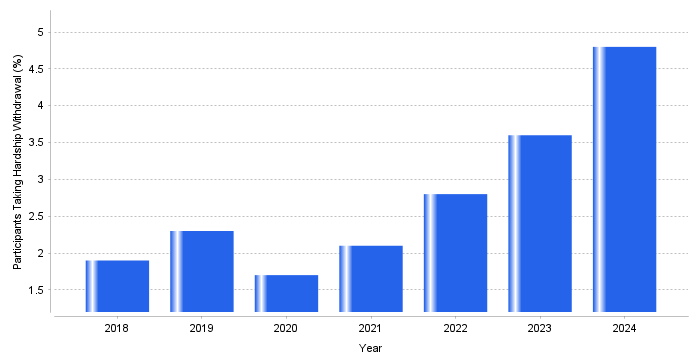
This dataset directly validates the article's claim of a 'structural shift' in retirement savings behavior, showing a clear upward trajectory from a low of 1.7% in 2020 to a record 4.8% in 2024. The data illustrates the 'Revolving Door' trap: while auto-enrollment has increased participation, inflation and economic pressure are forcing a growing segment of the workforce to immediately access those funds. To avoid this costly leakage, savers should prioritize building a separate liquid emergency fund before maximizing retirement contributions.
| Year | Participants Taking Hardship Withdrawal (%) (Percentage of Participants (%)) |
|---|---|
| 2018 | 1.90 |
| 2019 | 2.30 |
| 2020 | 1.70 |
| 2021 | 2.10 |
| 2022 | 2.80 |
| 2023 | 3.60 |
| 2024 | 4.80 |
Source: Vanguard (How America Saves 2025 Report) — Annual Hardship Withdrawal Rates (Vanguard Defined Contribution Plans)
THE NUMBERS
The data paints a picture of a workforce that is simultaneously saving more and struggling more.
- Record Leakage: Vanguard's data shows that 4.8% of participants initiated a hardship withdrawal in 2024, a significant jump from 3.6% in 2023 and more than double the rate seen prior to 2020 [1].
- The Cost of Cash: To put $10,000 of spendable cash in your pocket via a hardship withdrawal (assuming a 22% tax bracket and 10% penalty), you effectively have to withdraw over $15,000 from your balance [3].
- Stable Contributions: Despite these withdrawals, savings rates remain high. Vanguard found that 45% of participants actually increased their deferral rates last year, driven largely by automatic annual increases [1].
This creates a paradox: Account balances are rising due to auto-enrollment and market gains, but liquidity constraints are forcing a record number of people to break the glass on those savings immediately.
WHY NOW?
The surge in hardship withdrawals is the lagging indicator of the inflation spike that began years ago. While inflation rates have cooled, the cumulative price level of essentials—housing, insurance, and repairs—remains permanently higher. Vanguard's researchers note a specific correlation between natural disaster declarations and withdrawals, as homeowners tap funds to repair damage that insurance (which has seen premiums rise 24% over three years) may not fully cover [1] [4].
Furthermore, the mechanism of saving has changed. With 61% of plans now using automatic enrollment [1], more lower-income workers are participating in 401(k)s than ever before. These workers are statistically more likely to face liquidity shocks, meaning the system is successfully getting them to save, but their day-to-day cash flow forces them to pull it back out.
WHAT'S INTERESTING OR UNUSUAL
Conventional wisdom says that once someone raids their 401(k), they become discouraged and stop saving. However, new academic research challenges this "discouraged saver" narrative. A study by researchers at NBER and Vanguard found that retirement contributions are remarkably stable even after a loan or withdrawal [5].
This suggests a new behavioral pattern: The "Revolving Door." Workers are not abandoning retirement; they are cycling money through it. They contribute to get the employer match, then withdraw funds to pay bills, accepting the tax penalty as the cost of doing business. It is an expensive way to manage liquidity, but for many, it has become the only option.

WHO IT AFFECTS
- The Squeezed Gen X: This demographic faces the "sandwich" pressure of caring for aging parents and children while facing the highest cost-of-living increases. They have enough tenure to have a balance worth raiding, but not enough liquid cash to avoid it.
- The Auto-Enrolled Saver: Lower-income workers who were automatically opted into plans are benefiting from the match but are most prone to paying the 10% penalty tax to access that cash for emergencies.
- The "Wealthy" Hand-to-Mouth: Even households with healthy 401(k) balances are finding themselves "cash poor," resorting to hardship withdrawals rather than traditional loans because they fear locking themselves into monthly repayment obligations.
HISTORICAL CONTEXT
For most of the 2010s, hardship withdrawal rates hovered steadily around 2%. The jump to nearly 5% represents a structural break in trend [1]. The last time we saw significant pressure on retirement liquidity was during the Great Recession, but even then, the behavior was different. In 2008, people stopped contributing. Today, they keep contributing but keep withdrawing. We have effectively monetized our long-term stability to pay for short-term volatility.
WHAT THIS MIGHT MEAN
If this trend calcifies, we may see a bifurcation of the retirement system. One group will use 401(k)s as intended (long-term growth), while another group uses them as an inefficient, high-tax emergency fund. In the next 6 to 12 months, expect more employers to roll out "sidecar" emergency savings accounts (linked to payroll but accessible penalty-free) to stop this leakage. Until then, the IRS is collecting a windfall in early withdrawal penalties from households that can least afford it.
WHAT YOU CAN DO ABOUT IT
If you are facing a cash crunch, do not hit the "withdraw" button until you check these three alternatives.
- Check for the "Loan" Option First: A 401(k) loan is mathematically superior to a hardship withdrawal. You pay the interest back to yourself, not the bank, and you avoid the 10% penalty and immediate income taxes. Most plans allow you to borrow up to 50% of your vested balance (capped at $50,000) [6].
- Adjust Your Withholding Immediately: If you are over-contributing to get a tax break but then withdrawing that money for emergencies, you are losing money. Temporarily lower your 401(k) contribution to the minimum required to get your employer match (e.g., 4% or 5%). Redirect the difference into a high-yield savings account for liquid access.
- Investigate "In-Plan" Roth Conversions: Some plans allow you to access contributions (not earnings) from a Roth 401(k) penalty-free, or offer hardship provisions that are less punitive than full withdrawals. Check your plan's Summary Plan Description (SPD) specifically for "hardship" versus "loan" terms this week.