


1. WHAT HAPPENED
For the last three years, opening an auto insurance renewal envelope has felt like a punch to the gut. But a quiet shift in the data suggests the relentless price hikes have finally broken. After soaring 46% between 2022 and 2024, the national average cost of full-coverage car insurance actually fell 6% in 2025 [1].
This isn't just a slowing of inflation; it's a reversal. Insurers have moved from "panic mode" to "growth mode," creating a rare window of opportunity for drivers. However, because of how insurance pricing cycles work, you likely won't see these savings automatically. While the market average has dropped to $2,144 per year, loyal customers who stay put are essentially subsidizing the discounts being offered to new customers [1]. If you haven't comparison-shopped in the last six months, you are likely overpaying by hundreds of dollars.
Prices Pivot: Premiums Drop to $2,144 in 2025 After Hitting $2,329 in 2024
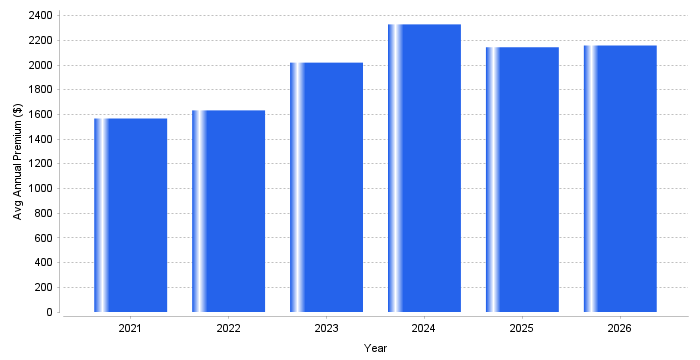
Data from Insurify confirms the 'Premium Pivot,' showing national average rates spiking from $1,633 in 2022 to a peak of $2,329 in mid-2024 before falling to $2,144 in 2025. This 2025 drop marks the first reversal after consecutive years of double-digit inflation. However, 2026 projections indicate the price war may be cooling, with rates expected to stabilize or slightly increase to $2,158.
| Year | Avg Annual Premium ($) (USD) |
|---|---|
| 2021 | 1567.00 |
| 2022 | 1633.00 |
| 2023 | 2019.00 |
| 2024 | 2329.00 |
| 2025 | 2144.00 |
| 2026 | 2158.00 |
Source: Insurify — Average Annual Full-Coverage Car Insurance Costs (2021-2026)
2. THE NUMBERS
- $2,144: The new national average annual cost for full-coverage auto insurance as of early 2026, down from the 2024 peak [1].
- -6%: The specific drop in average premiums nationwide throughout 2025 [1].
- 39 States: The number of states where average rates declined last year. Drivers in Wyoming, Iowa, and Arkansas saw prices plummet by more than 20% [2].
- $460+: The average amount a driver saves by switching insurers, according to data analysis by Consumer Reports [3].
What this means for you: A typical household with two cars could be leaving nearly $1,000 a year on the table by sticking with a policy priced during the "inflation panic" of 2023-2024. The market has repriced risk, but your current bill likely hasn't caught up.
3. WHY NOW?
Why would insurers cut prices when everything else still feels expensive? The answer lies in a concept industry insiders call "margin repair." During the post-pandemic years, insurers were losing money on every policy because repair costs and accident severity spiked faster than they could raise rates. They spent 2023 and 2024 aggressively hiking premiums to restore profitability [4].
By early 2025, that mission was accomplished. With their profit margins repaired, major carriers shifted strategies. They are now fighting a price war to win back customers. As Insurify's February 2026 report notes, "Insurers' margins are now high enough to absorb some costs without immediately raising prices," leading many to cut rates to attract new business [2].
4. WHAT'S INTERESTING OR UNUSUAL
Here is the twist: Car repairs aren't actually getting cheaper. The Consumer Price Index (CPI) shows that motor vehicle maintenance and repair costs were still rising at a clip of over 7% annually as of late 2025 [5].
Normally, rising repair costs push insurance premiums up. The fact that premiums are falling despite expensive repairs signals just how aggressive this competition for new customers has become. It creates a "Weird Gap" where the underlying cost of the service (fixing crashed cars) is rising, but the price of the product (the insurance policy) is falling—a temporary anomaly driven by the industry's hunger for market share.
5. WHO IT AFFECTS
- Winners: Drivers with clean records who shop around. The "new customer" discounts are back and bigger than before.
- Losers: The "Set It and Forget It" crowd. If you auto-renew, you are subject to what economists call "consumer inertia exploitation"—paying a higher rate simply because you haven't signaled you might leave [6].
- Watch Out: Drivers in New Jersey, New York, and Washington D.C. bucked the national trend, with rates still rising double-digits due to local litigation and density issues [1].
6. HISTORICAL CONTEXT
The insurance industry moves in distinct "hard" and "soft" cycles. We just exited a historically "hard" market—the toughest since the 1980s—where carriers tightened standards and raised prices regardless of your driving record. The last time we saw a pivot this sharp was following the 2008 recession, when reduced driving led to a period of flat or falling rates. However, the current drop (-6% in one year) is sharper than typical soft-market landings, indicating just how overpriced premiums had become by 2024 [4].
7. WHAT THIS MIGHT MEAN
Looking forward to the rest of 2026, this window of cheap rates may be short-lived. Analysts project rates to stabilize or tick up slightly (+1%) by year-end [2]. Furthermore, looming tariffs on imported auto parts could force repair costs even higher later this year, potentially ending the insurers' price war [1]. This suggests the next 3 to 6 months are the "sweet spot" to lock in a lower rate before external economic pressures force another correction.
8. WHAT YOU CAN DO ABOUT IT
1. Execute a "Rate Match" check (This Week)
Don't just browse. Go to a comparison tool or a competitor's site and get a quote for the exact same coverage you have now. If the new quote is lower, call your current insurer. Ask specifically: "I have a quote for $X less. Can you rewrite my policy to match current market rates?" Agents often have access to new "rating tiers" that aren't automatically applied to renewals.
2. The "500-to-1000" Swap (This Month)
If you have an emergency fund, check your collision deductible. Raising it from $500 to $1,000 can reduce your premium by 25% to 30% immediately [7]. In a falling rate environment, this multiplier effect is powerful. If you save $300 a year, the "risk" of the higher deductible pays for itself in under two years of accident-free driving.
3. Audit your "Telematics" comfort level
Usage-based insurance (apps that track your driving) is the fastest way to get a discount, but it comes with a "privacy tax." While carriers advertise savings of up to 40%, real-world data shows median savings are often closer to $120, and bad driving data can sometimes be used against you [3]. Only choose this if you are a genuinely low-mileage, cautious driver.