


1. WHAT HAPPENED
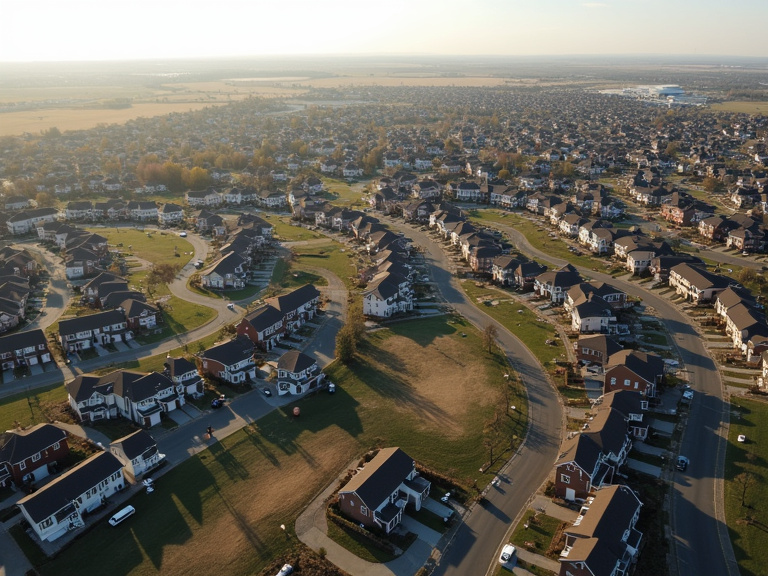
For millions of Americans, the appeal of a 30-year fixed-rate mortgage is the promise of predictability: your principal and interest payments never change. But a second, volatile monthly bill has quietly eroded that stability. According to new data released in January 2026, homeowners associations (HOAs) have become the dominant gatekeepers of American housing, and they are handing residents a massive, unexpected bill.
For the first time, data shows that nearly 3 million U.S. households are now paying over $500 per month—or $6,000 per year—in HOA or condo fees alone [1]. This isn't just for luxury high-rises; it is a structural shift in how American homes are built and maintained. With nearly 68% of all new construction now governed by an HOA, the era of the truly "independent" homeowner is effectively over [2]. For many, this fee has risen fast enough to effectively cancel out the benefit of a recent refinance or a raise.
HOA Dominance: Share of New Homes with Fees Hits 67% in 2023, Confirming Market Shift
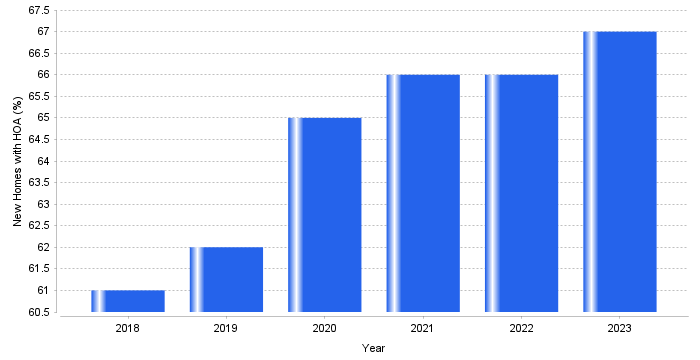
The article claims that the era of the independent homeowner is ending, with nearly 68% of new builds governed by HOAs. Official Census Bureau data confirms this structural shift, showing the percentage of new single-family homes sold with an HOA rising from 61% in 2018 to 67% in 2023. This trend validates the claim that buyers are increasingly forced into the 'fee-based' maintenance model, leaving them vulnerable to the rising costs described as a 'time bomb.'
| Year | New Homes with HOA (%) (Percent) |
|---|---|
| 2018 | 61.00 |
| 2019 | 62.00 |
| 2020 | 65.00 |
| 2021 | 66.00 |
| 2022 | 66.00 |
| 2023 | 67.00 |
Source: U.S. Census Bureau — Share of New U.S. Single-Family Homes Sold Within an HOA (2018-2023)
2. THE NUMBERS
- 67.9%: The share of new construction homes sold in the U.S. that now come with an HOA, compared to just 38.9% of existing homes. If you want a new house, you almost certainly have to join an association [2].
- $135 vs. $500+: While the national median monthly fee sits at $135, this number masks a steep bifurcation. In major metros and coastal areas, over 3 million households have crossed the $500/month threshold, effectively adding a "phantom mortgage" payment to their budget [1].
- 43.6%: The percentage of all homes for sale (new and old) that now require an HOA fee, up from 34.3% just six years ago [2].
What this means for you: If you are shopping for a home with a $2,500 mortgage budget, you may actually only have $2,000 in buying power once you factor in the average fee for a newer property. That $500 difference is roughly equivalent to $80,000 in mortgage principal at current rates.
3. WHY NOW?
Two distinct forces have collided in the last 12 months to spike these costs. First is the "Surfside Effect." Following the tragic collapse of the Champlain Towers South in Florida, new safety regulations (specifically Florida's SB 4-D and similar ripple-effect legislation elsewhere) have forced associations to stop kicking the can down the road. Associations that previously waived reserve contributions to keep monthly fees low are now legally required to fully fund their repair accounts by 2026 [3]. This has triggered catch-up assessments that can total tens of thousands of dollars per unit.
Second is the insurance crisis. Home insurance premium growth has slowed slightly to 8.5% in 2025, but that follows years of double-digit hikes [4]. Because HOAs must insure common structures (roofs, clubhouses, exteriors), they are passing these massive commercial policy hikes directly to you. Your personal policy might have gone up, but your share of the community policy went up, too.
4. WHAT'S INTERESTING OR UNUSUAL
The twist is that this inflation is happening while the assets themselves degrade. Foundational research from the National Bureau of Economic Research (NBER) highlights that housing naturally decays, and maintaining quality requires constant injection of capital [5]. Historically, single-family homeowners could defer maintenance—fixing a roof "next year" if cash was tight.
In an HOA, you lose that option. The board decides when the roof is fixed, and they send you the bill immediately. We are witnessing the "financialization of maintenance," where repair costs are no longer lumpy expenses you save for, but rigid monthly obligations that rise faster than inflation. The flexibility of homeownership is being replaced by the rigidity of a rental-like fee structure, even though you own the deed.

5. WHO IT AFFECTS
- New Construction Buyers (The Surprise Victims): You might think buying new means low maintenance costs. But with 67.9% of new builds in HOAs, you are signing up for a lifetime of rising fees starting day one [2].
- Fixed-Income Retirees (The Losers): Many seniors bought condos for the "low maintenance lifestyle." Now, mandatory reserve funding laws are forcing special assessments that can exceed their annual Social Security income.
- Cash Buyers (The Winners): Wealthier buyers who can afford homes in communities with "fully funded" reserves (defined as >70% funded) will see their property values hold, while underfunded communities face a death spiral of rising dues and falling prices.
6. HISTORICAL CONTEXT
In 2019, only about 34% of homes for sale came with an HOA fee. Today, that number is approaching half the market (43.6%) [2]. Historically, HOAs were associated with condos or exclusive golf communities. Today, they are the default municipal structure for average suburban expansion. Municipalities love them because the HOA pays for road maintenance and trash collection, saving the city money. The cost of infrastructure has effectively been shifted from the tax base (deductible) to the homeowner's monthly fee (mostly non-deductible).
7. WHAT THIS MIGHT MEAN
Expect a "tiered" real estate market to emerge in late 2026. Listings will start to be judged not just by price per square foot, but by the "Funded Ratio" of their HOA. Homes in associations with healthy reserves will command a premium, while those with low fees—historically seen as a bargain—will be viewed as ticking time bombs of future assessments. We may also see a rise in "HOA foreclosure" activity, where associations foreclose on fully-paid-off homes because the owners couldn't keep up with the rising monthly dues.
8. WHAT YOU CAN DO ABOUT IT
- Check the "Funded Ratio": Before buying into any community, demand the latest "Reserve Study." Look specifically for the "percent funded" figure. If it is below 70%, you are at high risk of a massive fee hike or special assessment in the near future.
- Ask for the "SIRS" Report: If you are in a coastal area or a building over 3 stories, ask if a Structural Integrity Reserve Study (SIRS) has been completed. If the seller says "no" or "we're working on it," walk away. The resulting bill could cost you $20,000+ immediately after closing.
- Budget for the "Phantom Mortgage": When calculating affordability, do not use the current HOA fee. Assume the fee will increase by 5-10% annually, not the standard 2% inflation rate. If the fee jumping to $600/month breaks your budget, the house is too expensive.
- Attend the Budget Meeting: If you already own, you can't just ignore the annual meeting. This is where the board decides whether to raise dues by $50 or $500. Your vote matters—specifically, vote against waiving reserve funding, which is just borrowing from your future self at a high cost.