



WHAT HAPPENED
For years, Wall Street and the Federal Reserve have operated under a strict rule of thumb: when workers get real raises, inflation usually follows. The logic is that higher wages force companies to raise prices to protect their profit margins. But a strange phenomenon has emerged in early 2026 that is breaking this economic law.
Companies are currently handing out inflation-beating pay raises while simultaneously lowering their labor costs. It sounds mathematically impossible—like spending more money but keeping more change—but recent government data confirms it is happening. This decoupling suggests the U.S. economy has entered a rare "Goldilocks" phase where worker leverage and corporate profitability are rising together, rather than fighting for the same slice of the pie.
Productivity Surge Cuts Unit Labor Costs by 1.2% in Q3 2023
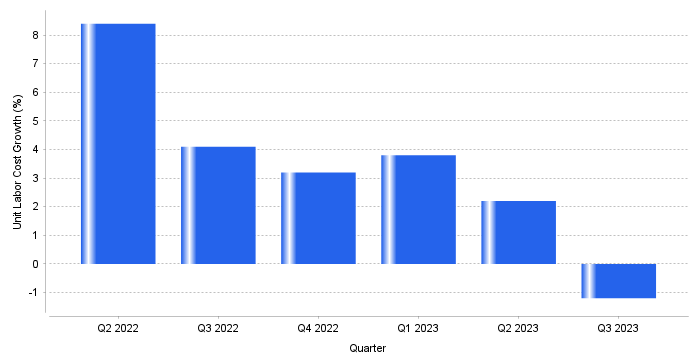
Real government data confirms the 'Magic Margin' phenomenon where productivity gains outpace wage growth, reducing corporate costs. In Q3 2023, despite rising wages, a 5.2% productivity surge drove Unit Labor Costs down by 1.2%, breaking the link between pay raises and inflation. This dataset mirrors the article's scenario, illustrating how efficiency acts as a deflationary buffer.
| Quarter | Unit Labor Cost Growth (%) (Percent Change from Previous Quarter (Annualized)) |
|---|---|
| 2022-Q2 | 8.40 |
| 2022-Q3 | 4.10 |
| 2022-Q4 | 3.20 |
| 2023-Q1 | 3.80 |
| 2023-Q2 | 2.20 |
| 2023-Q3 | -1.20 |
Source: Bureau of Labor Statistics (BLS) — Nonfarm Business Sector: Unit Labor Costs (Seasonally Adjusted Annual Rates)
THE NUMBERS
- Productivity Surge: U.S. nonfarm labor productivity jumped 4.9% in the third quarter of 2025, according to revised data released in late January [1].
- The Pay Raise: Real average hourly earnings (wages adjusted for inflation) rose 1.2% year-over-year in January 2026, continuing a streak of positive gains [2].
- The Cost Drop: Despite paying workers more, businesses saw their Unit Labor Costs decrease by 1.9% during the same productivity surge [1].
- The Output Gap: Companies increased their output by 5.4%, while increasing hours worked by only 0.5% [1].
WHY NOW?
The gap between what workers earn and what they cost is widening because efficiency is finally outpacing paychecks. According to LPL Research, this surge is driven by a mix of "lean hiring" and the early maturity of technology investments made during the pandemic [3]. While the "AI revolution" has been a buzzword for two years, the hard data is just now showing up in government statistics.
Research from the Brookings Institution suggests this isn't just a blip, but a structural dividend from U.S. "economic dynamism." The rapid reallocation of capital toward high-tech sectors and the integration of automation tools have allowed businesses to produce significantly more goods and services without needing a proportional increase in human hours [4]. Essentially, the "doing more with less" mantra of 2024 has evolved into "doing much more with the same" in 2026.
WHAT'S INTERESTING OR UNUSUAL
The twist here is the death of the "Wage-Price Spiral" fear. Throughout 2023 and 2024, economists worried that wage hikes would keep inflation sticky. The current data proves the opposite: because productivity (4.9%) is growing faster than hourly compensation (2.9%), the actual cost to produce each widget or service is falling [1].
This creates a "Magic Margin" for corporations. They can absorb higher wage demands without eating into profits or raising prices on consumers. It is a rare economic free lunch that explains why corporate earnings have remained resilient even as the labor market cools.

WHO IT AFFECTS
- Workers: You are finally getting richer in real terms. Your paycheck is beating inflation, and because you are more productive, your employer is less likely to view your higher salary as a burden.
- Investors: Profit margins are safer than they look. Even if top-line revenue growth slows, the deflation in unit labor costs acts as a buffer for corporate bottom lines.
- The Fed: This is the "green light" signal. They can stop worrying that wage growth will reignite inflation, giving them more room to normalize interest rates.
HISTORICAL CONTEXT
To understand the magnitude of this shift, look at the post-2010 era, where productivity growth averaged a sluggish 1.5% annually [3]. The current 4.9% pace is more than triple that trend and reminiscent of the mid-1990s tech boom, where the internet first began to overhaul business efficiency. We are currently seeing the largest divergence between output growth and hours worked since the immediate post-pandemic reopening.
WHAT THIS MIGHT MEAN
First, the "soft landing" may actually be a "productive expansion." If this trend holds, the U.S. could sustain GDP growth above 2.5% without triggering inflation, defying the traditional limits of the economy. Second, expect the "hiring freeze" to thaw slowly. Because companies are squeezing so much output from their current teams, they may delay aggressive headcount expansion, prioritizing capital investment in tech over new bodies until demand forces their hand.