



1. WHAT HAPPENED
For decades, the laws of the labor market were simple: when the economy cools, companies fire people. But in early 2026, the U.S. job market has entered a bizarre state of suspended animation that defies standard economic logic. We are witnessing a "frozen door" phenomenon where businesses have largely stopped hiring new talent, yet they are simultaneously refusing to let their current workers go.
This "low-hire, low-fire" dynamic has created a split-screen reality. If you have a job, you are statistically safer than you have been in years. If you are looking for one, however, you are facing the coldest market since the Great Recession. The front door is locked, but nobody is being pushed out the back.
Job Openings Plunge to 6.5 Million in Dec 2025, Locking the "Frozen Door"
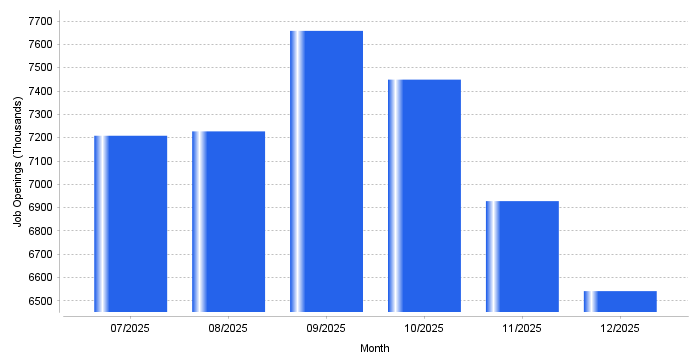
This dataset confirms the "Frozen Door" phenomenon described in the article. Job openings collapsed by over 1.1 million from September to December 2025, hitting a multi-year low of 6.5 million. Crucially, while demand for new workers plummeted, the article notes that layoffs remained flat at ~1.8 million (1.1% rate) during this same period, illustrating the "low-hire, low-fire" hoarding dynamic.
| Month | Job Openings (Thousands) (Thousands of Jobs) |
|---|---|
| 2025-07 | 7208.00 |
| 2025-08 | 7227.00 |
| 2025-09 | 7658.00 |
| 2025-10 | 7449.00 |
| 2025-11 | 6928.00 |
| 2025-12 | 6542.00 |
Source: U.S. Bureau of Labor Statistics (BLS) — JOLTS: Total Nonfarm Job Openings (Seasonally Adjusted)
2. THE NUMBERS
The latest data released in February 2026 paints a stark picture of this stagnation:
- Job Openings Plummet: According to the Bureau of Labor Statistics (BLS), job openings fell to 6.5 million in December 2025, the lowest level since 2017 (excluding the brief pandemic shock) [1].
- Layoffs at Rock Bottom: despite the drop in demand for new workers, the layoff rate held steady at just 1.1%—historically low territory. Companies let go of only 1.8 million workers in December, unchanged from the prior month [1].
- Initial Claims Defy Gravity: For the week ending February 14, 2026, initial jobless claims dropped unexpectedly to 206,000 [2]. This beats market expectations and signals that despite headline gloom, employers are clutching their existing staff tight.
- Hiring Stalls: The hiring rate remains depressed at 3.3%, hovering near levels not seen since 2013, a time when the economy was still limping out of a major recession [1].
3. WHY NOW?
Why are companies keeping workers they don't seem to need enough to expand? The answer lies in the trauma of the post-pandemic recovery. From 2021 to 2023, businesses fought a brutal war for talent, raising wages and offering perks just to keep the lights on. Now, faced with economic uncertainty—ranging from tariff anxieties to interest rate fatigue—executives are terrified of letting people go, fearing they won't be able to replace them if growth rebounds.
New foundational research helps explain this behavior. A National Bureau of Economic Research (NBER) working paper revised in late 2025 outlines the mechanics of "labor hoarding." The researchers found that firms view their specific human capital as a hedge against future demand shocks. By hoarding labor, companies are effectively paying an insurance premium to avoid the high costs of firing and rehiring later [3]. They are choosing to absorb the cost of slightly bloated payrolls rather than risk being understaffed when the cycle turns.
4. WHAT'S INTERESTING OR UNUSUAL
The weird gap here is the decoupling of labor demand (openings) from labor shedding (layoffs). historically, a drop in job openings of this magnitude (down nearly 1 million year-over-year) would trigger a spike in unemployment [1]. That isn't happening.
Instead, we are seeing a decoupling that Indeed Hiring Lab economists describe as a market "bending but not breaking" [4]. The correlation between cooling demand and rising unemployment has temporarily broken because companies are absorbing the slowdown by freezing net-new activity rather than cutting existing capacity. It creates a paradox where the economy feels fragile and robust at the same time, depending entirely on whether you are inside or outside the corporate walls.

5. WHO IT AFFECTS
- Entrants (Losers): Recent graduates and career switchers face a "frozen door." With the hiring rate at 2013 levels, the ladder up is missing its bottom rungs.
- Incumbents (Winners): Existing employees enjoy high job security. The "labor hoarding" mentality means even mediocre performers are less likely to be cut than in a normal slowdown.
- Businesses (Mixed): Firms are carrying higher payroll costs than current demand justifies, trading short-term margins for long-term stability [3].
6. HISTORICAL CONTEXT
To understand how unusual this is, we have to look back to the 2017-2019 period. Today, job postings have fallen back to 2017 levels, yet the economy is significantly larger than it was then [4].
More telling is the comparison to the 2008 financial crisis. In typical downturns, layoff rates spike to 1.5% or 2.0%. Today's 1.1% layoff rate is lower than the boom times of the mid-2000s [1]. We have effectively returned to the hiring sluggishness of the early 2010s, but without the accompanying mass unemployment that defined that era.
7. WHAT THIS MIGHT MEAN
If this standoff persists, we could see a decline in labor productivity. As the NBER research suggests, hoarding labor implies paying for capacity that isn't currently being used efficiently [3]. This could weigh on corporate earnings in Q1 and Q2 of 2026.
Furthermore, if demand does not pick up by mid-year, the "hoarding" dam may break. Companies can only pay to insure their workforce for so long. If the rebound is delayed, that 1.1% layoff rate could correct violently upward. But for now, the U.S. workforce is locked in place—safe on the inside, frozen on the out.