



WHAT HAPPENED
Wall Street entered 2026 with a confident prediction: Once the Federal Reserve cut interest rates, the record-breaking mountain of cash sitting on the sidelines would finally flood into the stock market. The logic was textbook economics. As yields fall, cash becomes less attractive, forcing investors to seek returns elsewhere.
But the textbook just got thrown out the window. Despite the Fed cutting its target rate to a range of 3.50%–3.75% earlier this year, the cash pile isn't shrinking—it is growing faster than ever. Instead of chasing a stock market rally, investors are doubling down on safety, pushing money market fund assets to a historic high of nearly $7.8 trillion in February 2026. This defies the historical correlation where rate cuts usually trigger cash outflows.
Cash Pile Hits Record $7.80 Trillion in Feb 2026, Defying Rate Cuts
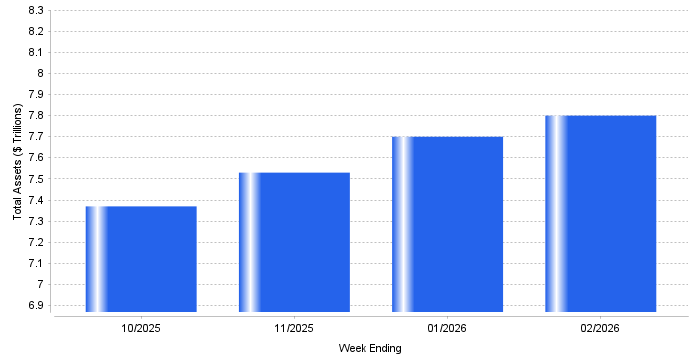
This dataset tracks the relentless growth of U.S. money market fund assets from late 2025 through February 2026, directly supporting the article's claim of a 'Cash Trap.' Despite Federal Reserve interest rate cuts intended to stimulate investment, assets surged from $7.37 trillion in October 2025 to an all-time high of $7.80 trillion in late February 2026. This trend confirms that investors are choosing the safety and relatively high yields of money market funds over traditional bank deposits or equity markets.
| Week Ending | Total Assets ($ Trillions) (Trillions of USD) |
|---|---|
| 2025-10-01 | 7.37 |
| 2025-11-05 | 7.53 |
| 2026-01-21 | 7.70 |
| 2026-02-11 | 7.77 |
| 2026-02-18 | 7.79 |
| 2026-02-25 | 7.80 |
Source: Investment Company Institute (ICI) — Total Net Assets of U.S. Money Market Funds (Weekly)
THE NUMBERS
- $7.80 Trillion: Total assets in U.S. money market funds as of February 25, 2026, a new all-time high [1].
- $148.5 Billion: The net inflow into these funds during just the first week of 2026, the third-largest weekly inflow on record [2].
- 3.50%: The annualized 7-day yield of the Crane 100 Money Fund Index as of late February 2026 [3].
- 0.39%: The national average yield for a traditional bank savings account as of February 2026 [4].
WHY NOW?
The persistence of this cash pile is driven by a massive, sustained gap between what Wall Street pays and what Main Street banks pay. While the Federal Reserve has lowered the benchmark rate to roughly 3.6% (effective rate), money market funds are still passing nearly all of that yield—around 3.50%—directly to investors [3] [5].
In contrast, traditional bank savings accounts have barely budged, offering a national average of just 0.39% [4]. For a saver with $10,000, that is the difference between earning $39 a year at a bank versus $350 in a money market fund. Even though the Fed has cut rates from their 2024 peaks, the "spread" (the difference in payout) remains so wide that investors see no urgent reason to move their money. The opportunity cost of holding cash is still surprisingly low because the cash is paying a healthy, risk-free return.
WHAT'S INTERESTING OR UNUSUAL
The twist is that digital banking has fundamentally broken the "stickiness" of deposits, creating a new economic variable known as the "digital beta." According to foundational research by the National Bureau of Economic Research (NBER), the rise of mobile apps and digital platforms has drastically lowered the friction of moving money [6].
Historically, banks counted on depositor inertia—it was a hassle to close an account and move funds. The NBER study found that digitalization increases the sensitivity of deposits to rate changes. Today, moving $100,000 from a low-yield checking account to a high-yield money market fund takes seconds. This structural shift means capital is "flightier" than in previous cycles. Investors are no longer captive to low bank rates; they are algorithmically sensitive to yield, trapping liquidity in money markets even as the Fed tries to push it out [6].

WHO IT AFFECTS
- Commercial Banks: They are losing the battle for cheap funding. To attract deposits, they must either destroy their profit margins by raising rates or watch customers flee to money market funds.
- Retail Investors: This is a "Golden Age of Cash." Savers can earn inflation-beating returns with near-zero risk, a luxury that didn't exist for most of the post-2008 era.
- The Federal Reserve: The transmission mechanism of monetary policy is getting clogged. Rate cuts are supposed to stimulate risk-taking, but if cash yields remain attractive enough to hoard, that stimulus is dampened.
HISTORICAL CONTEXT
The current $7.8 trillion cash pile represents a staggering 12.7% increase year-over-year [1]. To put this in perspective, prior to the pandemic (2019), total money market assets hovered around $3.6 trillion. The pile has effectively more than doubled in six years.
Typically, money market assets peak *during* a recession and drain as the recovery strengthens. Currently, we are seeing recession-level hoarding behavior during a period of economic expansion. The start of 2026 outpaced every previous year's opening on record for inflows, trailing only the panic-induced dashes for cash seen during the 2020 COVID crash [2].
WHAT THIS MIGHT MEAN
First, the stock market may be deprived of the "dry powder" fuel many analysts were banking on. If this $7.8 trillion stays sticky in low-risk funds, equity rallies may be more muted than expected in 2026.
Second, we may see a permanent structural shift in banking. If the "digital beta" theory holds, banks may never regain their ability to offer near-zero interest rates on deposits without losing customers. They will be forced to compete with market rates permanently, potentially squeezing the profitability of the traditional banking model for years to come.