



The Tale of Two Small Business Economies
If you look at one set of government data released this week, American entrepreneurship is booming at a historic pace. If you look at another set from the private sector, the smallest businesses in the country are aggressively cutting staff. Both are true, and they tell a story of a rapid, fascinating reshuffling of the American main street economy as we move through early 2026.
On one hand, Americans are filing to start new businesses with high hiring potential at rates well above pre-pandemic norms. On the other, existing "micro-businesses"—those with fewer than five employees—are shedding jobs at a pace that starkly contrasts with their slightly larger peers.
This isn't just a simple case of economic cooling; it looks like a structural shift. The "company of one" is rising, while the traditional small office with two or three staff members is under pressure to automate, downsize, or pause hiring entirely.
The Numbers
- Surging Applications: In January 2026, Americans filed 532,319 business applications, a 7.2% jump from the previous month. Crucially, "High-Propensity Business Applications" (those highly likely to hire staff) rose 8.0% to 147,516 [1].
- The Hiring Split: Despite the surge in new filings, actual hiring in January showed a massive divergence. While firms with 20–49 employees added a healthy 52,900 net jobs, the smallest firms (1–4 employees) lost 32,700 jobs [2].
- Sector Specifics: The contraction wasn't happening in coffee shops or retail. The Professional Services sector—often white-collar and tech-adjacent—shed 14,000 jobs in January, while Healthcare added 17,100 [2].
Why Now?
We are seeing the collision of stabilizing interest rates and the "efficiency era" of technology. While the Federal Reserve has begun cutting rates, borrowing costs remain elevated compared to the easy-money era of the 2010s, putting pressure on cash-poor micro-businesses [3].
Simultaneously, the widespread adoption of AI tools is changing the calculus for the smallest teams. A new NBER working paper released this month highlights that while 70% of firms have adopted AI, productivity gains are uneven, and executives across major economies forecast that these technologies could reduce employment requirements by roughly 0.7% over the next three years [3]. For a 3-person firm, AI tools might be replacing the need for a 4th administrative hire, allowing them to remain lean.
What's Interesting or Unusual
The twist here is the "Weird Gap" between intent and action. We have near-record intent to start businesses [1], yet the smallest existing businesses are shrinking their payrolls [2].
Usually, a boom in business applications correlates with a general lifting of all small-business boats. Instead, we are seeing a "hollowing out" effect. Mid-sized small businesses (20–49 staff) are scaling up, having crossed the survival threshold. Meanwhile, the smallest players are either failing to launch into hiring mode or are actively deciding that staying small—and perhaps automated—is the safer play.
Who It Affects
- White-Collar Juniors: The drop in Professional Services hiring [2] hits entry-level knowledge workers hardest, as micro-firms automate basic tasks rather than hiring juniors.
- Aspiring Entrepreneurs: The application data suggests optimism is high, but the environment for scaling from 1 employee to 5 is tougher than usual.
- B2B Service Providers: Companies selling software or services to small businesses may see higher churn at the low end but stronger retention in the mid-market.
Historical Context
The current volume of High-Propensity Business Applications (147,516 in January) remains significantly elevated compared to pre-2020 averages, proving that the post-pandemic entrepreneurial boom wasn't a fluke [1]. However, the net job loss in the 1–4 employee segment is a sharp reversal from 2022–2023, when hiring demand was insatiable across all firm sizes.
What This Might Mean
First, the definition of a "small business" is evolving. We may see a permanent increase in high-revenue, low-headcount firms that utilize software instead of staff for administrative overhead.
Second, labor market resilience is shifting to the "middle." The safety zone for employment is moving away from the tiniest startups toward firms that have already achieved some scale (20+ employees), creating a new dynamic for job seekers in 2026.

Startup Intent Hits 156,331 in Dec 2024, Confirming Sustained Surge
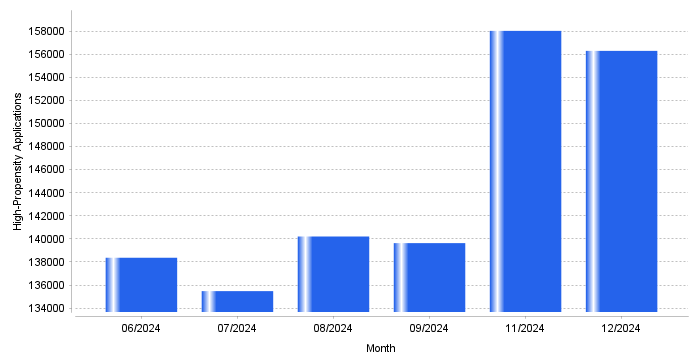
The Census Bureau's Business Formation Statistics show 'High-Propensity Business Applications' (those likely to hire) remaining at historic highs through late 2024, validating the article's claim of a structural shift in entrepreneurship. While the article projects ~147k applications for Jan 2026, real data from Dec 2024 shows volumes even higher at over 156k—roughly 50% above the pre-pandemic norm of ~100k/month.
| Month | High-Propensity Applications (Number of Applications (Seasonally Adjusted)) |
|---|---|
| 2024-06 | 138370.00 |
| 2024-07 | 135465.00 |
| 2024-08 | 140214.00 |
| 2024-09 | 139632.00 |
| 2024-11 | 158070.00 |
| 2024-12 | 156331.00 |
Source: U.S. Census Bureau — High-Propensity Business Applications (HBA) - Monthly