
Money / Claim File 4547
How to sign up for a Trump Account and claim the $1,000
The official process takes about 5 to 10 minutes. The important part is checking the right box on IRS Form 4547, then finishing the separate account activation without wandering into a copycat site.
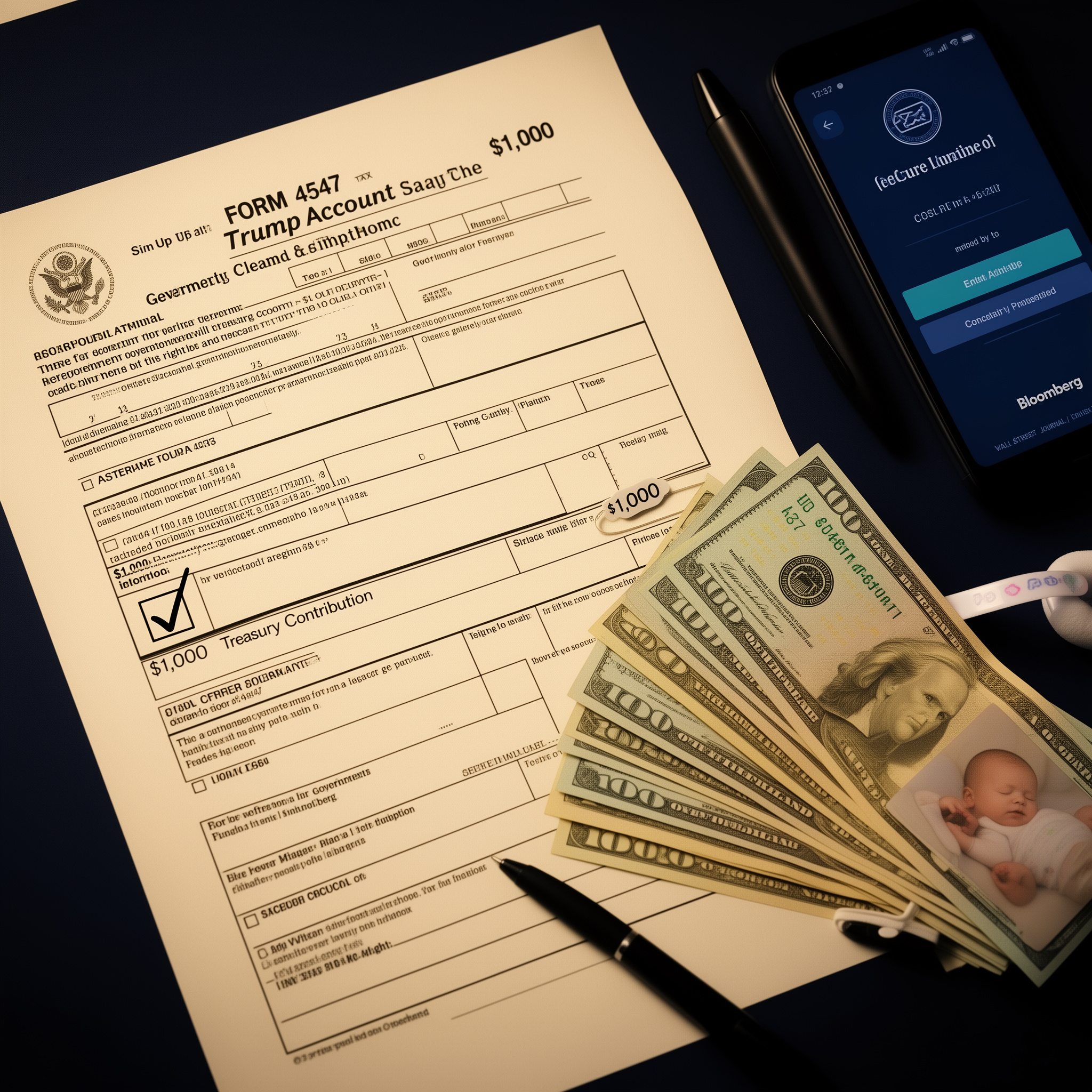
Claim Treasury’s $1,000
For an eligible child, this is free seed money. It does not use the regular annual contribution limit.
Place your own next dollar
Family money creates basis, but earnings do not. If the goal is college, a 529 can get better tax treatment. See the comparison →
The easiest place to get a Trump Account wrong is the beginning. The $1,000 Treasury contribution is not automatic, and downloading the investment app is not the same as electing to open the account.
The official route starts with the IRS. Parents, guardians, and other authorized people sign in to an IRS account with ID.me, complete Form 4547, and check the separate pilot-payment box for an eligible child. The IRS says the online election should take 5 to 10 minutes.
Before starting, separate two eligibility tests. A child who has not turned 18 before the end of the election year and has a valid, employment-authorized Social Security number can be eligible for an account. US citizenship is not a general account-opening requirement. The free $1,000 has narrower rules: the child must be a US citizen born from January 1, 2025 through December 31, 2028, have a valid Social Security number, and be the qualifying child of the person making the election.
Who gets to file matters. For an account-only election, the IRS priority order is legal guardian, parent, adult sibling, then grandparent. Someone lower on that list may act only when nobody in a higher category is available. To request the $1,000 at the same time, the filer must also reasonably expect the child to be their qualifying child for that tax year.
Step by step: how to sign up for the $1,000 Trump Account
The election happens at IRS.gov. The investing dashboard comes after the IRS processes it.
Go directly to the IRS Trump Accounts page
Use IRS.gov/trumpaccounts and choose “Sign in or create account.” The IRS sends you through ID.me. Avoid sponsored search results and unofficial sites.
Open the official IRS page ↗Complete Form 4547 for the child
Enter the responsible adult’s information, then the child’s name, Social Security number, date of birth, relationship, and address. Confirm that you are authorized to open the account.
Check Part III, line 7 for the $1,000
This is a separate election. If the child meets the pilot rules, check the box saying you want the Treasury contribution. Opening the account alone does not claim it.
Submit, then check the election status
The IRS Trump Accounts page lets you view the status of submitted election forms. Keep a copy or confirmation for your records.
The paper form makes the key distinction visible. Parts I, II, and IV establish the account. Part III, line 7 claims the $1,000 pilot contribution.
You can also make the election with a tax return. The Form 4547 instructions call filing it with a current-year e-filed return the fastest, safest, and easiest return-based route. A paper Form 4547 goes to the paper-return address that applies to your return. The IRS specifically says not to attach it to Form 1040-X or amend a return just to add it.
If your goal is to sign up now, the clean route is IRS.gov/trumpaccounts. Have the child’s Social Security number, birth date, and address ready. Do not stop after filling in the child’s details: Part III, line 7 is the box that asks Treasury for the $1,000.
After Form 4547: activate the account without getting scammed
The IRS election creates the request. Activation gives you the dashboard, bank link, and contribution controls.
After Treasury processes the election, follow the activation instructions through the official Trump Accounts app or its authorized web version. Treasury says the app is the main interface for balances, contributions, performance, recurring deposits, and linked bank accounts.
Treasury’s anti-scam guidance is unusually specific. Initial activation emails come from no-reply@TrumpAccounts.Treasury.gov. Later account emails may come from addresses ending in @trumpaccount.com. Treasury and its service providers say they will never ask for your password or one-time verification code by email, text, or phone.
- Start at IRS.gov/trumpaccounts or TrumpAccounts.gov.
- Use app-store links provided by the official government site.
- Use the official web app only through the government portal or trumpaccount.com.
- For help, use the official call center: 1-866-USA-4547.
- Never send a password or one-time code in response to a message or call.
There is no fee to open the account. Once it is active, parents can link a bank account, make a one-time deposit, or set a recurring contribution. None of that is required to receive the $1,000 pilot payment.
The signup rush is real, but describe it carefully. CNN reported on July 23, citing Treasury, that more than 7 million accounts had opened, 1.7 million were eligible for the $1,000 pilot payment, and $1.5 billion had been invested across all accounts. Seven million open accounts is not seven million children receiving Treasury money.
A child born before 2025 can still receive other money. They are outside the federal $1,000 birth window, but an eligible child under 18 can still have an account and receive employer or philanthropic contributions. CNN reports that Michael Dell and other donors have pledged one-time $250 deposits for children from middle- to lower-income households; the donor program, not the federal pilot, sets the final eligibility rules.
Treat Form 4547 and activation as two checkpoints. Submit the election through the IRS, verify its status, then use only the official app or web app to activate. Do not pay a signup fee, and do not hand a caller a one-time security code.
Claim the free $1,000. Pause before adding your next dollar.
The Treasury seed costs your family nothing. Recurring family contributions deserve a separate tax and goals check.
The account’s fine print does not make the free money unattractive. It changes the decision about what comes next. During childhood, the money is locked up and invested only in qualifying low-cost US stock index funds. At launch, Treasury selected State Street’s SPYM as the default, with four additional broad US stock ETFs planned as choices.
The regular contribution limit is one shared bucket. In 2026 and 2027, family and employer contributions generally share a $5,000 annual limit. An employer’s tax-excluded contribution is capped at $2,500 per employee across all of that employee’s children, not $2,500 per child, and it counts inside the $5,000 limit. The Treasury seed does not use that room.
Illustration: 18 years of compounding at 7%
RicherNews illustration at a constant 7% annual return, before taxes. This is not a forecast. Monthly deposits are modeled monthly; annual deposits are modeled at year-end.
The tax rule is more nuanced than “every withdrawal is taxed.” After-tax family contributions generally create tax basis, so that portion can come back tax-free. The Treasury seed, employer contributions excluded from income, and investment earnings do not create that basis. After the childhood growth period, each withdrawal generally carries a proportional slice of basis and a proportional taxable slice. The taxable portion follows traditional IRA income rules.
That can compare poorly with a plain brokerage account in some scenarios because the IRS says net long-term capital gains may receive a lower rate than ordinary income. A brokerage account also has taxes along the way and possible kiddie-tax complications, so there is no universal winner.
| Question | Trump Account | 529 plan | UTMA brokerage | Custodial Roth IRA | Biggest catch |
|---|---|---|---|---|---|
| Gets the Treasury $1,000? | Yes, if eligible | No | No | No | You need the Trump Account to collect the pilot payment. |
| Qualified education use | Penalty exception | Tax-free earnings | Flexible, taxable | Rules apply | Penalty-free does not mean tax-free in the Trump Account. |
| Access before adulthood | Generally locked | Education uses | For the child | Retirement rules | Trump Account hardship withdrawals are not allowed during the growth period. |
| Who can contribute? | Family, employers, others | Broadly open | Broadly open | Child needs earned income | Roth contributions cannot exceed the child’s eligible earned income. |
| Best first use | Claim free money | Education goal | Flexible child spending | Working child’s retirement | The best account depends on the purpose of the family’s own money. |
A 529 has the cleaner tax result when the goal is education. Investor.gov says earnings on qualified 529 withdrawals are not subject to federal income tax. It also notes that many 529 plans offer age-based portfolios that automatically become more conservative as college approaches, while Trump Accounts are confined to qualifying US equity index funds during the growth period.
At adulthood, traditional IRA rules generally take over. The statutory growth period ends on January 1 of the calendar year in which the child turns 18, which can be months before the actual birthday. Withdrawals before age 59 and a half may face a 10% additional tax unless an exception applies, including certain higher-education and first-home withdrawals.
One planning option at that point is a Roth conversion while the young adult is in a low tax bracket. The untaxed amount converted is generally taxable in the conversion year, but future qualified Roth withdrawals can be tax-free. This is a tax decision, not a free rollover, and the account holder should model the conversion income first.
For an eligible child, claim the $1,000 and ask whether an employer offers a contribution. Before adding recurring family money, name the goal. If it is college, compare a 529. If it is flexibility, compare a custodial brokerage. If the child later has earned income, compare a custodial Roth IRA. Free money first, planning second.
How we built this guide
This article synthesizes official IRS, Treasury, and SEC investor-education guidance available on August 18, 2026. It is general information, not tax or investment advice. The growth figures are RicherNews illustrations using a constant 7% annual return, monthly compounding for monthly deposits, and year-end timing for annual deposits. Real returns vary, fund values can fall, and taxes depend on the beneficiary’s circumstances when money is withdrawn.
We excluded unverified social-media anecdotes, unsupported claims about server queues, and the claim that every dollar withdrawn is taxable. IRS guidance says after-tax contributions can create basis, while the government seed, certain employer money, and earnings generally do not.
Common questions
How do I sign up for a Trump $1,000 account?
My child was born before 2025. Can they receive anything?
What do I need to open a Trump Account?
Is a Trump Account better than a 529 plan?
Sources & references
Primary sources were used for the signup steps, eligibility, and account rules. The current participation figures come from CNN reporting that attributes the totals to Treasury, and the 529 comparison uses SEC investor guidance. Open the latest Form 4547 instructions before filing because the process can change.
- Internal Revenue Service. Trump Accounts. Official online election path, required information, eligibility summary, and 5-to-10-minute estimate. ↗
- Internal Revenue Service. Form 4547, Trump Account Election(s), December 2025. Parts I through IV and the pilot contribution election on Part III, line 7. ↗
- Internal Revenue Service. Instructions for Form 4547. Eligibility, when and where to file, online and return-based filing routes, and signature rules. ↗
- US Treasury. Trump Accounts app and activation guidance, May 28, 2026. Official emails, web app, call center, and scam warnings. ↗
- US Treasury. Full Trump Accounts app launch, July 4, 2026. App features, linked banks, recurring contributions, and no signup fee. ↗
- CNN Business. Trump Accounts Have Launched: Here’s What Families Need to Know, updated July 23, 2026. Reports Treasury’s 7 million open accounts, 1.7 million pilot-eligible children, $1.5 billion invested, and pledged $250 philanthropic deposits. ↗
- Internal Revenue Service. Notice 2025-68. Contribution, basis, investment, distribution, age-transition, and early-distribution rules. ↗
- US Treasury. Investment lineup for Trump Accounts, July 1, 2026. SPYM default and four additional low-cost US equity index ETFs. ↗
- Investor.gov. Trump Accounts. SEC investor-education summary of eligibility, the pilot contribution, investments, and transition to traditional IRA rules. ↗
- Investor.gov. An Introduction to 529 Plans, January 28, 2026. Qualified tax-free withdrawals, age-based options, and Roth rollover restrictions. ↗
- Internal Revenue Service. Topic 409, Capital Gains and Losses. Net long-term capital gains may be taxed at lower rates than ordinary income. ↗
- FINRA. Ways to Invest for Children. UTMA and UGMA flexibility, lack of contribution and withdrawal penalties, child-benefit restriction, and transfer at the state’s age of majority. ↗
- Internal Revenue Service. Publication 590-A, Contributions to Individual Retirement Arrangements. Roth IRA contributions require taxable compensation and cannot exceed the applicable annual limit or compensation. ↗
- Internal Revenue Service. Retirement Plans FAQs Regarding IRAs. Traditional-to-Roth conversion methods, taxation of untaxed converted amounts, and Form 8606 reporting. ↗