Technology
The fine print behind your cheap AI video
Making a product photo or an ad clip now costs almost nothing. The catch is buried in the terms: whether you own it, whether it copies someone else, and whether a platform will even let it run. Cheap to make is not the same as safe to post.
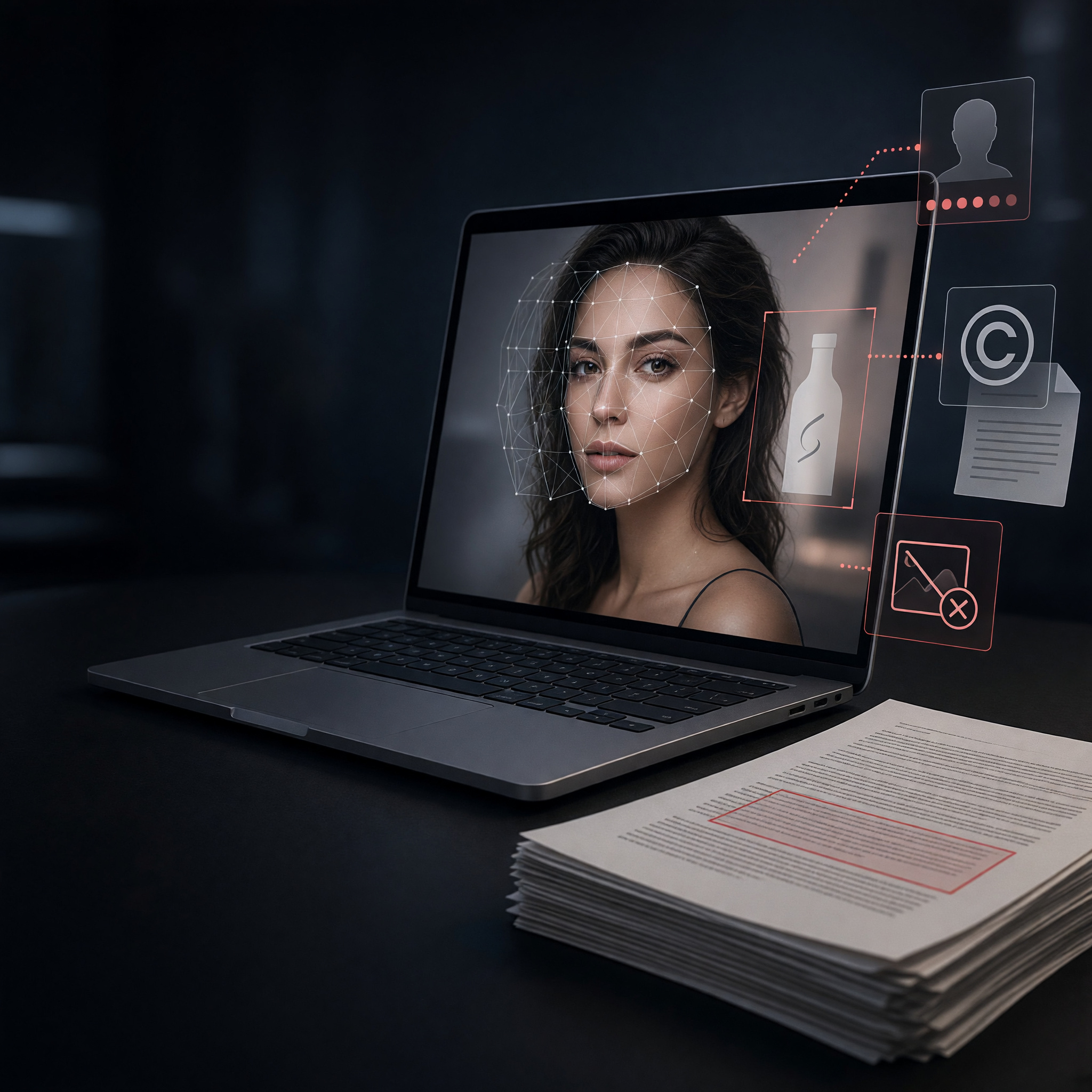
You can make a polished product video in about the time it takes to read this sentence. Type a prompt, wait a few seconds, download. It looks great, it cost almost nothing, and that is exactly where the trouble starts.
“Commercial use allowed” is the phrase every AI tool waves at you. It tells you almost nothing about who pays when something goes wrong.
Cheap and fast hides three questions the tool never asks. Do you actually own it? Are you copying someone? Will the platform even run it? Get one wrong and the free clip turns into a takedown, a lawsuit, or a fine. So before anyone posts anything an AI made, it has to clear three gates.
Before you post: three gates
Did a human actually shape it, or did a prompt do all the work?
Prompt-only output has no copyright. You can use it, but you cannot stop anyone else using it too.
Could it resemble a real brand, character, or person?
If it does, you can be sued, not the tool, and a free generator will not pay the bill.
Does the law or the platform require you to label it as AI?
Undisclosed or fake AI content can be labeled, rejected, or fined under new platform and FTC rules.
Gate 1: whose clip is it, really?
The tool says you own the output. US copyright law may say nobody does.
Type a prompt, get an image, and every tool tells you the same comforting thing: it is yours, use it commercially. Legally, that sentence does a lot less than it sounds.
Here is what that means for an ad. You can use it. You just cannot stop anyone else using it. If it is not copyrightable, you cannot register it or sue a competitor who lifts your exact AI video and runs it as their own. Other rules can sometimes still help (a trademark, a contract), but the copyright shield is simply gone.
“You own the output” also comes with strings the tool does not print on the button. OpenAI assigns you its rights in what you make, to the extent the law allows. Midjourney says you own your images too, with a catch: if your company makes over $1 million a year, you have to be on a paid Pro or Mega plan just to own them. Free and trial tiers are thinner still, and some tools bar commercial use outright or leave a watermark baked in.
There is a way back in. The Copyright Office is clear that a human who meaningfully shapes the work keeps copyright in that human part. The raw AI frame is unprotected; the edit built around it can be protected. The person in the loop is the legally valuable part of the whole workflow.
What a court protects in a finished AI ad
Per the US Copyright Office’s guidance on AI and human authorship: the human contributions are copyrightable; the machine’s are not.
Treat pure AI output as unowned. If an image or clip matters enough to protect, put a real human hand on it (your own footage, your own script, your own edit) and keep the receipts. And read the ownership tier: on some tools you do not own your own images until you pay.
Gate 2: are you copying someone?
A prompt can quietly borrow someone else’s work, logo, or face. When it does, the demand letter lands on the advertiser, not the tool.
The model learned from a huge slice of the internet, and sometimes that leaks into what it hands back: a recognizable character, a brand logo in a background nobody asked for, a face that looks a little too much like a real person. If the output is “substantially similar” to something protected, it can infringe, no matter which tool made it. And the person who published it can be on the hook, not just the company that built the model.
The math is the scary part. One protected frame can carry statutory damages of up to $30,000 per work, and up to $150,000 if a court finds the copying willful. A $20 clip does not come with $20 of risk.
The penalty menu, per violation
Bar lengths use a logarithmic scale so the small fines stay visible. Each figure is a statutory maximum or floor, cited below.
This is not hypothetical. The tools marketing teams actually use are in court.
The studios are suing the generator.
In June 2025 Disney and Universal sued Midjourney, calling it “the quintessential copyright free-rider and a bottomless pit of plagiarism.” Warner Bros. joined months later. The case is live.
A cheap app ad, an unlicensed face.
An AI app ran an ad using real footage plus an AI voice clone of Scarlett Johansson, with a tiny “Images produced by Lisa AI” disclaimer. She took legal action and the ad was pulled within days. The micro-disclaimer did not save them.
Cloned voices, and copyright did not help.
Voice actors sued Lovo after it cloned and sold their voices. In 2025 a court tossed most of the copyright claims but let the voice-theft claims go forward under New York’s right-of-publicity law. The weapon was likeness law, not copyright.
Two lessons hide in those cases. First, if a logo or watermark shows up in a generation, kill it: in the UK, Getty lost most of its case against Stability AI but won on trademark where the output carried Getty’s watermark. Second, the scariest risk is a real person’s face or voice, because that is barely a copyright question at all.
Right of publicity is state law, and it is a patchwork. Using someone’s face or voice to sell something without consent is actionable in a majority of states, by statute, common law, or both, with California and New York among the strictest. You do not even need the exact face; a look-alike that clearly evokes a real person can be enough. And the usual escape hatches do not hold: when a face-swap app argued its AI output was “transformative” and that copyright law overrode the claim, a federal appeals court rejected both and let the publicity case proceed. Tennessee’s 2024 ELVIS Act went further and added voice outright, aimed straight at AI clones.
And dead does not mean free. The George Carlin estate sued over an AI-generated comedy special in his voice; the case settled with a permanent injunction and the special was pulled. Postmortem likeness rights run long: 27 states protect a person after death, from 20 years in Virginia to 100 in Indiana, and potentially forever in Tennessee if the likeness is kept in use.
The floor is still rising. The federal NO FAKES Act, which would create a nationwide right against unauthorized AI replicas of anyone’s voice or face, cleared a key Senate committee in 2026. It is not law yet, but the direction only points one way.
Assume the output might be someone else’s. Vet the whole frame, backgrounds included, for logos and brands, and never put a real (or real-looking) face or voice in an ad without a license. When the output copies someone, the tool does not take the hit. The advertiser does, unless the tool promised to cover them, which is the last gate.
Gate 3: will the platform even run it?
Even a clean clip has to clear the new disclosure rules. And this is where the tools split hardest on who covers you when something goes wrong.
Say a clip cleared the first two gates. It still has to get published, and the rules on labeling AI content went from nice-to-have to enforced in about two years.
The rules keep landing
TikTok starts reading C2PA Content Credentials to auto-label AI content from other tools.
Tennessee’s ELVIS Act takes effect, adding voice to likeness protections, aimed at AI clones.
The FTC’s fake-reviews rule takes effect: AI-generated testimonials from people who do not exist are banned, at $50,000+ per violation.
Thaler v. Perlmutter: the DC Circuit affirms that AI-only works cannot be copyrighted.
Disney and Universal sue Midjourney, the first major Hollywood copyright suit against an image generator.
Getty v. Stability (UK): Getty wins the narrow trademark point where outputs carried its watermark.
New York’s synthetic-performer law takes effect: advertisers must disclose even a completely made-up AI person.
EU AI Act, Article 50: AI media must be machine-readable-marked and deepfakes disclosed, with fines to 15 million euros or 3 percent of global revenue.
The rule that bites fastest is fake AI testimonials. The FTC’s 2024 rule bans fake and false reviews and testimonials, including AI-generated ones attributed to people who do not exist or never used the product; its enforcement sweep put it plainly, that there is no AI exemption from the laws already on the books. It does not ban AI avatars outright. What it bans is a synthetic spokesperson vouching for a product nobody really tested, which is now a federal problem, not a growth hack.
FTC · Operation AI Comply“There is no AI exemption from the laws on the books.”
- The EU AI Act (from August 2, 2026) makes providers mark AI-generated media in a machine-readable way, and deployers visibly disclose deepfakes. A grace period on the marking rule runs to December 2, 2026 for systems already on the market.
- New York (from June 9, 2026) makes advertisers disclose a “synthetic performer,” even a completely made-up AI person who is not anyone real; $1,000 for a first violation, $5,000 after.
- TikTok, YouTube, and Meta all require realistic AI content to be labeled, and read industry “Content Credentials” to auto-flag it.
Here is the trap that catches careful people. Ad platforms lean on that provenance data, a standard called C2PA, to tell what is AI. Export or heavily compress a video and that hidden data often gets stripped, so a compliant clip can suddenly read as undisclosed and get rejected. TikTok says plainly that undisclosed AI content will be rejected or restricted.
The punishment usually is not a lawsuit. It is faster and dumber than that: the ad gets rejected, the budget burns on nothing, and the launch loses its early momentum. And the enforcement is mostly automated, so there is no person to argue with.
Which is the whole reason the tool choice matters. When something does go wrong, a few tools stand behind the customer and most just leave them holding it. That promise is called indemnity: the vendor agrees to defend you if the output triggers a third-party claim.
| Tool | Commercial use | Covers you if it infringes | The biggest catch |
|---|---|---|---|
| Free / open-source tools | ~ | × | You own the risk, and open models can even carry license strings of their own. |
| Runway | ✓ | × | Allows commercial use, but that permission is not a promise to defend you. |
| HeyGen | ✓ | × | Its terms disclaim any IP warranty; you assume the risk. |
| Midjourney | ✓ | × | And you only own the output above $1M revenue on a paid plan. |
| OpenAI Sora / API | ✓ | ~ | Business and API tiers only, not consumer, and it carves out trademark claims from using output in trade or commerce. |
| Canva | ✓ | ✓ | Canva Shield covers eligible Enterprise customers only. |
| Adobe Firefly | ✓ | ✓ | On qualifying paid plans, but it excludes output you modify, combine, or use in context, which is to say, once you turn it into an ad. |
| Google Vertex / Veo | ✓ | ✓ | Enterprise Cloud terms, conditioned on responsible-use practices. |
Read worst to best. “Commercial use allowed” is not indemnity. Every check in the last column is a paid or enterprise plan with caps, exclusions, or conditions attached, and terms change often, so confirm your exact tool and tier. Sources, each vendor’s own August 2026 terms: Adobe, Midjourney, HeyGen, Runway, Canva, OpenAI, Google.
Before a clip goes live: label it where the law or the platform says to, keep the provenance data intact through export, and know your coverage. If AI content is central to your marketing, the tools worth paying for are the ones that put indemnity in writing. “Commercial use allowed” is not that promise.
How we measured this
This report synthesizes publicly available law, policy, and vendor terms rather than presenting original data, and it is not legal advice. We prioritized primary sources: the US Copyright Office, the US Code (17 U.S.C. 504), the DC Circuit (Thaler v. Perlmutter), the FTC, the EU AI Act (Regulation 2024/1689), the New York Legislature, and the vendors’ own terms of service.
Court cases (Disney and Universal v. Midjourney, Lehrman v. Lovo, Young v. NeoCortext, the Carlin estate settlement, Getty v. Stability) are cited to court records or reputable case reporting; the Scarlett Johansson matter is described as reported legal action that led to the ad being pulled, not a decided lawsuit. The indemnity comparison reflects each vendor’s published terms as of August 2026; those terms change often, so confirm your exact tool and plan tier before relying on them. Every figure was checked against these sources in August 2026.
Common questions
Can I use AI-generated images and video commercially?
Do I actually own what an AI generates?
Can I really get sued over an AI video?
Do I have to disclose that an ad is AI-generated?
Sources & references
The US Copyright Office, the US Code, the courts, the FTC, the EU AI Act, the New York Legislature, and the vendors’ own terms of service are primary sources. Court cases are cited to court records or reputable case reporting. The Scarlett Johansson matter is reported legal action that led to the ad being pulled, not a decided lawsuit. Vendor indemnity terms change often, so confirm your exact tool and plan tier.
- US Copyright Office. Copyright and Artificial Intelligence. Copyright requires human authorship; prompts alone generally do not make output copyrightable, and an output substantially similar to a protected work can infringe. ↗
- US Court of Appeals, DC Circuit. Thaler v. Perlmutter (March 18, 2025). Affirmed that a work authored solely by AI cannot be registered for copyright. ↗
- 17 U.S.C. 504 (Cornell LII). Statutory copyright damages run up to $30,000 per work infringed, and up to $150,000 per work where the infringement is willful. ↗
- OpenAI. Terms of Use, ownership of content. OpenAI assigns you its right, title, and interest in output, to the extent permitted by applicable law. ↗
- Midjourney. Terms of Service. You own the assets you create, but a company making over $1,000,000 USD a year must be on a Pro or Mega plan to own them. ↗
- Disney and Universal v. Midjourney (C.D. Cal., filed June 11, 2025; case reporting via Georgetown Law). The first major Hollywood-studio copyright suit against an AI image generator; Warner Bros. filed a similar suit, consolidated in November 2025. ↗
- Variety. Scarlett Johansson took legal action (Oct 2023) after an app ad used an AI voice and likeness clone of her; the ad was pulled within days. ↗
- Lehrman v. Lovo (S.D.N.Y., July 10, 2025). The court let voice-misappropriation claims proceed under New York Civil Rights Law sections 50 and 51 while dismissing most copyright claims. ↗
- Variety. The George Carlin estate’s 2024 suit over an AI-generated comedy special in his voice settled with a permanent injunction and removal. ↗
- Getty Images v. Stability AI (UK High Court, Nov 2025). Getty dropped or lost most copyright claims but prevailed on a narrow trademark point where output displayed Getty’s watermarks. ↗
- California Civil Code 3344. Right of publicity: liability for using another person’s name, voice, photograph, or likeness in advertising without consent; a majority of states recognize such a right. ↗
- Young v. NeoCortext (9th Cir., Dec 5, 2024). The Ninth Circuit let a California right-of-publicity claim over the Reface face-swap app proceed, rejecting the transformative-use and copyright-preemption defenses. ↗
- State of Tennessee. The ELVIS Act (signed March 21, 2024; effective July 1, 2024) added voice to Tennessee’s personal-rights protections, aimed at unauthorized AI clones. ↗
- US Congress. NO FAKES Act. A proposed federal right against unauthorized AI digital replicas of a person’s voice and visual likeness; advanced out of Senate Judiciary in 2026 but not yet enacted. ↗
- FTC. Final rule on fake reviews and testimonials (16 CFR Part 465, effective Oct 21, 2024), penalties over $50,000 per violation; the “Operation AI Comply” sweep affirmed there is no AI exemption from existing law. ↗
- European Commission. EU AI Act, Article 50 transparency obligations (applicable Aug 2, 2026): AI media must be machine-readable-marked and deepfakes disclosed; fines up to 15 million euros or 3 percent of global turnover. ↗
- New York State Senate. S.8420-A (effective June 9, 2026) requires advertisers knowingly using a “synthetic performer” to conspicuously disclose it; penalty $1,000 first, $5,000 after. ↗
- TikTok. Requires realistic AI content to be labeled and, since May 2024, reads C2PA Content Credentials to auto-label it; undisclosed AI content can be rejected or restricted. ↗
- YouTube. Creators must use the “altered content” setting to disclose realistic content that is meaningfully altered or synthetically generated. ↗
- Meta. Applies “AI Info” labels when it detects industry signals or users self-disclose, and requires advertisers to disclose content made with third-party AI tools. ↗
- C2PA / Content Credentials. An open, cross-industry provenance standard (backed by Adobe, Google, Meta, Microsoft, OpenAI, TikTok) attaching tamper-evident metadata about how a file was made and edited. ↗
- IP indemnification (vendor terms). Google Cloud, Adobe (Firefly enterprise), Microsoft, OpenAI (business and API only), Shutterstock, Getty, and Amazon contractually defend qualifying customers against third-party IP claims for AI output, each on a paid or enterprise plan with conditions. ↗